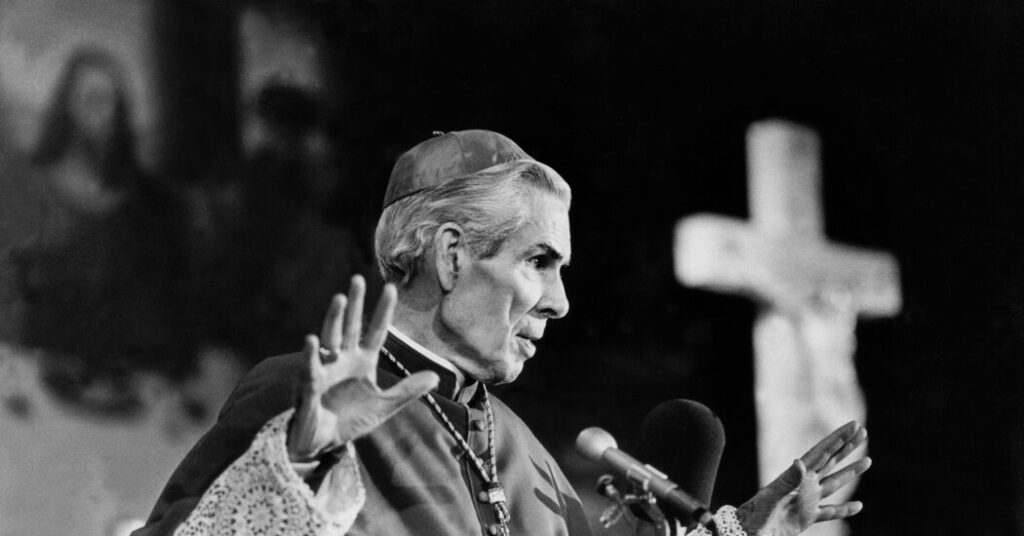
The Vatican will allow an American archbishop, who was one of the best-known Catholic clergy of the last century, to be beatified, ending a six-year delay and placing him one step away from sainthood.
The announcement about the archbishop, Fulton J. Sheen, who was born in Illinois and became a popular midcentury radio and television host, was made by the diocese of Peoria, which is sponsoring the archbishop’s cause for sainthood.
“This is a great moment for the local church in Peoria, for the church here in the United States and for the church universal,” Bishop Louis Tylka of Peoria said in an interview on Monday. He said he had been informed by the Holy See, the governing authority of the Roman Catholic church, that Archbishop Sheen can now proceed to beatification.
Archbishop Sheen, once called “the greatest communicator of the 20th century” by the evangelical preacher Billy Graham, headed a radio broadcast for 20 years before hosting the television series “Life Is Worth Living” in the 1950s and a similar program in the 1960s. He won an Emmy for most outstanding personality in 1953, besting nominees including Edward R. Murrow and Lucille Ball.
That year, he memorably condemned Joseph Stalin on a broadcast and gave a dramatic reading of the burial scene in Shakespeare’s “Julius Caesar” with the names of prominent Soviet leaders substituting for Caesar and his circle. “Stalin must one day meet his judgment,” the archbishop intoned. Stalin died after a stroke the next month.
Some experts credit Archbishop Sheen’s popularity with paving the way for the election of John F. Kennedy as the country’s first Catholic president in 1960.
“He showed the broad American public that the truths of our faith were consonant with the highest values of the society: patriotism, God, family and the struggle against Communism,” Archbishop Timothy Dolan of New York told The New York Times in 2009, as he prepared to lead a memorial mass for the 30th anniversary of Archbishop Sheen’s death.
In 2019, the Vatican abruptly postponed the beatification event for the archbishop just weeks before it was scheduled, and it remained in limbo until now.
A date and location for the beatification ceremony have yet to be announced, but it is expected to take place sometime this year. Beatification, a key step in the process of becoming a saint, means the church has investigated and verified a miracle connected to the person, and determined that he has either been martyred or demonstrated a “heroic” level of virtue. The next and final step is canonization, a rare honor that signifies a deceased person is worthy of veneration by the entire church.
The case for Archbishop Sheen’s canonization had been delayed by two hurdles. Most serious was a request by the diocese of Rochester, N.Y., where Archbishop Sheen served as a bishop for several years in the 1960s, for a review of “his role in priests’ assignments.” That stemmed from a concern that he may have overlooked sexual abuse by at least one priest in the diocese. The diocese eventually filed for bankruptcy, with a settlement last fall that included a $256 million fund for abuse survivors.
But after years of inquiries, including a probe by the state attorney general, there have been no public statements about any allegations against Archbishop Sheen. Msgr. James Kruse, then the director of canonical affairs in the diocese of Peoria and an advocate for Archbishop Sheen’s canonization, told a Catholic news outlet in 2019 that “extensive scrutiny” showed the archbishop had never put children in harm’s way or covered up abuse.
The other obstacle was an unusual dispute over the archbishop’s remains between the archdiocese of New York and the much smaller diocese of Peoria.
The cleric died in Manhattan in 1979, and his body was entombed there in St. Patrick’s Cathedral. But the case for sainthood originated with the head of the diocese of Peoria at the time, Bishop Daniel Jenky, who began exploring it in the early 2000s. And in 2016, the archbishop’s closest living relative, a niece, sued to have his remains moved to Peoria.
New York officials disputed the move in court but ultimately ran out of options, and the cleric’s remains were transported to St. Mary’s Cathedral in Peoria in the summer of 2019.
Before his beatification was postponed, Pope Francis formally approved the attribution of a miracle to Archbishop Sheen, opening a path for him to gain that status. Three other American-born men have been beatified, but the timeline to canonization can vary widely, and not all who are beatified reach that height. (Canonization usually requires a second verified miracle.)
The miracle attributed to Archbishop Sheen involved a stillborn boy in the diocese of Peoria in 2010. His parents had named the boy James Fulton after the archbishop, and they began praying for the archbishop to intervene. After just over an hour of prayer and medical intervention, the boy came to life, according to an account in the Catholic publication Our Sunday Visitor.
Many Catholics who have eagerly awaited Archbishop Sheen’s advancement on the path to sainthood celebrated Monday’s announcement. Some pointed out that the Vatican is headed by an American pope born in Illinois, who ultimately must approve any canonization.
“To have this happen during the 250th anniversary of our country, and he’s an American from Illinois, it’s God’s timing,” Oscar Delgado, an independent film producer who has been an adviser to the foundation promoting Archbishop Sheen’s legacy since the early 2000s, said on his drive to mass on Monday. “It’s a really great day.”
In Fishers, Ind., Katelyn Kudla rejoiced when she heard the news.
She and her husband, Steven, read a book about marriage by the archbishop when they were engaged a few years ago. The book, “Three to Get Married,” shaped their understanding of Christian matrimony and “how to love one another along with Christ,” she said. They also began watching episodes of his television show that have found a new audience on YouTube.
When their first child was born, they wanted to name their son after someone who could similarly inspire the boy in his own faith. In the end, the decision was easy: They named him Fulton.
Ruth Graham is a national reporter, based in Dallas, covering religion, faith and values for The Times.
The post U.S. Archbishop Will Be Beatified, One Step Away From Sainthood appeared first on New York Times.