Harvard University has more than 100 students who are in the Reserve Officer Training Corps. They will get their diploma and then put their life on the line for their country, serving under a secretary of defense, if he is still in his job by spring, who has nothing but contempt for their education and their alma mater.
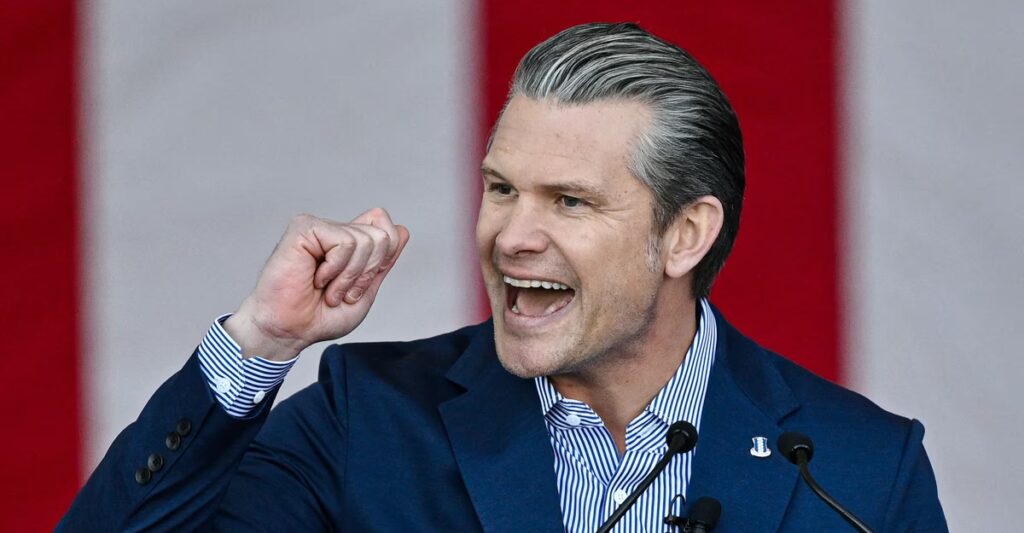
In a statement issued last Friday, Pete Hegseth charged that Harvard is graduating officers with “heads full of globalist and radical ideologies that do not improve our fighting ranks.” He declared that the Pentagon would cut all ties with Harvard and its programs.
Hegseth’s characterization makes it sound like students are lolling under the trees in Harvard Yard while getting instruction in Marxist theory from the Chinese Red Guards. This is, of course, nonsense, but Hegseth wants to paint colleges in general, and especially elite schools of the type he attended, as enemy territory. (His undergraduate degree is from Princeton, and he has a master’s degree from Harvard’s Kennedy School of Government, though he symbolically returned his diploma in 2022.) This campaign against education is not about what’s actually being taught at Harvard; rather, Hegseth, among others, is using the school as a punching bag to express the generic social anxiety and status-based resentment that drives much of the MAGA movement.
Although Hegseth said that he would examine Defense Department involvement at “other” schools, he made special mention of the Ivy League. Perhaps that’s because these institutions have long been a kind of shorthand for an elite standing to which Hegseth clearly once aspired—as did his boss. The president brags regularly about his degree from the University of Pennsylvania and about his uncle, who taught at MIT. But Donald Trump, like Hegseth, must know that his views are for the most part unwelcome on these campuses, and rejection stings. Trump’s hatred of these universities has had an effect: Republican voters went from viewing the role of colleges in American life positively to negatively almost overnight after Trump was elected in 2016.
The timing of Hegseth’s current anti-Harvard move is likely because of a sudden turn Trump took last week. For months, Trump has been attempting to squeeze Harvard for a $200 million settlement (over charges of … well, being Harvard, basically), and his efforts recently seemed to have reached a dead end, with Harvard apparently standing firm against paying. But when The New York Times reported last Monday that Trump had backed down, the president reversed course, posting twice late that same night and then again the next morning on Truth Social that he was now upping his demand to $1 billion, an arbitrary number that sounded as if it came directly from Dr. Evil trying to shake down the United Nations.
Soon, Hegseth jumped on the Harvard-bashing train, a kind of me-too move similar to the secretary’s clumsy attempts to involve himself in the administration’s immigration mayhem in Minnesota. Hegseth added that he would be looking at the Defense Department’s involvement with “all existing graduate programs for active-duty service members at all Ivy League universities and other civilian universities.” I reached out to Harvard to ask what the impact of Hegseth’s announcement might be on military participation at the university and was told that it is still sorting out the implications but that graduate students associated with the Defense Department across various Harvard divisions could be affected, including in the law school, Ph.D. programs, the Kennedy School, and continuing-education classes.
I am more than familiar with many of these courses and programs, because I designed and taught some of them. More than 10 years ago, the Air Force Institute of Technology reached out to me because the Air Force, after a series of scandals involving nuclear weapons, was under orders to expand general understanding of nuclear issues among both officers and enlisted personnel. The officer from AFIT asked if I could talk with him about ways to get courses I was then teaching at Harvard’s Extension School on international relations and nuclear weapons to more people in the Defense Department. (Military schools are sometimes not good about communicating with one another, and he was surprised to learn that I was not full-time Harvard faculty, but a professor at a sister military institution, the Naval War College. I would later become an adjunct professor at AFIT’s School of Strategic Force Studies.)
After many discussions, we approached Harvard, and the result was new course offerings on the Cold War, nuclear weapons, arms control, and deterrence. Harvard grouped these courses into a Nuclear Deterrence Graduate Certificate. I was proud to teach in this program, which I did separately from my War College duties; the courses were open to anyone but had a regular complement of military people, as well as civilians from organizations such as the U.S. Strategic Command.
No one was trying to indoctrinate students with Marxism or globalism; indeed, I gave lectures at both Harvard Extension and at the Air Force’s Nuclear School, in New Mexico, that were almost identical. I was teaching the students about the evolution of U.S. nuclear strategy, the history of arms control, and the various schools of nuclear deterrence. We did not spend our time on “woke” terms and concepts, unless such things as “circular error probable,” “post-boost vehicles,” and “blast overpressure” count as woke.
A diffuse resentment about education, and an underlying sense of insecurity, seem to afflict many in Trump’s circle. Trump himself, Steve Bannon, Stephen Miller, and Vice President Vance all attended elite schools and attained success, but for various reasons, they seem to have come away angry at institutions that they apparently, and in some cases accurately, felt would never embrace them. As The Boston Globe has reported, in his 2013 graduate thesis, Hegseth was an admirably bipartisan advocate for the “laudable goal” of closing racial achievement gaps; he supported “equality, diversity, and accessibility” in public education and called for allying with Democrats to improve such opportunities. But after leaving Harvard, he threw in his lot with Fox News and MAGA world—environments that rewarded rather than restrained the kind of undisciplined and extreme rhetoric Hegseth favors.
[Eliot A. Cohen: Hegseth’s headlong pursuit of academic mediocrity]
Hegseth’s announcement on Friday betrays this kind of neediness, a plea to be accepted by elite institutions: “For too long,” he said, “this department has sent our best and brightest officers to Harvard, hoping the university would better understand and appreciate our warrior class.” But that’s not why the military sends people to universities. They do not go to Harvard or Johns Hopkins pleading to be understood; they go so that they will understand. They go so that they can comprehend the complexities of the world they live in, develop the intellectual skills to be agile and dispassionate thinkers throughout their career, and, most important, spend time among the civilians they will one day work with in creating strategy, procuring weapons, and planning the use of force. In America, civil-military relations are 99 percent civil and 1 percent military.
Education is the foundation of a healthy democracy, especially one that relies on citizen-soldiers rather than a separate class of isolated Spartans. Hegseth yet again is showing that he is unfit for his post: He doesn’t seem to understand (or care) that when some of these young officers attain the ranks that Hegseth never reached and become senior leaders in the United States Armed Forces, what they learned at a top university or at a senior war college will be a lot more important than how many push-ups they did 20 years ago.
The post Pete Hegseth’s Attack on Harvard appeared first on The Atlantic.