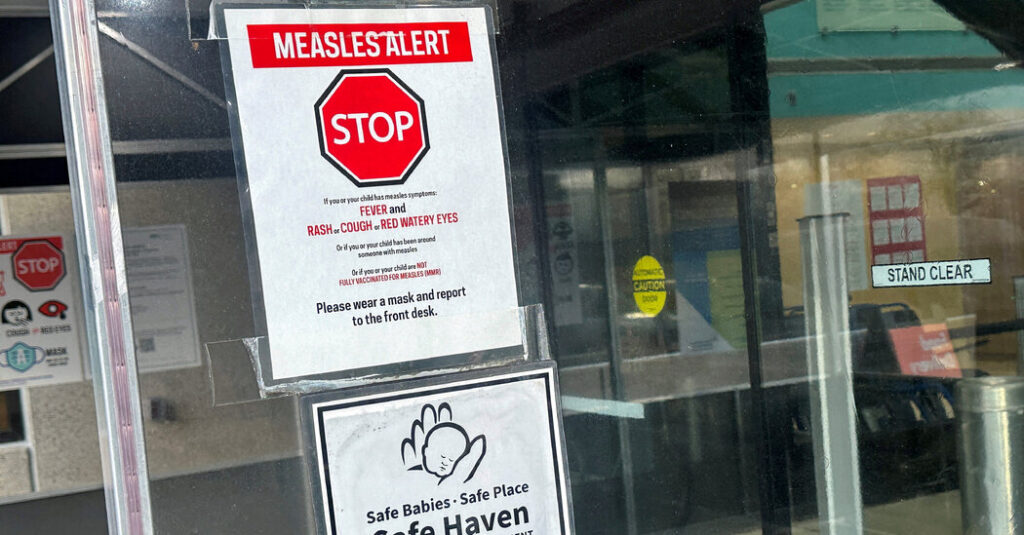
In 2025, the United States reported the highest number of measles cases in recent history. In 2026, there are few signs so far of the virus slowing down.
In South Carolina, a major outbreak has sickened more than 900 people, most of them children, since it began last fall. The virus is also spreading in Utah and Arizona, among other states. Of the 733 cases already recorded nationwide this year, a vast majority have occurred in people who are not vaccinated.
On Sunday, Dr. Mehmet Oz, leader of the Centers for Medicare and Medicaid Services, urged people to “take the vaccine, please” to curb the spread of the virus. As measles continues to circulate, we asked doctors what you need to know about symptoms, treatment and vaccination.
How does measles spread?
Measles is one of the most contagious diseases. It spreads when infected people cough or sneeze, releasing viral droplets that can linger in the air for hours or that can land on surfaces and contaminate them. If you touch a doorknob or a table where a droplet has landed, and then touch your eyes, nose or mouth, the virus can enter your body. People can spread measles days before they develop symptoms.
Why are we seeing so many cases now?
Because measles is so contagious, experts say that vaccination rates need to be above about 95 percent to stem the spread of the virus. In recent years, the rate has fallen well below that critical threshold, in part because of growing vaccine hesitancy.
Recent data from the Centers for Disease Control and Prevention showed that just 92.5 percent of American kindergartners had received measles, mumps and rubella, or M.M.R., shots during the 2024-25 school year.
There are many vulnerable parts of the country where coverage is far lower, including communities in West Texas and South Carolina that have experienced large measles outbreaks.
The United States is also now at greater risk of imported cases, as several other countries — including Mexico and Canada — grapple with their own large outbreaks.
What are the early signs of measles?
People typically start to feel sick around a week or two after they have come into contact with the virus. It can be hard to differentiate early symptoms, including a cough and a runny nose, from those of common viral infections.
“Generally, people are not that sick then, so they walk around and they’re highly contagious,” said Dr. Walter Orenstein, a professor emeritus at Emory University and the former director of the National Immunization Program at the C.D.C. That’s part of why measles spreads so easily.
A few days later, more distinct symptoms can appear, including small white spots in the mouth that are called Koplik spots. Measles also causes a notorious rash. The red or brown splotches start off behind the ears or near the hairline and then spread downward over the course of days.
Doctors can confirm a patient has measles by using laboratory tests.
How do you treat measles?
There is no specific treatment that will stop the virus in its tracks. Instead, patients are typically offered “supportive care,” like Tylenol, supplemental oxygen and I.V. fluids, to make them more comfortable while the virus runs its course.
Doctors sometimes administer high doses of vitamin A in a hospital to manage severe cases. But experts do not recommend taking it without physician supervision since vitamin A can build up in the body to toxic levels, causing liver damage; dry, peeling skin; hair loss; and, in rare instances, seizures.
There is also no credible evidence to show that taking cod liver oil supplements, which Health Secretary Robert F. Kennedy Jr. praised as a near miraculous treatment for the virus last year, has any benefit.
How serious is measles?
While most cases are mild, roughly one in every five unvaccinated people in the United States who contract the virus lands in the hospital.
The virus is particularly dangerous for children. Up to three out of every 1,000 children with measles die from respiratory and neurological complications, according to the C.D.C. As many as one in every 20 children with measles goes on to develop pneumonia, which is the leading cause of death from measles among children. In rare cases, children can also experience brain swelling, which can leave them with lifelong hearing damage or intellectual disabilities.
The virus also wipes out the immune system, which can leave people vulnerable to other infections for years after a bout of measles.
Is measles dangerous for pregnant women?
Pregnant women are 10 times more likely to die from measles than those who are not pregnant. The virus can also cause women to miscarry or go into labor prematurely. If women contract measles late in their pregnancy, they can also transmit the virus to their babies.
Women cannot get vaccinated during pregnancy. If pregnant women are not vaccinated against measles, physicians can give them immunoglobulin, an antibody treatment that is most effective within six days of exposure to the virus.
Pregnant women should try to ensure that their close contacts are immunized, said Dr. Orenstein. “Advocate with neighbors, friends, other family members to get their children vaccinated, to lower the risk of exposure,” he said.
How effective and safe is the vaccine?
The vaccine that protects against measles also protects against mumps and rubella, and is one of the most effective vaccines on the market.
Children typically start the two-dose M.M.R. series at 1 year old, though public health officials may recommend moving the first dose earlier for children living near an active measles outbreak. Together, the doses are about 97 percent effective at preventing an infection.
The M.M.R. shots, like all vaccines, may cause side effects.
The most common effects are mild, like a sore arm or redness around the injection site. More serious reactions are much rarer, but may include fever-induced seizures, which may be scary for parents but do not cause lasting harm.
And because the vaccine includes a weakened version of the virus, people with compromised immune systems could develop measles infections from the shot. However, this is extremely rare because doctors do not typically give the M.M.R. vaccine to seriously immunocompromised patients.
“It has a great safety record and very strong data to support that,” said Scott Weaver, chair in human infections and immunity at the University of Texas Medical Branch. “It’s been given to many hundreds of millions of people around the world.”
Can you still get measles if you’ve been vaccinated?
While it’s possible for fully vaccinated people to contract measles, it’s rare: Of the more than 2,200 cases reported in the United States in 2025, just 4 percent occurred in people who were fully vaccinated against measles. And when vaccinated people do become infected, their symptoms are often milder, and they are less likely to spread the disease to others.
The immunity created by the vaccine is also incredibly robust. If you’ve received two doses of the M.M.R. vaccine, you’re likely to be protected for life. But if you can’t track down your medical records, you can ask a doctor for a blood test to measure the amount of antibodies you have against the virus.
I’ve been exposed to measles. What do I do now?
First, it’s important to know if you’re immune. Nearly everyone who was born before 1957 should be immune, Dr. Orenstein said, because the virus circulated so widely then. If you were born between 1963 and 1967, you may have received a version of the vaccine that was less effective, and you may need to be vaccinated again, if you have not gotten another shot already.
Healthy adults who have received one shot of the vaccine are considered protected, as are school-aged children and some people with compromised immune systems who have received two shots.
If you have not been vaccinated, contact a physician as soon as possible. You may be able to still get some benefit from the measles vaccine if you get the shot within a few days of exposure. A doctor may also recommend that you receive immunoglobulin to lower your risk of becoming seriously sick.
Dani Blum is a health reporter for The Times.
The post What to Know About Measles as the Virus Spreads appeared first on New York Times.