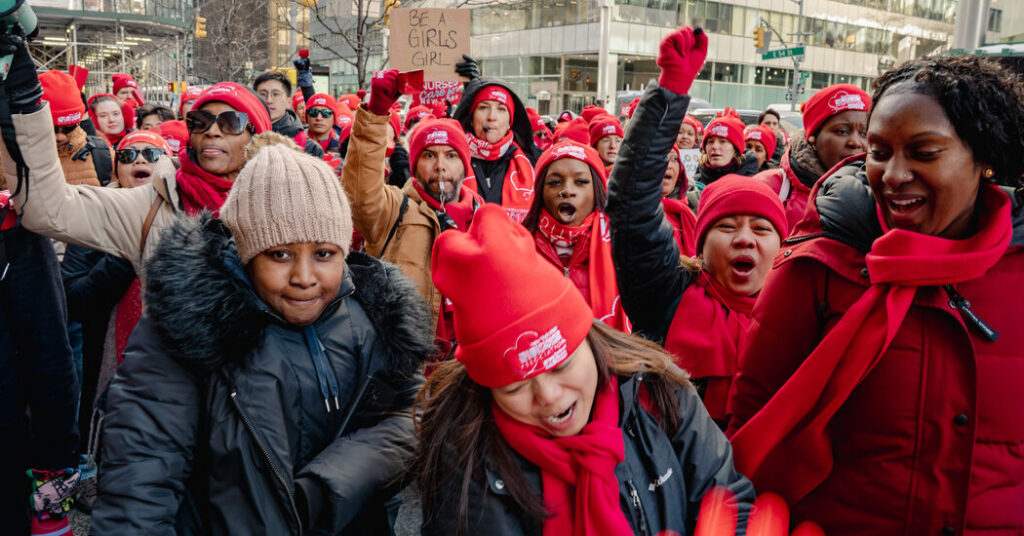
Nurses in New York City reached a tentative agreement on Monday to end a strike at two of three major health systems that has lasted a month and involved nearly 15,000 workers, according to their union.
The nurses’ union said that a deal was reached with the Mount Sinai Health System as well as Montefiore Medical Center, and covers 10,500 of the striking health care workers. The union and other people with direct knowledge of the negotiations said that the nurses will receive a raise of about 12 percent over three years.
The strike continued at NewYork-Presbyterian/Columbia hospital, the union said.
The tentative agreements will be put to a vote of the nurses over the next few days. If they are approved, the striking nurses will return to work within 72 hours of the vote.
The walkout has sent a jolt through New York’s medical system. Elective surgeries were canceled. Some patients were transferred to hospitals unaffected by the strike. And a few thousand travel nurses were hired on weeklong contracts to do the jobs of the striking health care workers.
The strike against some of the city’s leading medical institutions — including the main campus of Mount Sinai Hospital along with two other major hospitals within the Mount Sinai system — came at a steep cost. Cumulatively, the hospitals spent more than $100 million to hire temporary nurses.
For a month, the nurses had kept up picket lines in front of their hospitals through the bitter cold.
The deal between the hospitals and the nurses’ union, the New York State Nurses Association, was hammered out in a lower level of the Javits Convention Center during marathon bargaining sessions that unfolded as the Westminster Kennel Club Dog Show filled much of the convention center.
The main sticking points involved pay, minimum staffing levels in hospital wards and protections to reduce workplace violence.
“Now, nurses at Montefiore and Mount Sinai systems are heading back to the bedside with our heads held high after winning fair tentative contracts,” Nancy Hagans, president of the nurses’ union, said in a statement.
Ms. Hagans said the tentative agreements “maintain enforceable safe staffing ratios, improve protections from workplace violence and maintain health benefits with no additional out-of-pocket costs for frontline nurses.”
The union’s executive director, Pat Kane, said that the nurses “sacrificed their own pay and health care while on strike to defend patient care for all of New York.”
On Monday, a few details emerged regarding the ongoing negotiations at NewYork-Presbyterian/Columbia. The hospital issued a statement asserting that it was willing to pay the same wage increases agreed to by the other hospital systems.
“We look forward to bringing our nurses back to care for our patients,” Angela Karafazli, a NewYork-Presbyterian spokeswoman, said.
But an official with the nurses union said that the two sides had yet to reach a resolution on minimum nurse staffing levels.
The strike proved to be an unexpected test for the city’s new mayor, Zohran Mamdani, who took office not quite two weeks before it began and twice appeared in support of the nurses on their picket line. Ms. Hagans said that she received a message from Gov. Kathy Hochul and Mr. Mamdani last month after negotiations had stalled, urging the parties to return to the bargaining table.
The strike left many nurses feeling betrayed by the governor. On Jan. 9, Ms. Hochul had signed an executive order that declared an emergency because of health care staffing shortages, which allowed the hospitals to hire out-of-state nurses to work during the strike, even if they didn’t have New York licenses. Thousands of travel nurses worked short-term contracts for about $9,000 a week. Many nurses said that Ms. Hochul’s action had undermined the strike by alleviating the pressure on hospitals. On Feb. 2, nurses marched to her office in New York City.
That same day, Ms. Hochul extended the order but only for two days. The extension stated that it was to ensure patient safety, not “to afford leverage to any party in collective bargaining.” She subsequently extended the order several more times.
After three weeks of halting talks that saw little progress, the two sides began making headway last week, with negotiations extending late into the night some days. Negotiators on both sides spent days hashing out what security systems hospitals would place at entryways. At some hospitals, such as Mount Sinai, nurses wanted metal detectors and armed police officers. Hospital officials, meanwhile, wanted to rely on weapon detection systems that used artificial intelligence and a range of sensors — but did not create long lines or waits.
It was only in recent days that the two sides made much headway on the other core issues, including staffing minimums and pay.
The strike dragged on far longer than many nurses had anticipated. When the strike began, many had expected a repeat of 2023, when a smaller group of nurses walked out and hospitals were buoyed by federal bailout money that subsidized them during the coronavirus pandemic. Hailed as heroes who held the line during the deadly first wave of Covid-19 amid widespread burnout and deteriorating working conditions, they had already won agreements to significantly boost their pay: raises of nearly 20 percent over a three-year contract.
Chronic understaffing had left nurses in hospitals across the city with too many patients to properly care for at once. That longstanding problem worsened as the virus thinned out the nursing work force.
The 2023 contract propelled starting salaries at major Manhattan hospitals to about $120,000 in the last year. Many nurses make far more, with some hospitals paying nurses on average about $160,000, when overtime and years of experience are factored in.
By going on strike in 2023, the nurses locked in an agreement on nurse-to-patient ratios with enforcement mechanisms. When hospitals left units chronically understaffed, nurses could force administrators to pay them extra. Nurses in the Mount Sinai Health System were awarded $4.7 million from arbitrators in 2024 in nine understaffing cases.
Hospitals have chafed at those payments and sought to chip away at them. NewYork-Presbyterian went to federal court to appeal a similar arbitration ruling.
The nurses’ union said that the tentative agreements on Monday will preserve the union’s ability to enforce staffing levels.
Today, the financial outlook for hospitals is quite different from several years ago. Hospitals anticipate lean years ahead, with more than a million New Yorkers expected to lose health insurance and federal health care subsidies to the state slated to be cut by billions of dollars — a result of the domestic policy bill that President Trump signed in July.
In 2023, the hospitals were caught by surprise by the nursing strike — the first in New York City in a quarter century. Not this time. Hospital executives appeared to have decided, after the nurses’ 2023 win, to stand their ground, wary that if they were to fold quickly, they could see a strike every three years, when contracts expire.
“It’s kind of a scary precedent if they’re going to strike every time the contract runs out,” said Bill Hammond, a health care policy analyst at the Empire Center for Public Policy, an Albany think tank.
Observers were reluctant to declare either side a clear winner or loser.
“It sounds like a solid settlement,” Harry Katz, a professor of collective bargaining at Cornell University’s School of Industrial and Labor Relations, said. “I’d be very hesitant to say one side won and the other side lost — it seems like a solid compromise.”
Many of the nurses lost several weeks’ pay. The hospitals had to hire short-term contract nurses and treated fewer patients than they would have otherwise. The raises that were agreed to are consistent with the raises that unions are generally achieving through collective bargaining, Mr. Katz said.
Joseph Goldstein covers health care in New York for The Times, following years of criminal justice and police reporting.
The post N.Y.C. Nurses Reach Deal to End Strike at Two Hospital Systems appeared first on New York Times.