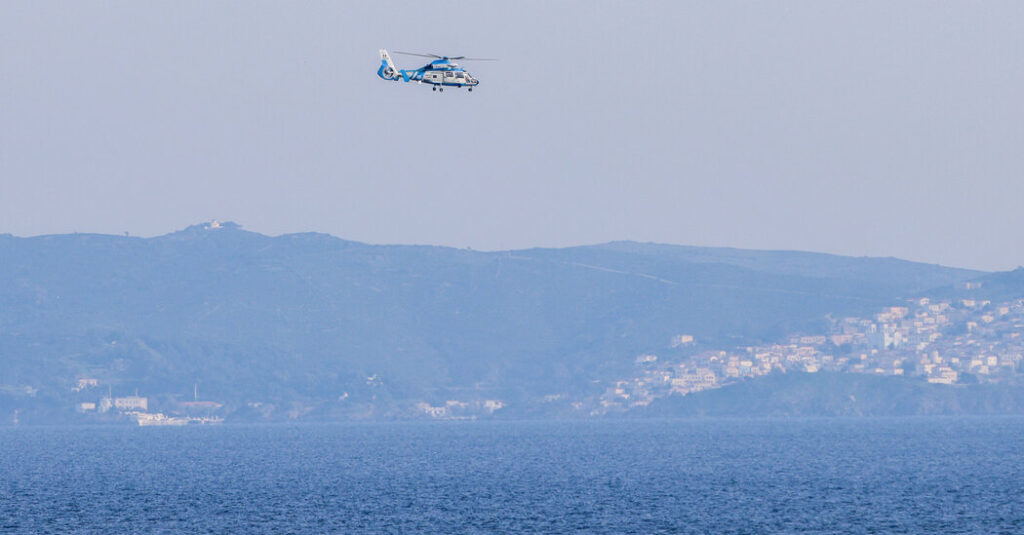
At least 53 migrants, including two babies, are missing after their rubber dinghy capsized last week off the coast of Libya as they tried to cross the Mediterranean to Europe, the International Organization for Migration reported on Monday.
The shipwreck brings the number of migrants feared drowned in the central Mediterranean since the start of the year to at least 484, more than a third of the total for all of 2025, according to the I.O.M., a branch of the United Nations.
The Libyan Coast Guard rescued two survivors, both Nigerian women. The women told I.O.M. officials that the boat — carrying at least 55 people from different African countries — had departed from Zawiya, Libya, on Thursday night and that it capsized about six hours later. One survivor lost her husband; the other lost two babies.
More than 33,400 migrants have died or gone missing in Mediterranean waters since the I.O.M. began tracking deaths at sea in 2014. Most of them died crossing the central Mediterranean between North African countries like Libya and European ones like Italy, though some perished in the narrower eastern straits between Turkey and Greece, or to the west between Morocco and Spain.
Since the Mediterranean death toll peaked in 2016, European countries including Italy have attempted to curb maritime migration by scaling back state-led rescue operations; placing greater restrictions on private rescue initiatives; and encouraging governments in North Africa — particularly those in Libya and Tunisia — to do more to stop smugglers from operating from their shores.
Against that backdrop, the level of unauthorized maritime migration to Europe has fallen, as has the number of reported shipwrecks. But the death toll remains high: Last year, more than 1,300 migrants died or were missing in the central Mediterranean, according to the I.O.M.
The agency has previously noted that “the real number of dead and missing along these routes is believed to be higher as many incidents go unreported or undetected.”
The unusually high death toll in the central Mediterranean in January, which the I.O.M. said was at least 375, was linked to Cyclone Harry, an exceptionally powerful storm that battered southern Italy and Malta.
According to Italy’s Interior Ministry, more than 66,000 people arrived by boat to Italy during 2025, about the same as in 2024, but less than half the roughly 157,000 arrivals in 2023. That year, the European Union struck a deal with Tunisia to try to stem the flow of migrants. Italy also has bilateral accords with Tunisia and Libya.
Mediterranea Saving Humans, a civil society group that attempts to rescue migrants from shipwrecks, said on social media that the latest shipwreck was “the direct result of European policies of closing borders, collaborating with militias, and criminalizing sea rescues.”
The Italian government has long provided logistical support to the Libyan Coast Guard to help it combat people smuggling, but denied funding militias that hold sway in parts of the Libyan coastline.
Elisabetta Povoledo is a Times reporter based in Rome, covering Italy, the Vatican and the culture of the region. She has been a journalist for 35 years.
The post 53 Migrants Missing After Boat Capsizes Off Libya, U.N. Agency Says appeared first on New York Times.