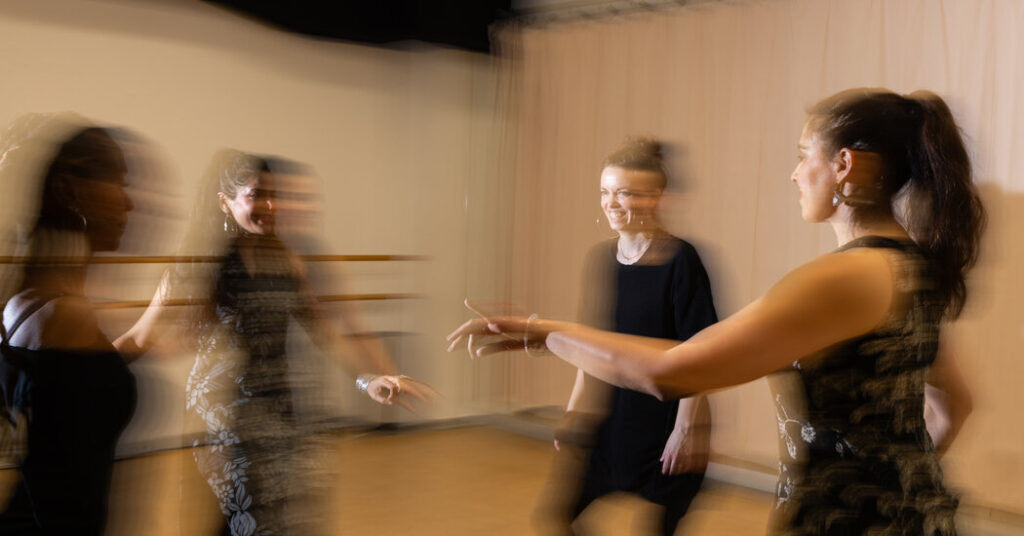
Some do it with metal. Others go at it barefoot and with bells on. But these dancers can communicate across those differences, through music.
In “Speak,” American tap dancers collaborate with their counterparts in kathak, a classical Indian percussive dance form. While these genres have been crossed before, rarely have the participants been such masters of their art.
On the tap side are Michelle Dorrance, the only tap dancer to have won a MacArthur grant, and Dormeshia, widely considered the world’s greatest. Representing kathak are Rachna Nivas and Rukhmani Mehta, disciples of Chitresh Das, who was the foremost guru of kathak in the United States. (He died in 2015.)
On Feb. 21, “Speak” is to have its New York premiere at 92NY as the culmination of “What Flows Between Us,” a daylong festival of Indian music and dance curated by Nivas. In line with 92NY’s “Women Move the World” series, of which it is a part, all the leading artists are women.
“We wanted to show how these art forms can speak to one another,” Nivas said about the collaboration.
Accordingly, “Speak” has two bands: a jazz trio and a group of classical Hindustani musicians. There are traditional solos in each idiom, but the kathak dancers also jam with the jazz players, and the tap dancers trade rhythms with the tabla drummer. At the end, everyone joins the musical conversation.
“We’re inviting each other into the nuances and the details of our forms and seeing where all those things connect,” Dorrance said.
“It’s not fusion,” Nivas said. “The deeper you go into your own form, the more equipped you are to have a really meaningful collaboration. It’s because we have all gone so deep into our forms and are rooted in an extremely disciplined practice that the meeting of us is like fireworks.”
In one sense, “Speak” is a demonstration of differences between kathak and tap. Where tap dancers have amplifying metal on the bottoms of their shoes, kathak dancers drum the floor with bare feet; they wear bells around their ankles that mark accents like a shaker but also resonate nearly continuously, almost like a high-pitched drone. Each form has distinct ways of using the feet and organizing rhythm, developed over centuries.
The collaboration has been a learning experience that both sides have had to approach with a beginner’s mind. Dorrance described the “insane” but pleasurable challenge of jumping into a kathak meter of 9 ½ beats. (Tap dancers usually work in threes and fours, maybe fives.) “The kathak footwork is so subtle and so fast as it moves between notes that it’s hard to see what’s happening,” she said.
Mehta recalled struggling to understand jazz grooves and marveling at tap technique. “There are so many things that Michelle and Dormeshia can do with their feet that we can’t,” she said. “Sometimes you have to translate, but sometimes you’re like, ‘Maybe I can move that way.’”
Teaching each other has also revealed much about their own forms. “It’s like a mirror,” Nivas said. “Michelle and Dormeshia ask me questions about things I learned without being fully aware, and I have to investigate my form to answer.”
Nivas recalled watching Dormeshia take a kathak phrase and turn it into something else in tap. “And I’m like: ‘I can do that now. I can bring it back into my own dance.’”
Dorrance alluded to the tradition of improvisational exchange in tap, in which one dancer will copy or “steal” a move or rhythm from another dancer, then change it. This is called “making it your own.”
“Some of the exchange here is stealing it back,” Dorrance said. She can take a tap step that has been translated through the bodies and traditions of the kathak dancers and incorporate it back into hers.
“We were teaching them the Shim Sham,” Dorrance said, referring to a routine from the 1920s that almost all tap dancers know. She noticed that the kathak dancers were shifting their weight in a manner derived from Indian technique. “And I’m like, ‘That’s a great choice, why don’t I shift my weight that way?’ It makes such sense in this rhythmic pocket that I’ve lived in since I was 3 years old.”
Improvisation is an essential part of kathak, Nivas said, though these days it is often neglected in favor of choreography. With their guru, she and Mehta “lived it day in and day out,” she said. “But with him gone, we’re always wanting to have that nourished and fed, and Michelle and Dormeshia do that.”
This is what flows between them. “Hanging around with these tap dancers feels like home,” Nivas said.
“What really struck me was how familiar some of their footwork feels,” Dormeshia said. “We might be using a different part of the foot, but rhythmically we’re speaking the same language.”
The women also connected through a shared reverence for elders. “We all take very seriously being tradition bearers and cultural historians,” Dorrance said. The dancers spent many hours showing each other video footage of masters in their arts, many long dead, delighting in the discovery of similarities.
“Speak” is a continuation of a project by Nivas and Mehta’s guru, Das. In the early 2000s, Das, in his 60s, met the then-young tap phenom Jason Samuels Smith while jamming near the dressing rooms at a performance at the American Dance Festival. “It was like love at first sight,” Nivas said. “They couldn’t stop dancing together.”
That meeting grew into a duo performance, “India Jazz Suites,” which toured North America and India many times. (It was the subject of the 2013 documentary “Upaj: Improvise,” produced by Mehta.)
“Both had this generosity of spirit where they brought in their own communities and worlds,” Nivas said. Through Das, Nivas met Smith, who invited her to the Los Angeles Tap Festival, where she met Dormeshia, taught kathak and bravely leaped into the intense competitions of one-upmanship that tap dancers call cutting contests.
(Das incorporated cutting contests into his own practice. Nivas recalled some bewildered Indian parents asking, “What is cutting?”)
Eventually, Nivas and Mehta invited Dorrance and Dormeshia to join what Nivas described as “the next chapter of the conversation.”
“It was sort of like, ‘The ladies have something to say now, too,’” Nivas said.
“‘India Jazz Suites’ was 10 men,” she added. “We had six women and four men,” including the musicians. “And when the show was over, I turned to Rukhmani and asked her, ‘Why does this feel so different?’ And she’s like, ‘It’s because we’re women.’”
“There’s a deep sense of exchange, listening, trust and shared responsibility,” Dormeshia said.
In organizing the rest of the festival, Nivas tried to extend that spirit and the idea of cross-genre collaboration among artists rooted in tradition. The Hindustani vocalist Saili Oak is working with a classical string quartet. Nirmala Rajasekar, a South Indian Carnatic musician who plays an ancient plucked-string instrument called a veena, is performing with her daughter Shruthi, a vocalist trained in both Carnatic and Western classical traditions.
The afternoon is enlivened by a battle of drums from various Indian traditions — tabla, mridangam, ghatam — all with female players.
Finding a first-rate tabla player was the biggest challenge, Nivas said. “Other than vocalists, female musicians are very rare in North Indian music.”
“Speak” caps off the festival in the evening.
Nivas wants “What Flows Between Us” to be for audience members what the creation process for “Speak” was for her and her collaborators: “a transformative experience.”
The post Like Fireworks: When Masters of Two Dance Traditions Meet appeared first on New York Times.