Greenlanders own a lot of guns: more than 35,000 long rifles, on an island of 56,000 people. Everyone I met there in January knew how to hunt. And more than one person made clear to me that they were ready to stand their ground against a possible American invasion.
“I have 10 hunting rifles,” Finn told me when I visited his home in Nuuk. (He asked me to withhold his full name because “taking credit for things is not the Greenland way.”) “I am a decent shot,” he added, “but not as good as my friends, who can hit a seal in the water at 200 meters, from a moving boat.”
Nuuk, a city of no more than 20,000 people, is serviced by one of very few runways in a wilderness more than three times the size of Texas. Finn was born there, to a Danish father and an Inuit mother. “You must know,” he told me—after we’d sat for an hour or so over tea and salted musk ox, and he had come to trust that I was not one of the “other” Americans—“that I will defend my home.”
The “other” Americans had also been to visit. In early 2025, right-wing influencers roamed downtown Nuuk, handing out $100 bills to children and telling them to pose for cameras while wearing free MAGA swag. I, too, encountered a group of children—on a climb up the tallest hill (in Ohio we would call it a mountain) overlooking the capital. Four kids scampered past. “We don’t like Trump!” they said on hearing my accent.
[Read: ‘We are learning to bully back’]
Looking down on the airfield below, I was struck by the forbidding topography. Steep, snow-covered mountains flanked the icy fjords. The word that came to mind was desolate. Jacob Kaarsbo, one of my climbing companions, was a former Danish intelligence officer and an expert on Greenland’s defense.
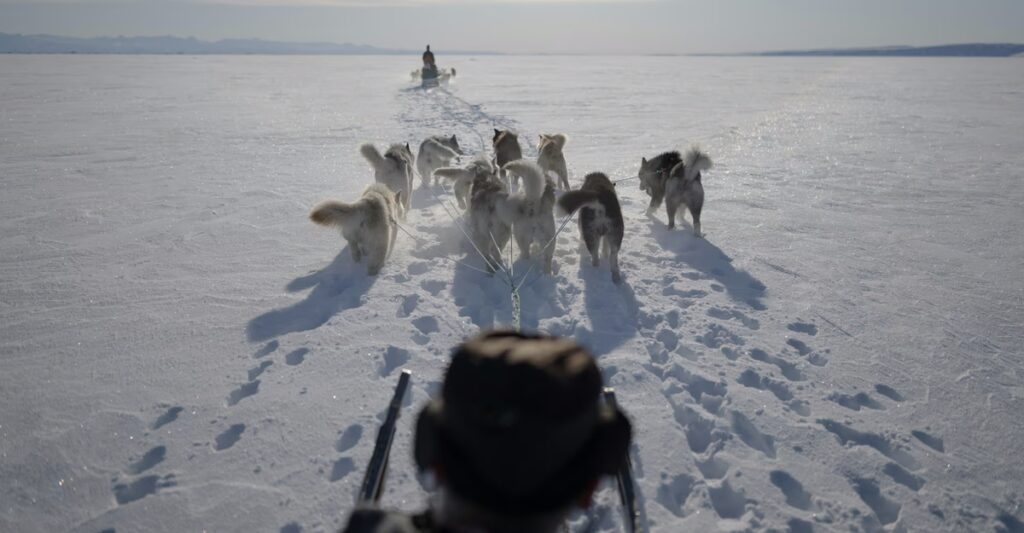
“There are only a handful of runways that we have to defend,” he told me. “And in the north,” he added, “there are villages where the next living soul is 1,000 miles away.” Danish special forces maintain a presence in those wild expanses. Monthslong expeditions known as Sirius Patrol rely on sled-dog teams, and serve to remind any interloper that Greenland is not for the taking.
President Trump recently mocked the sled-dog teams. But in the frozen North, the only vehicles that can operate reliably are sleds pulled by dogs. People have tried using machines, but the cold turns oil to sludge, and when machines fall through ice, they can’t be pulled out. If a sled breaks through, it floats long enough to be recovered. If dogs and men fall through, they pull themselves out, drag their sleds onto thicker ice, and carry on.
Two hours north of the capital sits a fishing village accessible only by boat. We left Nuuk’s port before sunrise, and once we were in the fjord, we navigated past slabs of ice until we reached the settlement. Most of Greenland’s inhabitants live in towns like this: a one-room schoolhouse, a chapel, a lone medic equipped to treat only minor injuries. Anyone with a serious health issue has to be evacuated to Nuuk by boat. As we approached the dock, a small hunting party was casting off.
The village may be one of the most isolated in the world. But even there, people asked me: “What does America want?” By their reckoning, Greenlanders already provided everything the United States could want. “Is it true,” one of the villagers asked, “that your president has a ‘psychological need’ to own us?” Some in the village wanted to believe that Trump had never said this, that the reports were fake.
[Read: Denmark’s army chief says he’s ready to defend Greenland]
Throughout the settlement, I noticed animal carcasses nailed to the sides of homes. Most were small game—birds and hares—but I also saw a quartered reindeer. This was the local method of refrigeration, and the villagers survived on subsistence hunting. I found myself thinking about the gun culture back home—performative, based on a myth of self-sufficiency. In this Greenlandic village, gun ownership was rooted in the requirements of an unforgiving environment. Walking back to the boat, I saw a blood trail that led up from the dock. The hunting party had been successful.
Trump’s posture toward Greenland has had a very real impact on the people who live there. Three nights before my visit, the power failed in Nuuk. One woman I spoke with was convinced that the Americans were coming. Many of her friends thought the same. “Venezuela,” she said. “The first thing the Americans did was cut the power.” The next morning, calls to the mental-health crisis line in Nuuk spiked.
Part of me wondered whether this was an overreaction. Then Orla Joelsen, a local guide, showed me a building that sat mostly empty in the center of town.
“It is waiting,” Joelsen said, “for the Americans.”
The U.S. government has long maintained a minimal presence in Nuuk: one permanent consular representative and a handful of other staff. That has been more than enough for as long as anyone can remember. Now the U.S. has leased this new building, which it has yet to occupy, and which covers tens of thousands of square feet, with enough office space for more than 100 people. To the locals, the facility looms as the likely headquarters for a coming occupation.
The Greenlanders I met will not submit easily. They seemed ready to fight, and more than capable. Greenlandic and Danish authorities were also preparing. Warships from Denmark arrived at the harbor during my visit. My guide told me that until recently, he had never seen guards at the port, where heavily armed Danish soldiers now checked vehicles entering and leaving. “It is not because of the Russians,” Joelsen said. “It is because of the Americans.”
In late January, the Greenlandic government posted an alert advising all residents to prepare to “fend for yourself for five days if a crisis arises.” The notice included recommendations on stockpiling medicine, batteries, and fuel, as well as tips on surviving without power or water. Similar circulars have been issued before, in anticipation of major storms and other natural events. But this one included something new: “Consider access to hunting weapons.” That was a call to arms.
“The more people who can fend for themselves and help others, the stronger we stand as a society,” the alert added. “Do what you can and help those around you. Fortunately, we are good at that.”
In Nuuk, stores were running low on ammunition, not because people were afraid of one another, nor because they needed that much ammo to hunt. “The bullets are for the Americans,” one local told me, “if they come.” He assured me that the government was working to replenish the depleted ammunition supply.
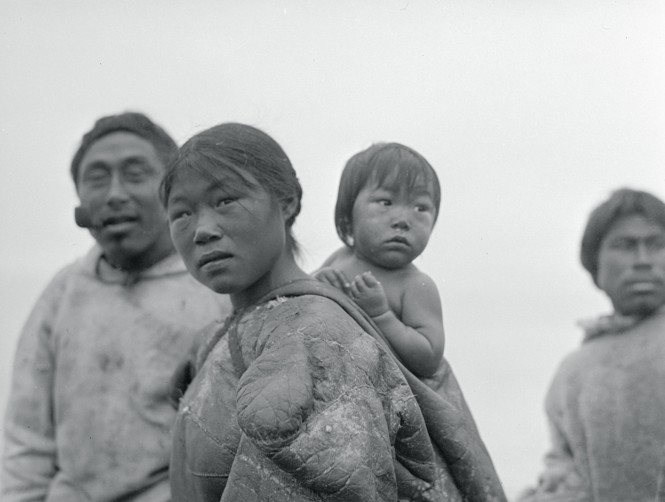
The Greenlanders I met were warm and welcoming, but not without a fierce pride. Their ancestors had carved a civilization out of the ice with tools made from whalebone and meteorite fragments. They’d hewn garments from cured whale intestine, sealskin, and thick polar-bear fur—still the warmest insulation on Earth. Today’s Greenlanders are prepared to defend what they have built here.
“If we are pushed,” Finn told me, “we are ready to die.”
That’s a fight America has no reason to pick. It’s also one that America could lose.
The post Greenlanders Are Ready to Fight appeared first on The Atlantic.