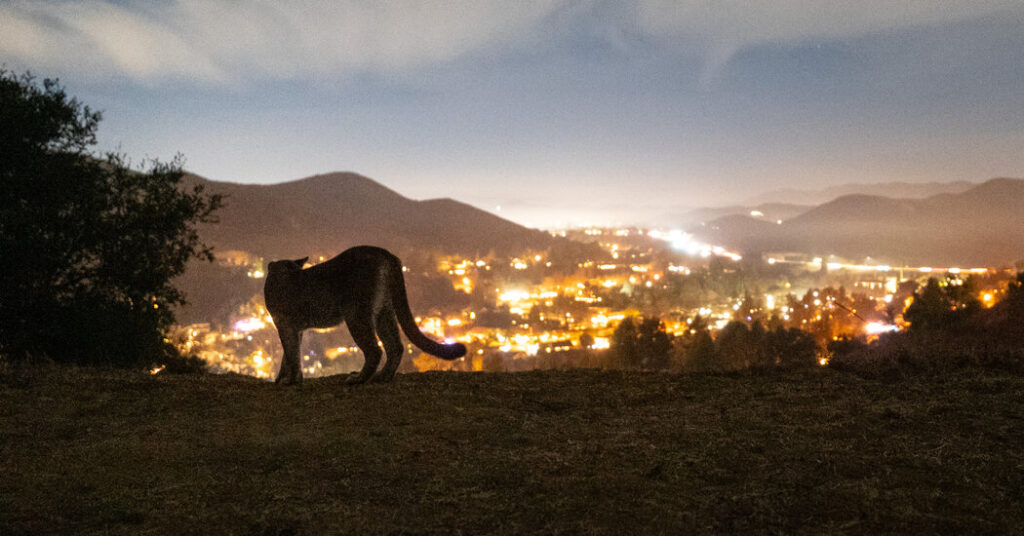
For a mountain lion, the kindest intervention for a broken leg is often euthanasia. But the cub known as P-121 was getting a second chance.
Found in a roadside ditch in the Simi Valley near Los Angeles, he was one of scores of California mountain lions struck by vehicles each year. At only about five months old, he should have spent another year with his mother. But she was nowhere to be seen.
An X-ray brought good news: the break in his hind leg was clean. He would undergo surgery and remain at a wildlife rehabilitation facility for several months, until his limb mended and he was old enough to fend for himself. If all went well, he would return to the wild.
California’s mountain lions stand at a crossroads, and the story of P-121, who arrived at the San Diego Humane Society’s Ramona Wildlife Center on Thanksgiving Day in 2023, offers a searing glimpse into the challenges facing the animals. Researchers and wildlife advocates have been working to implement solutions even as pressure on the animals continues to mount.
Between 2018 and 2023 alone, California added 550 miles of lanes to state highways. Populations of mountain lions in the central coast and south are so beleaguered that this week, the state is expected to declare them threatened under its endangered species law. At the same time, one huge, concrete-and-steel fix is set to come late this year: the largest wildlife crossing of its kind in the world, a $114 million endeavor to save lions around Los Angeles. Gov. Gavin Newsom announced part of that funding, needed to finish the project, last week.
Creatures big and small are suffering as humans increasingly dominate the planet, taking away habitat that species need to survive. The power and majesty of apex predators like mountain lions can capture the human psyche, helping inspire conservation work, but also come with controversy because of the danger they can pose to people, pets and livestock.
What happens to California’s mountain lions could hold lessons for the world.
𓂃
Perhaps 4,000 mountain lions, also known as cougars and pumas, live in California. About 1500 of them inhabit pockets throughout the state’s most populous regions, from around San Francisco down through San Diego. These animals are the ones that the state’s Department of Fish and Wildlife has recommended for protection.
While attacks on people are scary and at times devastating, they are rare. Conservationists like to point out that dogs, and also lightning, kill far more Americans than mountain lions. Still, dwindling habitat is forcing the animals closer to humans, and the state has recorded 12 attacks since the beginning of 2020, more than in any previous decade. Of those, one was fatal.
Beyond vehicle collisions, mountain lions face a host of other threats. California’s highways hem in populations, isolating them from each other. Unable to disperse to new territory, males end up mating with their daughters and granddaughters. Signs of inbreeding, a major concern, are now showing up in abnormal sperm and kinked tails, researchers have found.
The barriers created by roads also put young lions at greater risk of getting killed by older, breeding males defending territory. Cats in the Santa Monica Mountains outside Los Angeles are among the hardest hit.
“In the two decades of research, I can count on one hand the number of males born in the Santa Monicas that have survived past the age of 2,” said Jeff Sikich, a wildlife biologist with the National Park Service and a leading expert on mountain lions. “Usually they’ll run into the adult male and get killed, or attempt to cross the freeway and get killed, or get killed on another roadway in the mountains.”
Rodenticide is another leading cause of death, as poison in mice and rats moves up the food chain. Dead mountain lions may at first appear to have been healthy, but postmortem exams reveal pools of blood inside their abdominal cavities.
“It’s a horrible death,” Mr. Sikich said.
And climate change is exacting a toll as it intensifies wildfire and forces the cats to find new habitat on landscapes where humans are taking up more and more space.
Mountain lions are thought to have the largest range of any mammal in the Western Hemisphere. They’re found from Canada to around the southern tip of South America, and historically, from east to west coasts. Bounty hunting in North America began as early as the 1600s, according to the National Park Service, and continued until the 1960s. The disappearance of mountain lions from ecosystems contributed to an overpopulation of deer and other prey animals, leading to overgrazing and erosion.
In the United States, they now exist mostly in western states and in Florida, where they are known as panthers.
𓂃
A few days after arriving at the Ramona Wildlife Center, P-121 underwent surgery to realign his broken leg. Veterinarians inserted a metal plate and 10 screws.
It’s not easy to repair a wild mountain lion. Every hands-on check requires sedation. Physical therapy isn’t possible.
“The first few weeks after the orthopedic surgery were very worrisome,” said Angela Hernandez-Cusick, a wildlife rehabilitation supervisor with the San Diego Humane Society. To limit the lion’s interaction with humans, caregivers watched him on a trail camera. His leg looked concerningly stiff.
But over time, it limbered up. His caregivers relocated him to an outdoor enclosure where he could move around more, and he quickly charmed them with his curiosity and playfulness.
To simulate physical therapy, they placed deer scents and essential oils in trees, and he climbed up to investigate.
To ensure he could hunt, they put live rats in his enclosure. “He did very well,” Ms. Hernandez-Cusick said, even catching a squirrel or two that wandered in.
After seven long months in rehab, it was time for P-121 to return to the wild.
The team was happy to see him set off, but nervous for the challenges he would face, especially as a young male.
“They’re having to figure out where to establish themselves, and they’re having to avoid people, homes, cars, dogs, and bigger mountain lions,” said Dr. Deana Clifford, a wildlife veterinarian with the California Department of Fish and Wildlife who oversees mountain lion health. “These guys have to navigate all that, figure it out, disperse and try to find a place to be a mountain lion in this land of obstacles.”
𓂃
Across the world, two major cities are known for being home to large cats: Mumbai has leopards and Los Angeles has mountain lions.
The roots of the city’s wildlife crossing trace back to the 1980s, when wildlife advocates at the Santa Monica Mountains Conservancy realized the need for habitat connectivity.
Research starting in the early 2000s on collared cats revealed how severely highways, notably U.S. 101, prevent movement. Scientists and environmentalists started trying to find money for a crossing, perhaps a tunnel.
Then, in 2012, Beth Pratt, the National Wildlife Federation’s regional executive director for California, read an article in The Los Angeles Times about P-22, a mountain lion who lived in the city’s Griffith Park. He had to cross two freeways, Interstate 405 and U.S. 101, to get there.
Mr. Sikich took her on a tour of the park.
“At first I was like, ‘Oh my God, get this mountain lion out of here, there’s celebrities walking their dogs, there’s a merry-go-round, there’s golf,’” Ms. Pratt recalled. “But then he explained to me what this cat, and not just P-22, what all the mountain lions in the Santa Monica mountains, were dealing with.”
The effort to build a wildlife crossing began in earnest, and Ms. Pratt became a chief wrangler of the sprawling, multiagency, public-private effort. In P-22, she found a potent symbol: a handsome lonely bachelor, a Hollywood hero in trouble.
“Every Angeleno knows how the 405 can impact your dating life, right?” Ms. Pratt said. “He’s trapped in traffic alone, cut off from his kind. And that resonated with people.”
The project broke ground on Earth Day in 2022, at the only location in the region with enough protected land on both sides.
Eight months later, P-22 — elderly, sick and injured after a collision with a car, something he had avoided for years — was euthanized.
𓂃
While the cats around Los Angeles have received a lot of attention, they aren’t the only ones at risk.
The Santa Cruz Mountains above Silicon Valley are home to 60 or 70 cats, according to Richie King, a field biologist with the Santa Cruz Puma Project, a partnership between the University of California Santa Cruz and California’s Department of Fish and Wildlife.
The group tries to keep 10 to 15 collared at any given time. Their research seeks to better understand mountain lion ecology and helps identify where wildlife crossings would be most effective.
But it’s not easy to find the animals for collaring.
On a mild morning last spring, Mr. King got word that a mountain lion was ready for him. The team works with a houndsman, and his Plott hounds had driven it into a tree. Mr. King hurried into the woods to dart the animal.
“It’s always a little nerve wracking,” Mr. King said.
The cats typically jump from the tree when darted, and they have a couple minutes before losing consciousness. If they stay in the tree, the team will toss sticks near them to encourage them to jump down, so they don’t get injured by falling.
When it comes to cubs, which get special expandable collars, the hard part is finding where their mom hid them.
The team collars cubs at around five weeks old. Wait longer than that, researchers say, and they won’t be able to catch them.
𓂃
Less than two months after P-121’s release, the state’s wildlife department got a call from the Los Angeles County Sheriff’s Office. A collared mountain lion had been found lying along Soledad Canyon Road in Santa Clarita.
It was P-121. This time, the collision had killed him.
A necropsy found catastrophic internal injuries and exposure to multiple rodenticides. Otherwise, he looked healthy. The earlier fracture had healed well.
“After so many months in care and having such a win with his medical recovery and release, it was devastating,” Ms. Hernandez-Cusick said. “His story is one that defines the challenges of rehabilitating mountain lions in the fragmented habitats of Southern California.”
Based on research by the University California Davis, it’s likely that around 100 more California mountain lions have been killed by vehicles in the year and a half since P-121 died.
The wildlife crossing near Los Angeles, named for Wallis Annenberg, a major donor, is slated to open in late 2026.
The state contributed about $77 million, according to Ms. Pratt, primarily with funds designated for the environment. The remaining $37 million came from private donors.
Last month, landscapers finished covering the main structure with 5,000 native plants, grown from seeds collected from the area.
The crossing is expected to help species far beyond mountain lions, including bobcats, coyotes, rabbits, bats, lizards and snakes.
As significant as it is, it’s only one crossing. But environmentalists hope it will inspire more throughout the state and beyond. In recent years, wildlife crossings have gained popularity nationwide and abroad, in large part because they are built at collision hot spots, improving safety for humans.
The location for the Annenberg crossing was different, the ten-lane freeway so wide that “most animals just get there and turn around,” rather then trying to cross, Ms. Pratt said. Instead, the site was chosen for habitat connectivity, to help wildlife survive in urbanized environments.
“Wildlife is running out of habitat and human development isn’t stopping anytime soon,” Ms. Pratt said. “We need to learn how to coexist, and the Annenberg is such a testament to that.”
Loren Elliott is a freelance photojournalist who frequently covers human-wildlife coexistence and conflict.
Catrin Einhorn covers biodiversity, climate and the environment for The Times.
The post Can Mountain Lions Survive as Humans Close In? California Is Trying to Find a Way. appeared first on New York Times.