SARASWATI, by Gurnaik Johal
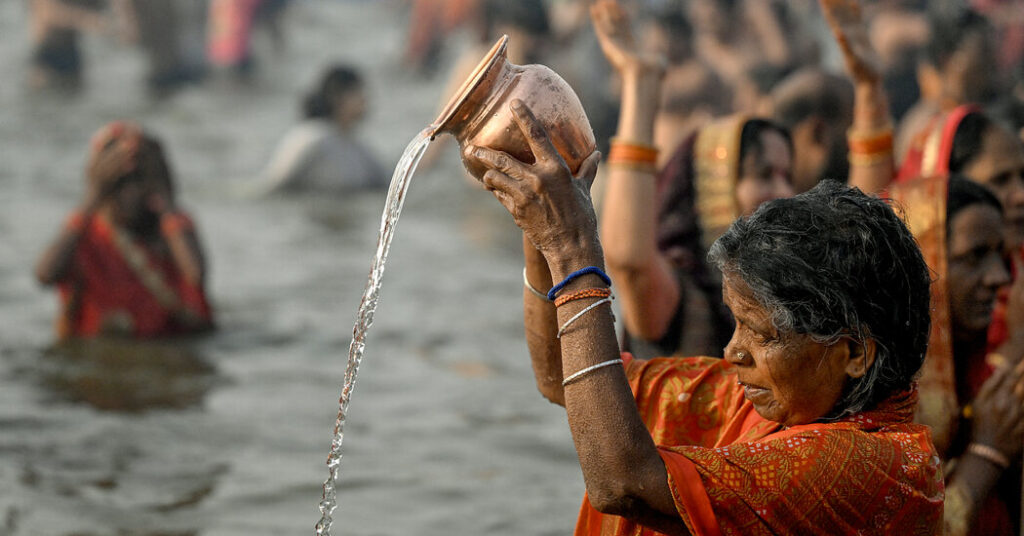
At the beginning of “Saraswati,” Gurnaik Johal’s clamorous, inventive and polyphonic novel, the mythical river of the title bubbles to life on a sleepy agricultural plot in India.
To the Hindu-right dispensation ruling the country, this is a sign of rebirth, the revitalization of a glorious past rather than the troubling outcome of melting glaciers in the Himalayas. India might be trapped in a polycrisis of inequality, authoritarianism and climate change, but the return of the Saraswati, a sacred symbol of Vedic legend, will allow the nation to harness ancient glory in a techno-futuristic present.
“It’s not just the country’s history arriving at your doorstep, it’s the country’s future, ” a leader of the Hindu right says to his admiring audience.
This is a complex backdrop, one that sounds quite plausible to those with even a cursory knowledge of India in recent decades. Johal brings to this context an inquiring mind, one that ambitiously sifts through the demented, fantastical nature of right-wing politics in India while connecting it to systemic planetary collapse.
Seven novellas, told through the perspective of characters descended from the same ancestors in the north Indian state of Punjab, serve as the book’s interweaving narrative lines. Scattered through the world as part of a global Sikh diaspora, these characters allow Johal to offer glimpses of an Earth in crisis, while the story of the river’s return and the rise of the Hindu right forms a through line that connects them all.
Reminiscent, on the one hand, of global novels like David Mitchell’s “Cloud Atlas,” and, on the other, of more politically edgy South Asian fiction such as Numair Atif Choudhury’s “Babu Bangladesh!” and Shubhangi Swarup’s “Latitudes of Longing,” Johal’s book explores a wide range of ideas and locations.
Beginning with Satnam, a London-based corporate drone who has inherited the land where the Saraswati emerges, and branching out to protagonists in Kenya, Singapore and Canada, the principal characters seem to embody the seven legendary rivers of Punjab. They mirror other motifs, too: a piece of phulkari cloth woven by one of the ancestors and sliced into seven pieces; and the regional qissas, or oral tales, inserted between the seven stories. The book is a rich tapestry, occasionally bewildering, often beguiling.
In just one narrative, centered on Gyan, a former musician turned eco-activist in British Columbia, we learn about the spruce beetle, the Hindustani raga “Megh Malhar,” how to spike trees to disrupt commercial logging, and the history of the anticolonial Ghadar movement in the United States in the 1920s. Gyan is possibly the most compelling of the protagonists, the most in sync with the novel’s anguish. Trapped in her apartment by a furious storm and reflecting in a long, hypnotic paragraph on the state of the world, she seems to become almost a voice for the planet:
Fires in Saskatchewan, in Manitoba, in Australia, in the Amazon; fires in Europe, in the Middle East; there were fires all across Asia … polling stations were burning, supermarkets, there were yachts on fire, fires spreading through cruise ships … protesters dancing in front of the White House … people gluing themselves to the gates of Parliament.
The novel, Johal’s first, is strongest in these sections of diasporic foraging, offering its most affecting characters: Gyan; Harsimran, a stunt double in Singapore; and Nathu, an archaeologist in Kenya. It is less assured when focusing on India and how its Hindu-right government manipulates media, mass hysteria and technology to promote its authoritarian regime. Johal’s fictional demagogues, Gen. Prakash Ji and the prime minister Narayan Indra, aren’t particularly convincing, and neither are their foot soldiers.
Similarly, the texture of life in this quasi-dystopic India feels thin, rendered theoretically rather than through deep engagement with lived experience. Johal checks off some aspects of the Hindu right’s modus operandi, its mob lynchings and bulldozing of shrines and slums, and yet the novel never quite comes to terms with the everyday horror of Muslim lives in India, or the ghastly self-distortions practiced by upper-caste Hindus. It doesn’t help, either, that the two characters tasked most heavily with the India sections of the story are Satnam and an unnamed, and rather implausible, Indian journalist who narrates many of the events around the rebirth of the river and connects the other protagonists.
Nevertheless, the novel convinces far more often than not. Grappling with complex ideas, brave in its effort to parse inequality, and principled in its attempts to connect the strands of colonialism, authoritarianism and climate collapse, “Saraswati” is a welcome shift from the family dramas and autofictions that have tended to dominate literary renderings of India. In fact, as Johal shows us, while the Hindu right continues its rhetoric casting India as the first, oldest and grandest civilization in the world, it is very much in line with the dark state of the planet: offering tawdry fascist delusions in the face of melting glaciers, rising oceans and receding groundwater.
SARASWATI | By Gurnaik Johal | Pegasus | 375 pp. | $28.95
The post In This Novel, a Mythical River Returns to an India in Crisis appeared first on New York Times.