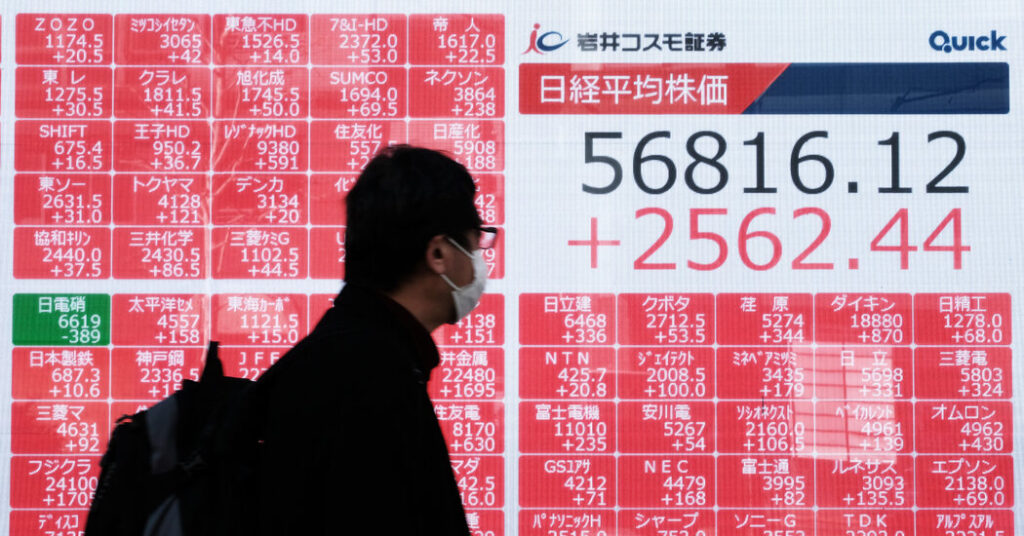
Japanese stocks surged on Monday as investors embraced Sanae Takaichi’s landslide election victory, a result seen as a green light that may further embolden the prime minister to pursue her particular brand of expansionary fiscal policy.
While markets were largely positioned for a Liberal Democratic Party win since Ms. Takaichi’s surprise decision in January to call for an election, Monday’s rally suggests the results were viewed as providing her a significant mandate to accelerate her economic agenda. The benchmark Nikkei 225 soared by nearly 4 percent on Monday, hitting a record high. The broader Topix climbed by more than 2 percent.
Ms. Takaichi is broadly viewed as a boon for corporate Japan because of her long-held backing of low interest rates and robust fiscal spending to stimulate growth. Last year, she pushed through a record supplementary budget and has since advanced plans for large state-led investments in creating “national champions,” companies that are leaders in strategic sectors such as artificial intelligence and semiconductor manufacturing.
What has come to be called the Takaichi Trade essentially bets on higher stock prices and a weakened yen, which benefits Japan’s exporters by making their products more competitive overseas.
On Monday, investors snapped up shares of companies expected to benefit from her spending priorities, including those in the A.I., semiconductor, and defense sectors. Kawasaki Heavy Industries, a defense giant, jumped more than 15 percent, while Advantest, a chip equipment maker, climbed 11.5 percent.
A key question is whether the rally will endure beyond the immediate post-election period. For a sustained rally, investors and analysts say the Takaichi administration must demonstrate that its spending is successfully boosting productivity and the global competitiveness of Japanese firms.
Ms. Takaichi has so far “failed to define what vision she has for the Japanese economy in particular,” Jesper Koll, an investment committee member of the Japan Catalyst Fund, wrote in a recent note. She needs to lay out concrete policies on how she will build upon her predecessors’ efforts to draw more investors to Japanese financial markets and create the national champions she has promised, according to Mr. Koll.
Another central question for Ms. Takaichi’s agenda remains whether her expansionary policies have pushed Japan’s balance sheet too far. Last month, she signaled support for a suspension of certain consumption taxes, and bond yields jumped as investors questioned the government’s ability to fund the strategy.
Yields on Japanese government bonds, which indicate market sentiment about the government’s ability to pay its debts, leapt on Monday. The 10-year bond rate, also a benchmark for long-term interest rates, at one point reached 2.28 percent.
In an interview with the public broadcaster NHK late Sunday, Ms. Takaichi seemed to acknowledge the support for what she called her “proactive fiscal policies,” noting that heading into the vote, she felt she could not proceed with such major shifts without first seeking a mandate from taxpayers.
Asked about plans to reduce consumption taxes, Ms. Takaichi scaled back her rhetoric, avoiding a specific time frame for implementing cuts and saying instead that she would “accelerate deliberations.”
River Akira Davis covers Japan for The Times, including its economy and businesses, and is based in Tokyo.
The post Investors Give an Exuberant Welcome to Takaichi’s Big Win in Japan appeared first on New York Times.