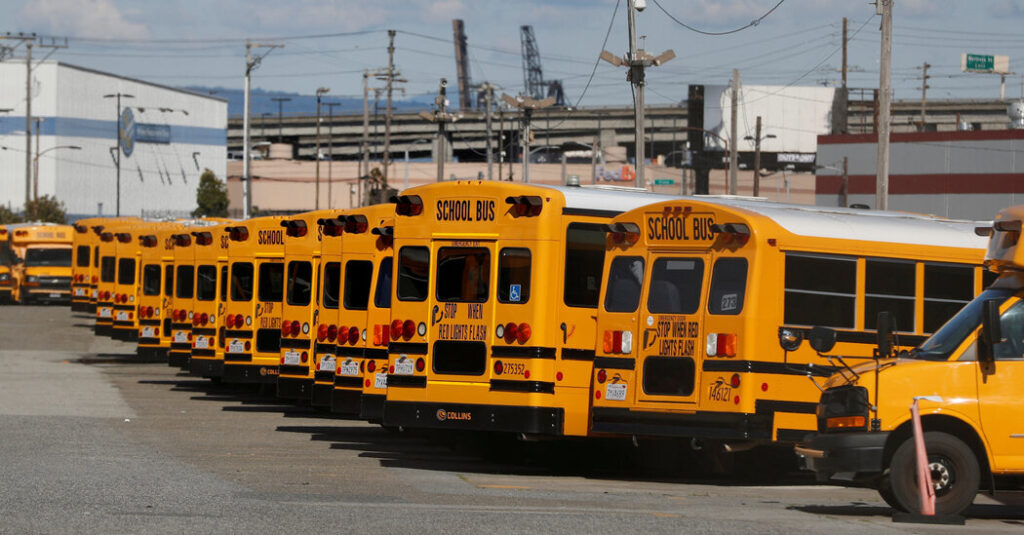
San Francisco teachers went on strike on Monday for the first time in nearly half a century, closing public schools for roughly 50,000 students in the city.
The teachers walked out after their union, United Educators of San Francisco, could not reach an agreement on raises and health care costs despite nearly a year of negotiations with the San Francisco Unified School District. The union represents about 6,000 educators, counselors and nurses who work in more than 100 schools in the city.
The strike has no set end date. The last teachers strike in San Francisco, in 1979, lasted for nearly seven weeks, making it one of the longest in state history.
San Francisco’s closure could be a harbinger in California, as teachers unions have made a concerted effort to pressure districts for more compensation in recent months. Besides the walkout in San Francisco, teachers in Los Angeles, San Diego and two Sacramento-area school districts have authorized strikes as part of their ongoing contract negotiations.
In San Francisco, the local labor union said that rising health care premiums had driven many employees to leave the school district, California’s sixth largest, resulting in vacancies that hurt student instruction.
The union pushed forward with the strike despite a plea from Mayor Daniel Lurie on Sunday to postpone it.
“The affordability crisis for those of us devoted to San Francisco’s next generation is real,” Cassondra Curiel, the president of United Educators of San Francisco, said in a statement. “Enough is enough.”
San Francisco parents said they empathized with teachers struggling to make ends meet in one of the nation’s most expensive cities. But they were frustrated that the two sides couldn’t reach a deal — and that their children would pay the price.
Some said the strike brought back memories of closures during the pandemic. San Francisco Unified had one of the nation’s longest Covid shutdowns, and students did not have full in-person instruction for more than an entire school year.
Autumn Brown Garibay, 40, said that campuses were closed when her daughter, currently in fifth grade, was a kindergartner in 2020.
“She literally looked at me and said, ‘This again?’” said Ms. Brown Garibay, who works in marketing technology and lives in the city’s Mission District. “How long will it last? Just like with Covid, I don’t know, nobody knows.”
The California Teachers Association, the statewide teachers union, launched a campaign last year called “We Can’t Wait” to encourage and support local unions taking more forceful actions in labor negotiations.
David Goldberg, the California Teachers Association president, said that teachers have watched their colleagues win sizable pay increases by going on strike. Teachers in Richmond, Calif., across the bay from San Francisco, negotiated an 8 percent raise over two years after a nearly weeklong strike in December.
“Folks, frankly, are learning from each other,” Mr. Goldberg said in an interview. “It’s something we’ve never done, and it’s a very exciting model for how to really build power in a huge state like ours.”
In San Francisco, health care costs for teachers have been the biggest sticking point. While the district completely pays for individual coverage, a teacher with family health care coverage pays about $1,200 a month. That could soon increase to $1,500 a month, according to the union.
Employers in various sectors have charged more for dependent coverage to offset health care inflation.
“Some of us only ever see half of our paychecks after health care premiums are taken out. This is not acceptable or sustainable,” Teanna Tillery, a member of the union’s bargaining team, said at a press briefing last week announcing the strike.
The union has asked the district to cover all medical premiums for its members and their dependents, as well as provide a 9 percent raise over two years. The district’s most recent offer included a 6 percent raise over two years, as well paying a large portion of family health care costs for three years, using funds from a local tax. After three years, the district could either stop paying the additional coverage or secure funding to extend it.
“This is a win-win proposal,” said Maria Su, district superintendent, at a news conference on Friday.
Ms. Su said that the strike left her with no choice but to close schools. The union that represents 253 district administrators, including principals, launched a sympathy strike as well.
“I know this situation is distressing for families and students,” she said.
Even though California is providing a record amount of funding per student — and its school funding has been above the national average for the last several years — some school districts are still struggling to balance their budgets. Student enrollment continues to decline in California, and districts receive less money overall when they educate fewer students.
Many districts have not been able to close schools because of community and labor opposition, and they have not cut staff in parallel with their loss of students.
At the same time, districts are seeing higher rates of absenteeism than before the pandemic, which further hurts their funding because they receive money based on how many days students attend, said Tony Thurmond, the state superintendent of public instruction.
Mr. Thurmond, an ally of teachers unions, has proposed legislation to change how California funds its schools — to base the formula on the number of students enrolled in a district, rather than the average daily attendance — but, at an estimated cost of more than $3 billion, it has stalled in the legislature.
“Even though California’s legislature and governor have provided a lot of funding to our schools, it’s just proving to not be enough,” said Mr. Thurmond, who is running for governor.
In Southern California, the teachers union in the Los Angeles Unified School District, California’s largest, declared an impasse in contract talks in December, and last month authorized a strike if an agreement could not be reached through mediation.
The union, United Teachers Los Angeles, is seeking to increase starting teacher salaries to $80,000 and asking for smaller classroom sizes in some grades. District officials say that Los Angeles Unified cannot afford the union’s proposal.
Julie Van Winkle, a vice president at United Teachers Los Angeles, said that the coordination was inspired by the 2018 “Red for Ed” movement, in which thousands of teachers in politically conservative states walked off the job to demand higher pay and more school funding.
“The specifics of what San Francisco is fighting for and what we in Los Angeles are fighting for are not completely the same, but there’s a big overlap in that Venn diagram,” Ms. Van Winkle said.
U.T.L.A. teachers went on a sympathy strike in March 2023 when support staff walked out, shutting down schools for three days. The last teachers-only strike in the district was in 2019, when teachers walked out for six days. Before that, the last strike by Los Angeles Unified teachers was in 1989.
In San Francisco, Ryan Alias, a high school English teacher, pays $1,500 per month for health care coverage for his wife and two daughters. That’s a large portion of his annual salary that could otherwise help them buy a house and pay off their student loans, he said, and not have to consider moving to somewhere cheaper.
“This is a life-changing amount of money,” said Mr. Alias, who has been teaching for 12 years. “For my family and many of us, this is a stability issue for this district. We need to know we’re comfortable putting down roots in this district and growing our skills here and continuing to be part of the community.”
Meredith Dodson, executive director of the San Francisco Parents Coalition, said that she believes teachers deserve higher pay and benefits.
But she also worried about lower-income parents who couldn’t afford child care or to take days off work to watch their kids during the strike. Her group, a nonprofit that was formed in 2020, surveyed 700 parents last week and found that nearly a quarter would have to miss work if a strike took place. Many parents were very concerned about disruptions for their children, including learning loss, she said.
Ms. Dodson, who has a second-grader and a fourth-grader, said she was particularly frustrated by what felt like a statewide push for strikes.
“We don’t want to see our district and our students pulled into something that is broader than our local situation,” she said. “Our local situation could be very different from what’s happening in Santa Cruz or L.A. or Monterey or Fresno.”
Soumya Karlamangla is a Times reporter who covers California. She is based in the Bay Area.
The post San Francisco Teachers Walk Out for the First Time Since 1979 appeared first on New York Times.