The Olympic Games have only just begun, but already the athletes of the world owe the host nation a debt of gratitude.
More than a thousand years ago, the people of Italy developed a taste for the dried wheat noodles introduced to the region by Arab traders. Over the next several centuries, the Italians cultivated them into the globally beloved foodstuff known as pasta.
Today, Olympic athletes are among pasta’s most voracious consumers and foremost appreciators, leaning on the carbohydrate-rich staple to fuel their performance goals. Even as the science around nutrition continues to evolve, pasta remains as omnipresent in sports as spandex, as crucial to competitors as any energy drink.
It comes as no surprise, then, that the prospect of carbo-loading this month at a Winter Games in pasta’s spiritual home has left many Olympians’ mouths watering.
“I’m a pasta girl, so I’m hyped,” said Mystique Ro, 31, an American skeleton racer. “Spaghetti is my go-to. Then there’s gnocchi. I’m also a fettuccine person.”
Oh, to be blessed with a hyperactive metabolism and a mandate from your job to eat mountains of fettuccine.
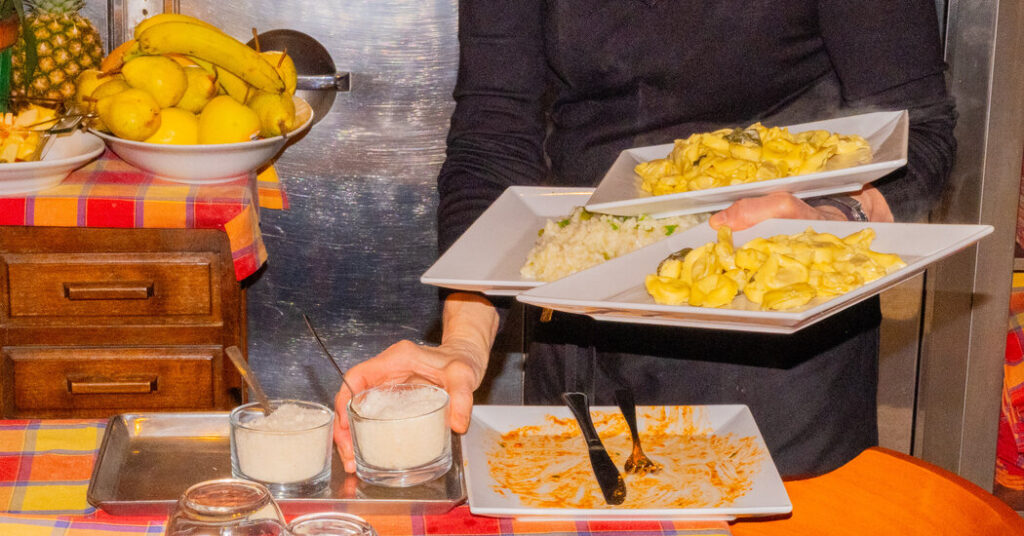
At these Olympics, a whopping 600 kilograms of pasta (or roughly 1,300 pounds) will be served each day across the three cafeterias in the athletes’ villages, according to Elisabetta Salvadori, the head of food and beverage for the Italian Olympic organizing committee.
The International Olympic Committee has unveiled a bespoke pasta shape modeled after the Olympic rings. (Sorry, foodies: The I.O.C. says the pasta is a “limited-edition product not available for sale.”)
Restaurants are leaning into the carbohydrate connection, too: Miscusi, in central Milan, introduced a special pasta dish for the Games (creamy gnocchi with mushrooms, kale and walnuts) and adopted a cheeky motto: “Eat pasta, ski fasta!”
GOAT Pastas
Ask some Olympians about their greatest-of-all-time pastas, and their eyes light up.
Alex Hall, 27, who won a gold medal for the United States four years ago in slopestyle skiing, is one. He relies on pasta to power long training sessions in the mountains, even eating it for breakfast sometimes. He declared the GOAT pastas to be tortellini and farfalle.
“Cook ’em quick,” said Hall, whose mother is from Bologna, Italy. “Keep ’em al dente.”
Long ago, elite athletes consumed large quantities of protein — a huge steak, perhaps — in the immediate run-up to competition. That began to change in the 1960s, when a group of Swedish scientists discovered the efficacy of carbs as fuel source.
Carbo-loading was born, and pasta soon conquered the sports world.
The tennis star Roger Federer ate pasta with light tomato sauce two hours before just about every match of his career. The Boston Marathon used to host a pre-race pasta dinner at City Hall, while the New York City Marathon held one for years at Tavern on the Green in Central Park.
This month, St. Joseph Catholic Church in Hayward, Wis., will host its annual “spaghetti feed,” inaugurated in 1982, for participants in the American Birkebeiner, the largest cross-country skiing race in North America.
“People come back for seconds and thirds,” said Mary Roles, 74, a volunteer, who helped cook 95 pounds of dry pasta for 468 people last year. “Everybody leaves happy.”
Pre-race pasta has also become a punchline: In an episode of NBC’s “The Office,” Michael Scott unwisely inhales a heaping takeout container of fettuccine Alfredo before a five-kilometer charity run.
For elite athletes, the all-out carbo-loading of decades past has made way in recent years for a more nuanced approach, said Hunter Baum, a dietitian for the U.S. ski and snowboard team, one that might be called “carbo focusing.”
“Now, it’s more based on evidence, practice and research: How do we target and time it better and more strategically?” Mr. Baum said.
Disappointed Chefs
With hordes of athletes descending on northern Italy, Olympic organizers took a “food-as-fuel” approach to the dining facilities. Part of this meant coming to terms with the fact that many top competitors prefer plain pasta with a smidgen of sauce on the side — borderline blasphemy, like a cappuccino in the afternoon, in a nation of opinionated Epicureans.
“This is surprising, from an Italian point of view,” said Ms. Salvadori, trying to sound diplomatic. She had to break this news to the local caterers for the athletes’ villages who had expected to showcase their cooking chops.
“They were a bit upset, to be honest,” she said.
Athletes can still find traditional, heartier preparations — lasagna, cacio e pepe, various ravioli — in the cafeterias, she said. Risotto and polenta, staple dishes of the Games’ hubs, Milan and Cortina d’Ampezzo, are well represented, too.
Besides, the worldwide appeal of pasta — and the basis of its popularity for athletes — may be in its adaptability.
“It’s like a canvas on which you can express your own culture, your own taste, your own preferences,” said Fabio Parasecoli, a professor of food studies at New York University. “For Italians, there are specific rules. But once the canvas is exported, it’s a free-for-all, in a way.”
The recent history of pasta at the Olympics, it must be noted, is not all appetizing.
Resi Stiegler, an American who competed in Alpine skiing at the 2006 Games in Turin, Italy, panned the pasta served in the athletes’ village there as “horrible.”
Michael Phelps, the most decorated Olympian in history, told reporters at the 2016 Summer Games in Rio de Janeiro that he had gritted his teeth through “a pound of spaghetti” as part of his post-pool recovery routine.
“And I’m not a spaghetti fan,” he said. “I forced myself to eat it.”
An Olympic Test of Willpower
There are, of course, other delicious ways for athletes to get their carbs. At the Summer Games two years ago in Paris, Kenyan competitors brought ugali, a doughy cornmeal staple. The Irish came with caseloads of porridge.
“We eat a lot of pho,” said Chris Plys, 38, an American curler.
But pasta is king.
Derek Parra, an American speedskater who won two medals at the 2002 Games, fondly recalls a visit to Padua, Italy, in 1996 for the Inline Speed Skating World Championships. The night before his first event, he visited a local restaurant and sampled some tortellini carbonara.
“The next day, I won a gold medal,” he said, laughing, “and so I went back every night.”
Jake Adicoff, 30, a Paralympic cross-country skier from the United States, recalled taking a cooking class as a child while vacationing with his family in Italy. They learned to make pasta e ceci, a chickpea stew, and he now whips it up with ditalini (a short, tubular pasta) for his teammates.
“It’s got plenty of vegetables, protein and carbs, and it’s pretty easy to make,” he said. “It’s a great winter dish.”
With all this delicious starch around, some athlete gourmands may have to exhibit willpower in Italy.
Jason Brown, an American figure skater, is such an aficionado of Italian food that he diverted a family trip to Greece last summer to Rome for a daylong eating extravaganza. The itinerary included a stop at Ristorante Pietro Valentini, whose truffle gnocchi, he said, was “to die for.”
Brown, 31, plans to control himself during these Games. In the midst of competition, he prefers homemade smoothies prepared with a blender he packs in his luggage.
But when his events are over, he said, laughing, “I carbo-load like crazy.”
Andrew Keh covers New York City and the surrounding region for The Times.
The post Olympians Love Pasta. They’re in the Right Place. appeared first on New York Times.