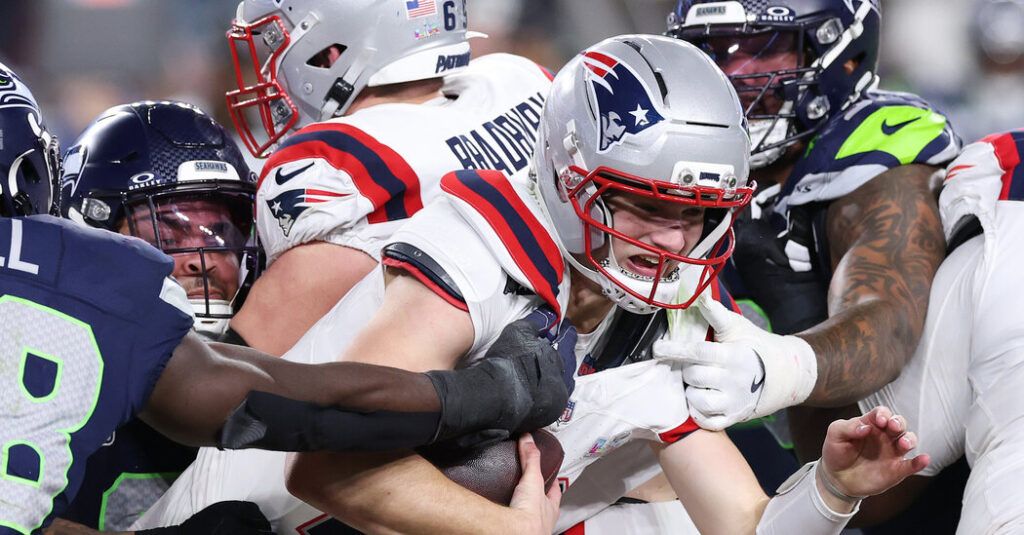
On Sunday, the Seattle Seahawks defeated the New England Patriots 29-13 in Super Bowl LX.
Were you watching?
If so, what was your favorite part? The game itself? Bad Bunny’s halftime show? The million-dollar advertisements? Or, the maybe the snacks you ate with friends or family?
In The Athletic article “Seahawks Bully Drake Maye, Patriots On Way To Dominant Super Bowl 60 Win,” Matt Barrows writes:
SANTA CLARA, Calif. — The bullies are back.
The Seattle Seahawks, who rode a dominant defense to their first Super Bowl title 12 years ago, did it again Sunday, suffocating Drake Maye and the New England Patriots in a decidedly defensive 29-13 win at Levi’s Stadium.
Egged on by a raucous, pro-Seattle crowd, the Seahawks sacked Maye six times and picked him off twice, one of which was returned 45 yards for a touchdown by defensive lineman Uchenna Nwosu. The Patriots did not score until the fourth quarter, and Seattle also forced a fumble.
In praising his players, coach Mike Macdonald had to shout to be heard above the din of the fans who gathered in the southeast corner of the stadium.
“They made it happen,” he said of the dream of reaching the Super Bowl win. “They made it come to life. And we won the game.”
In “Bad Bunny Delivers a Love Letter to Puerto Rico at Super Bowl Halftime,” Jon Pareles, Ben Sisario and Lindsay Zoladz write about the much anticipated halftime show:
Would he be political? Would he stick to the hits? And would Lady Gaga — or Ricky Martin — make an appearance?
In the end, Bad Bunny managed to hit all those notes at his halftime performance, walking out in a beige football jersey labeled “OCASIO” (after his full name, Benito Antonio Martínez Ocasio) and the number 64, and leading a show that featured a joyful celebration of Latin heritage, before he spiked a football in triumph.
His performance included Lady Gaga doing a salsa-style version of her streaming smash with Bruno Mars, “Die With a Smile” (in English), and later Ricky Martin — who arguably began the crossover process for modern Latin pop that led to Bad Bunny — performing Bad Bunny’s track “Lo Que le Pasó a Hawaii.” (Both stars had been cited by online bettors in the run-up to the show, with decent odds.)
Featuring a sugar cane field, a wedding seemingly officiated onstage, a New York-style street scene complete with a bodega and a pan-American parade, the show spanned country and city, family and hemisphere, work and play and dancing everywhere. It placed Bad Bunny’s beloved Puerto Rico at the center of a communal celebration, where vintage salsa and traditional bomba and plena easily segued out of reggaeton and dembow. The sounds were mostly organic, not electronic: a brassy salsa band, a white-clad band of plena percussionists. Bad Bunny was summoning a Latin heritage across generations, one that recognized hard work — cane-cutting, electric-grid repairs — alongside the good times workers sweated to earn.
And, on those expensive advertisements, Mike Hale writes in “The Super Bowl Ads (So Far), Ranked”:
What do the 2026 Super Bowl ads tell us? That we obsess over our weight while guzzling beer and soda, downing potato chips and ordering food delivery from our couches? We already knew that.
What’s new this year is the onslaught of commercials trying to convince us that artificial intelligence is going to change our lives, with more than a dozen ads for A.I. chatbots or other A.I.-based services. But, aware of the fear A.I. inspires in many people, the ads mostly offer to change our lives in small, unthreatening ways.
Students, read one or more of the articles above, and then tell us:
-
Did you watch the Seattle Seahawks defeat the New England Patriots in Super Bowl LX? If so, what was your reaction? Who were you rooting for? Did you enjoy the decidedly defensive 29-13 win? Or was it mostly forgettable?
-
If you didn’t watch, how did you spend your Super Bowl Sunday instead?
-
Did you catch the halftime show? Were you already a Bad Bunny fan? What specific aspects — whether the music, the staging, the dancing, the costumes, the symbolism or anything else — were most or least successful, in your opinion? Why?
-
What did you think of the commercials this year? Which were your favorites and least favorites? Why? Did you agree with the ranking of ads by the Times TV critic?
-
Whether you are a football fan or not, why do you think the Super Bowl is such a big deal in American culture? Is it more than just a game? What do you think it means culturally, and why?
Students 13 and older in the United States and Britain, and 16 and older elsewhere, are invited to comment. All comments are moderated by the Learning Network staff, but please keep in mind that once your comment is accepted, it will be made public and may appear in print.
Find more Student Opinion questions here. Teachers, check out this guide to learn how you can incorporate these prompts into your classroom.
Jeremy Engle is an editor of The Learning Network who worked in teaching for more than 20 years before joining The Times.
The post What’s Your Reaction to Super Bowl LX? appeared first on New York Times.