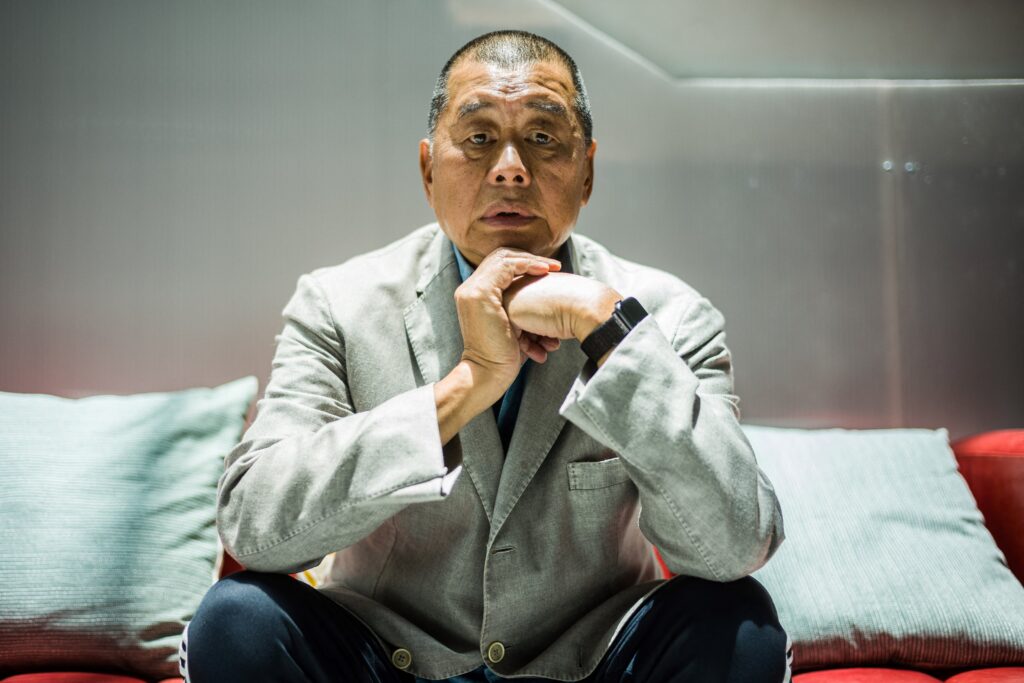
Hong Kong newspaper founder Jimmy Lai, a leading figure in the city’s pro-democracy movement and an ardent critic of the Chinese Communist Party, was sentenced Monday to 20 years in prison after being found guilty in December of sedition and collusion with foreign forces.
The heavy sentence means that Lai, 78, who is a British citizen, could spend the rest of his life imprisoned as a martyr-like figure, exemplifying the price nonviolent dissidents are paying for their activism in the once-freewheeling city. Lai’s family and some supporters still hold out hope that Washington or London might secure his release through diplomatic negotiations.
The sentence was not a surprise as Beijing has sought to wipe out the city’s few remaining press freedoms and judicial independence. It is the longest sentence ever in a national security case in Hong Kong.
“Today, the curtain falls on press freedom in Hong Kong,” said Thibaut Bruttin, director general of Reporters Without Borders, in a statement after Lai’s sentencing. “This court decision underscores the complete collapse of press freedom in Hong Kong and the authorities’ profound contempt for independent journalism.”
“The prosecution of Jimmy Lai has been from the outset a perversion of the rule of law in Hong Kong, with the outcome predetermined,” said James Cunningham, former U.S. consul general to Hong Kong and chairman of the Committee for Freedom in Hong Kong Foundation, a U.S.-based advocacy group focused on human rights. “Today’s sentence risks being a death sentence.”
In convicting Lai of three charges, the three government-approved judges declared there was “indisputable evidence” that he conspired to undermine national security. His “only intent” was to seek the downfall of the Chinese Communist Party, one judge said.
Lai was accused of using his Apple Daily media outlet to call for sanctions on Hong Kong and Chinese officials as punishment for cracking down on pro-democracy demonstrations in 2019. He was also accused of financing international campaigns to garner support for such sanctions.
Authorities in Beijing and Hong Kong have cast Lai as a sinister force behind the demonstrations, which sprung from a grassroots protest movement and did not have clear leadership.
Much of the case against Lai hinged on his efforts to lobby governments in Taiwan, Britain, Japan and the United States to impose “sanctions, blockades or hostile activities” against Hong Kong after the city’s national security law took effect in June 2020.
That law loosely defined terms including “inciting subversion” and “collusion” and allowed sentences of life in prison.
In the intervening years, media outlets and civil organizations have been disbanded, and critics of the government have gone silent. Now, almost every prominent opposition figure in Hong Kong is either in jail or in exile.
When he was convicted, press watchdogs, human rights groups and Lai’s family decried the decision as confirmation of the city’s eroding freedoms and the judiciary’s willingness to comply with Beijing’s broader agenda — as well as a stern warning to others calling for democracy.
“To date, the trial can only be described as a sham and bears no relation to the rule of law,” said Aleksandra Bielakowska, the advocacy manager for Reporters Without Borders’ Asia-Pacific bureau. “Given his worsening health, urgent international pressure is more important than ever.”
Lai has been held in detention since December 2020, almost all of it in solitary confinement, which his family said had taken a heavy toll on his health.
Lai’s family and international lawyers have focused their attention over the past year on lobbying Washington and London to secure his release through diplomatic negotiations with Beijing.
President Donald Trump, who had said he would “100 percent” get Lai out of jail, raised concerns about his case with Chinese leader Xi Jinping during their first face-to-face meeting of Trump’s second term, held in South Korea in October, according to a report by Reuters.
But analysts say Trump is loath to jeopardize his April meeting with Xi in Beijing or his efforts to strike a trade deal that he could call a win against the world’s second-biggest economy ahead of midterm congressional elections in November.
Lai’s sentence is even harsher than the 11-year sentence handed down to Liu Xiaobo, a Chinese dissident, in 2009 for subversion.
Liu, until Lai, was China’s most prominent political prisoner and was awarded the Nobel Peace Prize in 2010. He died in police custody in 2017, after being granted medical parole when he was diagnosed with liver cancer.
Bruttin of Reporters Without Borders said in the statement that democracies “must stop prioritising the normalisation of relations with China and instead exert pressure on the Chinese regime and Hong Kong authorities” to ensure the release of Lai and other journalists from prison. “His sentence must not become a death sentence,” Bruttin said.
Sammy Westfall contributed to this report.
The post Hong Kong democracy champion Jimmy Lai sentenced to 20 years in prison appeared first on Washington Post.