A ray of hope is emerging in American education.
Not among Democrats or Republicans, each diverted by culture wars. Not in the education reform movement, largely abandoned by the philanthropists who once propelled it. Not in most schools across the country, still struggling with chronic absenteeism and a decade of faltering test scores.
Rather, hope emerges in the most unlikely of places: three states here in the Deep South that long represented America’s educational basement. These states — Alabama, Louisiana and Mississippi — have histories of child poverty, racism and dismal educational outcomes, and they continue to spend less than most other states on public schools.
Yet, consider:
-
Louisiana ranks No. 1 in the country in recovery from pandemic losses in reading, while Alabama ranks No. 1 in math recovery.
-
The state with the lowest chronic absenteeism in schools is Alabama, according to a tracker with data from 40 states.
-
Once an educational laughingstock, Mississippi now ranks ninth in the country in fourth-grade reading levels — and after adjusting for demographics such as poverty and race, Mississippi ranks No. 1, while Louisiana ranks No. 2, according to calculations by the Urban Institute. Using the same demographic adjustment, Mississippi also ranks No. 1 in America in both fourth-grade and eighth-grade math.
-
Black fourth graders in Mississippi are on average better readers than those in Massachusetts, which is often thought to have the best public school system in the country (and one that spends twice as much per pupil).
I wrote about Mississippi’s educational successes in 2023, but many of my fellow liberals then scoffed at the notion of learning from a state so tainted. Skeptics, mostly on the left, have made many critiques of the gains, including that they fade in upper grades, that the states are cheating, that this is all a temporary blip and that any progress is simply a result of holding back weak readers.
The critiques have been effectively rebutted — for starters, they can’t explain the continuing gains in Mississippi or the magnitude of the gains. Just as striking, the Mississippi gains increasingly are being replicated in Alabama and Louisiana, as they follow similar approaches. That’s enormously encouraging, for it suggests that other states can also lift student trajectories if they are willing to learn from Southern red states they may be more accustomed to looking down on.
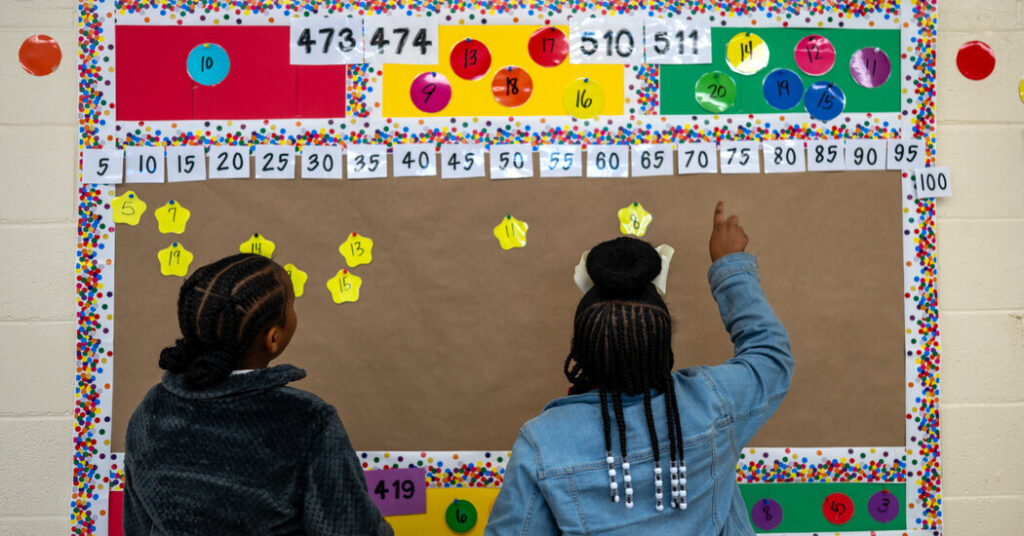
So I traveled through Mississippi and Alabama with the photographer Lynsey Addario to understand the lessons to be learned. Perhaps the most important is an insistence on metrics, accountability and mastery of reading by the end of third grade. And while reading gets the attention, just as important is getting kids to attend school regularly.
Even in the 2023-24 school year, well past the pandemic, some 23 percent of American schoolchildren were chronically absent — and “they can’t learn if they’re not in the classroom,” Patrick Sutton, superintendent of Marion County Schools in Alabama, told me when I visited his schools.
In classrooms and offices, teachers and administrators frequently mentioned the motivating power of report cards — not the letter grades given out by schools, but those they receive. Alabama gives its schools report cards, based in part on student performance and attendance, with grades that are widely noted in local communities, and these are one more reason to track down missing children.
Schools in Alabama respond firmly when a pupil doesn’t show up. After three unexcused absences, the school suggests a meeting with the parents. After five unexcused absences, school district officials summon parents and warn that they face legal risks if the truancy continues. At seven unexcused absences, the school may refer the parents to the juvenile court.
This can lead to a court appearance before a judge. “They could actually put the parent in jail,” Sutton said, although this seems to be more of a threat than a practice.
The Marion County district is a mining and manufacturing area that lost many jobs, and it wrestles with poverty and addiction. Yet even so, the district slashed chronic absenteeism to 11 percent in the last school year.
When I visited schools in another high-poverty area, Jasper, Ala., I got a glimpse of how officials track down truants. A high school senior had recently stopped attending classes after he quarreled with his mother and ran off; nobody seemed to know where he was. So school officials leaned on a buddy of his and were able to geolocate the missing senior on Snapchat: He had taken refuge at the home of a girlfriend 15 miles away.
“We’re going to get him back,” Jonathan Allen, an assistant superintendent, told me confidently. He noted that the school uses every tool available. When students are embarrassed to go to school because of bad hair or teeth, teachers try to find them free haircuts or dental care — whatever it takes.
What I see is schools fighting for their students. These states have created a structure that closely monitors each school’s performance and incentivizes principals and teachers alike to do everything they can to get kids back in class and learning.
The same incentives push up the region’s high school graduation rates, which are high by national standards — especially considering the high rates of poverty and low levels of parental education.
In Mississippi, where the four-year high school graduation rate is now 89 percent, the State Department of Education each year must approve a “dropout prevention plan” from each school district. The state education department “office of accountability” publishes lists that shame the 10 school districts with the lowest graduation rates.
What does that kind of accountability mean at the grass roots? In impoverished Leland, Miss., in a high school that is almost entirely made up of low-income Black students, I met Tahitianna McCoy, a sophomore who had just taken a $12-an-hour job working 5 p.m. to 5 a.m., Monday through Friday, at a warehouse.
The family needs the money to pay rent and buy food, she said.
Tahitianna would be the first in her family to graduate from high school, but it’s hard to see how she can graduate if she studies by day and works all night.
So her school district’s 11-person “dropout prevention team” has swung into action. Sometimes the team browbeats employers to offer work schedules compatible with class (or sleep), or it may arrange for students to take some classes online. When I visited, the school was optimistic that it could work something out so Tahitianna could stay in school.
Measurement and metrics are particularly evident in strategies to get children to read by the end of third grade.
In Hollandale in the Mississippi Delta, one of the poorest parts of the country, I met Dyhlan Wooten, an 8-year-old girl in a school where Black students make up 98 percent of the enrollment. At the beginning of third grade this school year, Dyhlan read at only a first-grade level.
So Dyhlan is pulled out of class along with other lagging readers every day for small-group tutoring in reading. Each child is tested weekly, with scores posted in a green, yellow or red zone, indicating how likely it is that they will pass a big reading test in the spring. (The charts identify pupils by a number, not by name.)
That test is a milestone, for in 2013, Mississippi adopted a third-grade gate — meaning that all third graders must pass a reading test to advance to fourth grade. The state then set up a system to monitor all students beginning in kindergarten to help get them on track to pass the test. Mississippi also revamped its curriculum, invested in pre-K and set up a system to coach teachers to improve their skills.
Dyhlan is determined to learn to read so she can pass the test. Her family is helping her. The teachers want to ensure that all of their children pass. And the principal and superintendent are desperate for Dyhlan and the others to read; children’s ability to read figures significantly into the grade the school gets from the state.
Hollandale’s school district now has a B on its state report card, with a detailed assessment made public and creating accountability in the community. The school report cards light a fire under everyone: It turns out that superintendents will work at least as hard for an A as a student will.
So instead of feeling lost, Dyhlan sees the entire school and community obsessed with helping her read. She’s now in yellow territory. The next week, she told me confidently, she’d be in the green zone.
Mississippi children who lag or miss school days in some cases are pushed to attend after-school sessions or Saturday school. And if they fail the reading test twice, they are pressed to attend summer school and will get one final chance to pass before fourth grade begins. If they fail that last chance, they normally must repeat third grade.
Mississippi’s early reforms focused on reading, but math scores rose as well: Perhaps when students can read, they enjoy school more and so thrive in other subjects as well.
For anyone familiar with civil rights history, national testing results are astonishing. A Black Mississippi child is two and a half times as likely to be proficient in reading by fourth grade as a Black California child.
Likewise, low-income children are more likely to test proficient in reading in Mississippi or Louisiana than in California, Massachusetts or New York. A low-income fourth grader is almost twice as likely to test proficient at math in Mississippi as in Oregon.
For many years, skeptics have offered dispiriting arguments about the prospects for educational gains: The way to improve literacy is to fix the family, fix addiction, fix the parents, for as long as the child’s environment is broken, there’s not much else that can be done.
The gains in these states suggest that that critique is wrong. Mississippi and Alabama haven’t fixed child poverty, trauma and deeply troubled communities — but they have figured out how to get kids to read by the end of third grade.
This matters in myriad ways: One recent study found that states with large increases in school test scores enjoyed rising incomes and drops in teen motherhood, incarceration and arrest rates compared with states that didn’t enjoy such gains.
What’s particularly impressive is that the Southern surge states lifted student achievement with only modest budgets. Spending per pupil in Alabama and Mississippi was below $12,000 in 2024, while in New York it was almost $30,000.
That’s worth celebrating and emulating. Yet, unfortunately, there’s not much sign of that.
It’s not just that Democrats are skeptical that there’s anything significant to learn from red states. It’s also that Republican leaders themselves seem strangely indifferent.
Indeed, instead of trumpeting the gains in three red states and doubling down on successful policies, Republicans even in these states are pushing hard for more vouchers (which have a mixed record at best) so that children can flee the improving public school systems — thus threatening the very progress they should be proud of. Rather than trying to scale Mississippi’s gains, national Republicans have an education agenda that focuses on trans children and school bathrooms, demolition of the federal Department of Education and erasure of ugly bits of history. There are many culture war arguments about what books are in the school library, but not enough talk about how to help children read what’s on the shelf.
A common thread in Mississippi, Alabama and Louisiana has been strong educational leadership, which in turn is able to impose a coherent strategy statewide. This includes “science of reading” curriculums, teacher coaching, measurement of student performance and accountability at all levels. In these states, everyone is rowing together; in Northern school systems, in contrast, there may be more oars but these often are pulling in different directions.
Mississippi became a leader partly because Jim Barksdale, the former C.E.O. of Netscape, was a native Mississippian embarrassed by his state’s reputation — so beginning in 2000 he undertook a big push to improve the state’s schools. That led Mississippi to recruit Carey Wright, an education executive in Washington, D.C., to run the state’s schools; she did a superb job before leaving in 2022. She now runs schools in her home state, Maryland.
In Alabama the drive is led by Eric Mackey, a onetime science teacher who has done an outstanding job leading his state’s schools since 2018. In Louisiana, John White led schools from 2012 to 2020 with a firm hand.
Wright, White and Mackey provided rigorous leadership and emphasized measurement and metrics. It was easier to undertake these reforms in states like Mississippi that lacked strong teacher unions, but in any case, Wright and the others do not radiate the disdain for teachers or unions that one sometimes sees in education reform circles.
“We’re not trying to push teachers out,” Mackey told me. “We already have a teacher shortage. We’re trying to take the teachers we have and upskill them.”
Douglas N. Harris, an economist and education expert at Tulane University, said that the three states’ success is based in large part on demanding accountability and raising expectations. “Expectations for students, teachers and schools are central,” he said.
“The debate in education is often framed as a tension between excellence and equity,” Harris added. “I reject that. The system already has lower expectations for disadvantaged students. We need high expectations and standards to give them a better chance.”
In retrospect, I’m afraid that in some parts of the country — particularly blue states — we succumbed to the idea of lowering standards in hopes of improving equity. With warm and fuzzy hopes of reducing race gaps, for example, Oregon reduced graduation requirements and San Francisco for a time stopped teaching algebra to eighth graders. Some schools embraced “equitable grading” practices such as refusing to give zeros, ending penalties for turning in assignments late and allowing repeated retakes of tests.
These strike me as examples of what President George W. Bush called the “soft bigotry of low expectations.”
Our liberal leniency went off the rails in other ways, including grade inflation and a general coddling of students: Recent cohorts of high school students have simultaneously had rising G.P.A.s and falling A.C.T. scores, and at Harvard, 60 percent of grades in the last academic year were A’s. Colleges have accepted dubious claims of disability so that students can, for example, get extra time for tests. The Atlantic reports that 38 percent of Stanford undergraduates are registered as having a disability.
The University of California San Diego reported a surge in the number of freshmen who hadn’t even mastered middle school math — even though more than a quarter of them had high school math G.P.A.s of 4.0.
The Southern surge states take an approach that is closer to the opposite. Disadvantaged students get extra help but are pushed to succeed on the same terms as everyone else, for that is what the adult job market will demand.
“There’s no excuses, right?” said Mary Kennedy, an elementary school principal in Hackleburg, Ala. I heard that repeatedly. Sutton, the Marion County school superintendent, told me that the “secret sauce” behind the Southern surge is quite simply “no excuses.”
“We no longer accept that our kids can’t compete with anybody in the world,” he added.
Here’s another way of looking at the issue: From 1990 until about 2015, test outcomes for American K-12 students generally improved, and then they began to slide. So what went wrong in 2015? Much of the answer may be screens, social media and then the pandemic, but another may be a national erosion of accountability in education. It was in 2015, after all, that the No Child Left Behind law was dropped, and states began to put less emphasis on testing and outcomes — except in a few places like Mississippi.
The gains in Alabama, Louisiana and Mississippi are often called the Southern surge, but that’s a bit of a misnomer. It’s really those three states, not the South as a whole. Florida’s fourth-grade reading scores have dropped since 2017. So have those in Arkansas, Georgia and North Carolina.
Thomas Kane, an education expert at Harvard, believes that the national gloom about education is overdone, partly because the three out-performers show what is possible, just as earlier periods of improvement in Massachusetts, Florida and Tennessee underscored the power of evidence-based policies and meticulous execution.
“States around the country have a lot to learn from what Mississippi, Alabama and Louisiana are doing,” he said.
We liberals need to wake up to the reality that we are being outperformed on education, opportunity and racial equity — supposedly our issues. As recently as 2019, blue states had better average test scores than red states, after adjusting for demographics; now, red states are mostly ahead. We used to say that education was the civil rights issue of the 21st century, and if so, we should be ashamed that by that metric, Mississippi Republicans are ahead of California Democrats. If we care about kids, we must be relentlessly empirical, and that must mean a willingness to learn from red states.
Kane said something you don’t expect to hear from a Harvard professor: “I hope that there are lots of governors that are looking at Mississippi and saying, ‘Look, I want us to be next.’”
The Times is committed to publishing a diversity of letters to the editor. We’d like to hear what you think about this or any of our articles. Here are some tips. And here’s our email: [email protected].
Follow the New York Times Opinion section on Facebook, Instagram, TikTok, Bluesky, WhatsApp and Threads.
The post These Three Red States Are the Best Hope in Schooling appeared first on New York Times.