Of the many questions posed by those gathered in U.S. District Judge Richard Leon’s courtroom last week, the most obvious one of all never came up: Why on earth was anyone here in the first place?
Until now, the military has pursued only a tiny number of criminal cases against retirees for actions that occur after military service has ended. Until now, the idea that the secretary of defense would accuse a lawmaker of treason simply for disagreeing with him would be laughable. Until now, any free-speech debates concerning sitting members of Congress have led to the conclusion that lawmakers ought to have—to borrow from former Chief Justice Earl Warren—the widest possible latitude to express themselves.
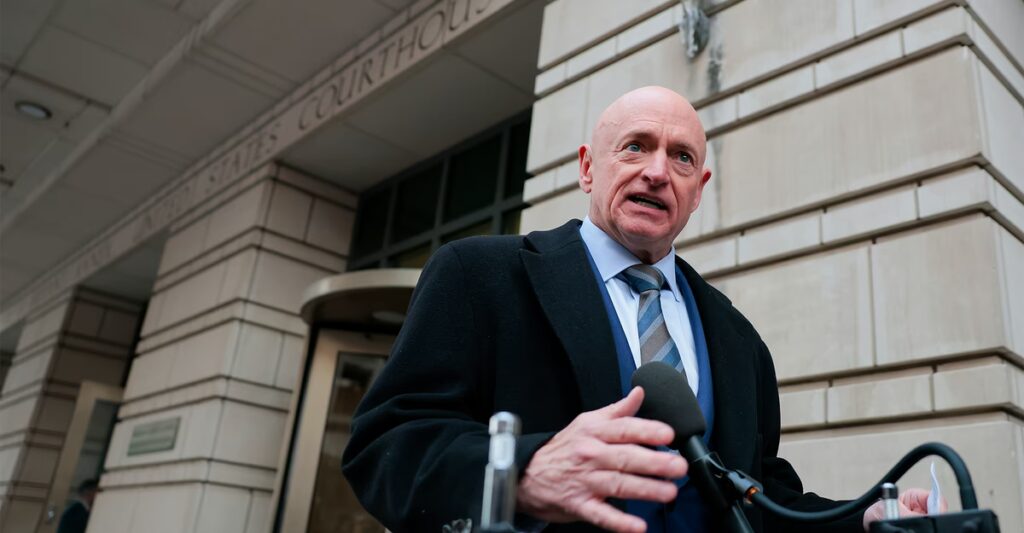
And yet there we all were anyway, gathered to see Mark Kelly—the fighter pilot turned astronaut turned U.S. senator—defend his First Amendment rights against an attempt by the Pentagon chief, Pete Hegseth, to silence him and knock down his military retirement rank and pay.
As someone who’s covered 10 secretaries of defense, I’ve never seen anything like what Hegseth is doing—not even close. If Hegseth gets his way, he won’t just be punishing Kelly; he will succeed in dramatically curbing the First Amendment rights of all military retirees, some of the very people who have fought to defend such freedoms.
At the heart of the case is a November video in which Kelly and five other Democratic lawmakers—all veterans of the military or intelligence agencies—address U.S. troops, reminding them that they “can and must refuse illegal orders.” Their goal with the video was to push back against the president’s domestic troop deployments, a trend his critics feared might lead to clashes with ordinary Americans or be used to interfere in upcoming elections. At the time the video was posted, Democrats were also assailing the administration over the legality of its air campaign against suspected Latin American drug boats. The lawmakers did not specify which problematic orders they had in mind.
[Read: ‘An example MUST BE SET’]
The Trump administration’s response was swift. Adviser Stephen Miller called the video an attempted “insurrection.” Donald Trump declared that the “traitors to our Country should be ARRESTED AND PUT ON TRIAL,” and reposted suggestions that they be hanged. Hegseth ordered the Navyto look into Kelly’s “potentially unlawful” comments, something he was able to do because Kelly is the only one in the video who receives benefits as a military retiree. (Although some 18 million military veterans are living in the U.S., according to the Pew Research Center, a much smaller share of those people reach retirement status.) Kelly now receives lifelong retirement pay and is subject to rules, including the Uniform Code of Military Justice. In early January, Hegseth issued Kelly a letter of censure over his “seditious statements and his pattern of reckless misconduct,” which, Hegseth said, had harmed military discipline and undermined the chain of command. He also asked Navy Secretary John Phelan (a Republican donor and billionaire art collector with no naval experience) to begin a review of Kelly’s retirement rank and pay.
The Trump administration’s attempts to go after Kelly are, several legal experts told me, straightforwardly outrageous and without merit. But even if the judge rules in Kelly’s favor, it’s worth paying attention to this fight, because it underscores the degree to which the Trump administration is seeking to expand executive power in novel ways. Far more is at stake than the retirement benefits of one man.
The U.S. military has sought legal action against its own retirees only in a rare few cases—and those cases have typically involved egregious crimes, such as sexual assault. And although the military can prosecute sitting service members for prohibited speech—to make sure troops stay in line and follow orders, the military has strict rules prohibiting them from insulting public officials or making statements that undermine “good order and discipline”—several former military lawyers told me that no cases have previously been brought against a military retiree for something said after they hung up their uniform. “It’s important for the public to understand the extraordinary power that the administration is asking the courts to bless,” Ryan Goodman, a former Pentagon lawyer who teaches at the NYU School of Law, told me.
If the government prevails against Kelly, it will establish a precedent for punishing retirees for statements perceived as out of line by whoever is in charge at the time. (The Trump administration denies that this case has any First Amendment issues to consider, saying that even as a retiree, Kelly has no right to undermine military discipline by encouraging others to question orders.)
Even before the Kelly episode, I had heard from numerous veterans about the chilling effect that Hegseth has had. The defense secretary—who insists on being called the “war secretary”—has used social media and speeches to vilify opponents, including former service members. Those who have worn the uniform are now less likely to criticize the administration’s policy or personnel moves, because they fear for their benefits or worry about getting in hot water with current employers skittish about backlash from the administration.
[Read: Hegseth is seriously testing Trump’s ‘no scalps’ rule]
During his first term, Trump mused about bringing senior officers whom he disliked, including Stanley McChrystal and William McRaven, back onto active duty and court-martialing them, but Pentagon officials talked him out of it, former Defense Secretary Mark Esper wrote in his memoir. Trump once insinuated that retired General Mark Milley, who served as his second chairman of the Joint Chiefs of Staff, should be executed. Shortly after taking office, Hegseth stripped Milley of his security detail.
Expanding the military’s ability to control veterans’ speech would be a major and historic reversal of basic freedoms. Retired service members turned public officials have a long history of criticizing Pentagon leaders in ways those leaders might find objectionable. Dwight D. Eisenhower famously warned Americans about the corruption that would come from the unchecked growth of the military-industrial complex, focusing on the power of the people in mitigating “the potential for the disastrous rise of misplaced power” that would “endanger our liberties or democratic processes.” John F. Kennedy beat back the A bomb–loving generals he believed were as dangerous as Nikita Khrushchev. Veterans have often been some of the harshest (and most clear-eyed) analysts of the military’s shortcomings.
I was thinking about this history as I watched Kelly stand at attention when Judge Leon entered the courtroom on Tuesday, a combat veteran who was doing just as new recruits are taught: holding his spine ramrod straight, fists curled back, thumbs aligned with the seam of the pants.
Leon, who kept his eyebrows positioned in a skeptical V for much of the hearing, seemed to be focused on that history too. How are veterans on Congress’s Armed Services Committees, he asked, supposed to do their job if they can’t criticize the military without fear of prosecution? Leon was visibly wary of the government’s arguments, at times tipping into what appeared to be barely contained bewilderment. At one point, when the Justice Department attorney John Bailey conceded that there were “a few unique things” about the government’s First Amendment–related claims, Leon barked back, “You think?”
Dan Maurer, a former Army lawyer and combat engineer, told me that Hegseth’s decision to pursue administrative disciplinary steps against Kelly—rather than an attempt to court-martial him—was likely because a trial would leave Kelly’s fate to a military jury. When I asked whether such a jury would convict Kelly, he laughed dismissively. “Absolutely not,” he said. Maurer, who teaches law at Ohio Northern University, said he believes that the administration’s objective is more about demonstrating punitive action and appealing to the base than winning in court. “They don’t care what the courts say, because they’re going to depict them as liberal, woke courts,” he said. (Judge Leon was appointed by George W. Bush.)
Tim Parlatore, Hegseth’s personal lawyer who now serves as an adviser in his office, suggested that the Pentagon might not pursue a criminal case against Kelly, because doing so would require him to be called back to active duty in the executive branch. This would effectively remove Kelly from his Senate seat and force litigation. “The Constitution prohibits somebody from holding office in two branches at the same time,” he told the Trump ally and Joseph McCarthy enthusiast Laura Loomer in December.
This brings up a second way that Hegseth’s orders would expand Pentagon leaders’ powers over military retirees. According to Maurer, who signed a letter from a group of retired military lawyers expressing concern about the actions against Kelly, the administrative procedure for reviewing and possibly reducing a retiree’s rank and pay has never been understood to apply to actions that occur after retirement.
[Read: Hundreds of generals try to keep a straight face]
Hegseth, who did not attend the hearing, has long expressed his disdain for the military justice system, advocating for lenient treatment of troops convicted of war crimes and deriding judge advocate generals, or JAGs, as pencil-necked “jagoffs.” The Pentagon spokesperson Kingsley Wilson said in an emailed statement that can only be interpreted as a non sequitur that Hegseth and his team would “do everything in our power to stop those who seek to harm Americans and the brave men and women defending our Homeland.”
But the government’s lawyer seemed to stumble at times, struggling to defend Hegseth’s actions. Leon noted that the cases the government had cited as precedent weren’t a perfect fit; they were either First Amendment cases involving currently serving troops or cases about other kinds of crimes involving retired military personnel. (Bailey argued that they were relevant because retirees can be recalled to active duty to be court-martialed.) Bailey asserted that retiree speech could still undermine good order and discipline, and denied that Hegseth’s actions would extend the reach of the military’s punitive powers over retirees. (“I know you don’t view it that way, but that’s what you’re doing,” Leon responded.)
Kelly’s attorney, Benjamin Mizer, urged the judge to shut down the Navy’s review because Hegseth’s public statements had put his thumb on the scales. “He’s not a decision maker who has kept an open mind,” Mizer told Leon. Federal courts have had a history of deferring to the military on national-security matters. Leon will issue a decision by Wednesday.
If the government prevails, the silencing of longtime service members would be like barring retired doctors from opining on health policy, Maurer said. When debating matters of war and peace, he said, it serves the public to hear from the very people who have served on the front lines—and lived through the consequences.
The post This Is So Much Bigger Than Pete Hegseth or Mark Kelly appeared first on The Atlantic.