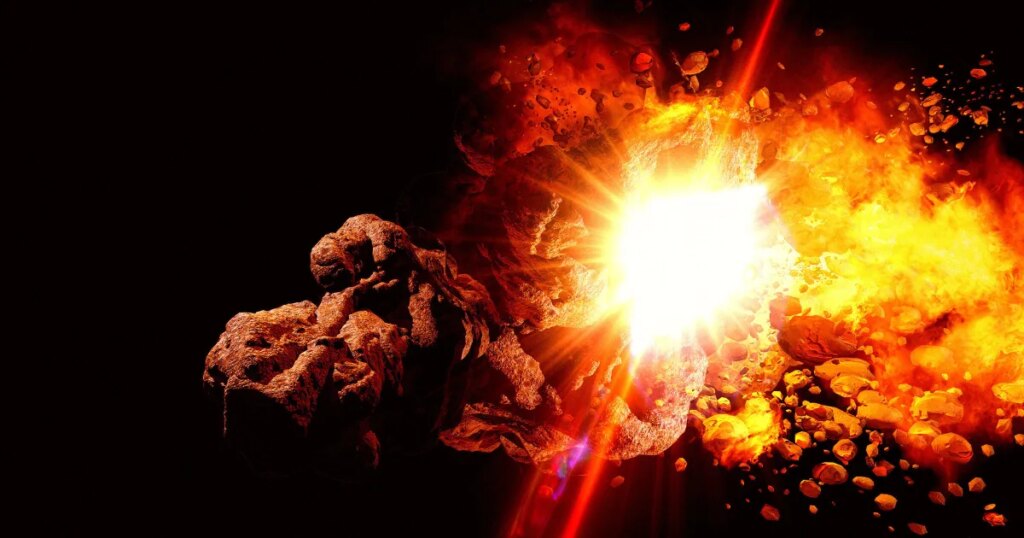
Plenty of asteroids can survive their fiery plunge through the Earth’s atmosphere. If they’re big enough, they can prove incredibly destructive, like the 60-foot Chelyabinsk meteor that exploded over the southern Ural region in Russia in 2013, releasing a blast equivalent to 30 times the energy of the atomic bomb that was dropped on Hiroshima.
And in case an even larger space rock were to ever threaten humanity, we’d have to get creative to keep it from colliding with our planet. Crashing a spacecraft into it like a pool ball to redirect its path — just like NASA did with its proof of concept Double Asteroid Redirection Test (DART) mission in 2022 — may not always be on the table, given the many uncertainties involved.
In a new paper published in the journal Nature Communications, an international team of researchers — including scientists from CERN and the University of Oxford — revisited the idea of blowing up an incoming asteroid with a nuclear warhead.
There are intuitive concerns. What if the asteroid shattered, turning a cosmic sniper shot into a shotgun blast of debris raining down over our planet?
But the team used CERN’s Super Proton Synchrotron (SPS) to study how asteroid materials react to different levels of physical stress, including large-scale simulations of nuclear deflection, and found that the space rocks are surprisingly resilient.
“Planetary defense represents a scientific challenge,” said Karl-Georg Schlesinger, cofounder of nuclear deflection startup Outer Solar System Company (OuSoCo), which partnered with the scientists, in a statement. “The world must be able to execute a nuclear deflection mission with high confidence, yet cannot conduct a real-world test in advance.”
In an experiment, the team exposed samples of a metal-rich meteorite to 27 short but intense pulses of a proton beam at CERN’s HiRadMat facility. Afterward, the team moved the meteorite to the ISIS Neutron and Muon Source at the Rutherford Appleton Laboratory in the UK to analyze changes to its internal structure at a microscopic level.
To their surprise, the “material became stronger, exhibiting an increase in yield strength, and displayed a self-stabilizing damping behavior,” explained OuSoCo cofounder Melanie Bochmann.
The finding could have major implications for how we approach future asteroid redirection efforts.
“Our experiments indicate that — at least for metal-rich asteroid material — a larger device than previously thought can be used without catastrophically breaking the asteroid,” Bochmann said. “This keeps open an emergency option for situations involving very large objects or very short warning times, where non-nuclear methods are insufficient and where current models might assume fragmentation would limit the usable device size.”
Fortunately, the researchers could soon have far more data to go by. Both NASA and the European Space Agency are planning to study Apophis, an enormous asteroid somewhere between 1,000 and 1,500 feet in width, which is expected to come eerily close to the Earth — closer than many geosynchronous satellites at just 20,000 miles — to Earth in April 2029.
“As a next step, we plan to study more complex and rocky asteroid materials,” the researchers said in a statement. “One example is a class of meteorites called pallasites, which consist of a metal matrix similar to the meteorite material we have already studied, with up to centimeter-sized magnesium-rich crystals embedded inside.”
The upcoming research could have fascinating implications outside of asteroid redirection as well.
“Because these objects are thought to originate from the core–mantle boundary of early planetesimals,” they added, “such experiments could also provide valuable insights into planetary formation processes.”
More on asteroids: Asteroid Behaving Strangely
The post Scientists Say Heck, Just Nuke a Killer Asteroid Heading for Earth appeared first on Futurism.