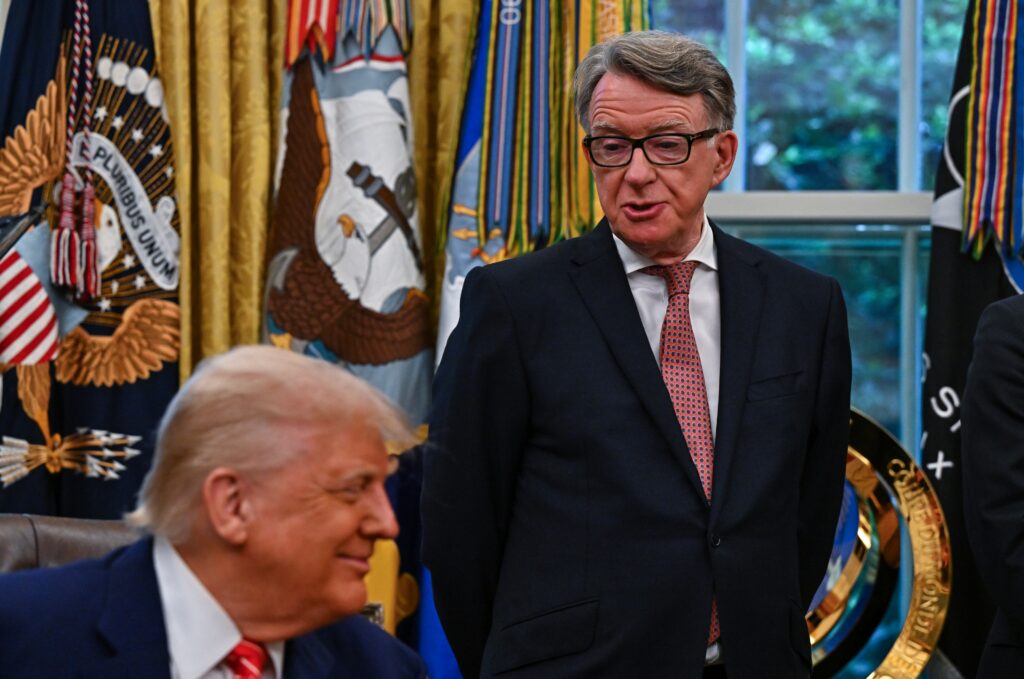
The fallout from the latest release of files related to sex offender Jeffrey Epstein is being called the biggest political scandal so far this century. Newspapers and television news are splashing fresh revelations daily. High-profile careers are crashing. The police are investigating. There are even whispers of “borrowed time” for the country’s leader.
Not in the United States, but in Britain.
The enormous tranche of more than 3 million emails and other documents, photos and videos released by the Justice Department on Jan. 30 have created a minor headache in the White House and a major crisis in Whitehall. Prime Minister Keir Starmer is under immense pressure to explain why he appointed longtime Labour insider Peter Mandelson as Britain’s ambassador to the U.S., despite knowing Mandelson continued to consort with Epstein after he pleaded guilty in Florida in 2008 to charges including soliciting prostitution from someone under 18.
On Thursday, Starmer made a public apology to Epstein’s victims for “having believed Mandelson’s lies” and agreed to release the vetting reports around Mandelson’s ambassadorial appointment. On the same day, 50 percent of YouGov respondents said the prime minister should resign — including 37 percent of his own voters.
In conversations with members of Parliament across the political spectrum, they all offered variations on the theme that, as one said, the mood throughout the Westminster political class is “febrile.” Despite the fevered response to the latest revelations, and Starmer’s struggle to respond, it is difficult for Labour MPs to remove their party leader, and no one I spoke with felt confident Starmer will go — not yet. But tensions are high, and if local elections in May go as badly for the Labour Party as current polling suggests, several MPs said the Epstein files will be seen retrospectively as “the beginning of the end.”
As for the Prince of Darkness — the nickname Mandelson earned for his ruthless and effective role in shaping the Labour Party over the past 40 years — he had been dismissed as the prime minister’s man in Washington in September after friendly correspondence to Epstein was exposed. Now, following the Justice Department’s new document dump, he is the subject of an investigation by the Metropolitan Police.
In addition to allegations that Mandelson shared sensitive government information with Epstein when serving as business secretary in the Labour government around the time of the 2008 financial crisis, it’s alleged that in 2009 he may have also shared sensitive market information.
The contrast between responses to the latest Epstein files release in Britain and the U.S. is stark. President Donald Trump, who is mentioned thousands of times in the newly revealed documents, was not directly asked about them in his one-hour interview with NBC News on Wednesday night. Starmer, who is mentioned zero times in the files, is currently fighting for his political life and is under pressure to try to solidify his own position by firing his second chief of staff in 18 months.
What accounts for these radical differences? “Brits are not used to something like this happening,” says one senior figure in Westminster. “The impact is therefore unknown, but also seismic.” For Americans, who have heard about the Epstein files throughout multiple election cycles, the president’s featuring in them is not news. Indeed, the Epstein connection is baked into the Trump presidency. Another twist in the Epstein saga is more easily drowned out due to endless distractions emanating from the White House, which in just the past week included calls to “nationalize” elections and sharing racist videos of a former president.
British politics is by no means immune to scandal, but the desensitization that has worked in Trump’s favor is not working for Starmer. Labour’s historic win last July was secured in part by the party’s pledge to clean up politics after the Conservatives, whose disrespect for the electorate was symbolized by a “suitcase of wine” wheeled into 10 Downing Street during the pandemic lockdowns while Boris Johnson was prime minister. Labour promised to bring Tory scandals to an end. “If the party hadn’t acted like it was the high priest of integrity, things might be different now,” one former minister told me.
It’s extraordinary that the most high-profile investigation prompted by the Epstein documents so far has nothing to do with his exploitation of teenage girls (Mandelson is married to a man) and is occurring outside the U.S.
In the U.S., by contrast, the Epstein files have played out almost exclusively in the court of public opinion. Business leaders, journalists, academics and others have faced calls to resign or been ostracized for their Epstein affiliations revealed in emails. The men almost uniformly deny knowing about his sordid obsessions. Some of their emails, especially when discussing women, are revolting. Others are benign and have risked branding a lot of innocent people as bad actors.
Public humiliation was always the most likely outcome of the unprecedented and risky release of millions of documents seized for investigation purposes. The emails are a mixed bag: damning, or embarrassing, or totally tangential — but seemingly none could spark a criminal investigation, according to the Justice Department. So the ripple effects barely register in Washington. Yet across the ocean, a political earthquake erupts.
The post The Epstein files release is an earthquake. Just not in Washington. appeared first on Washington Post.