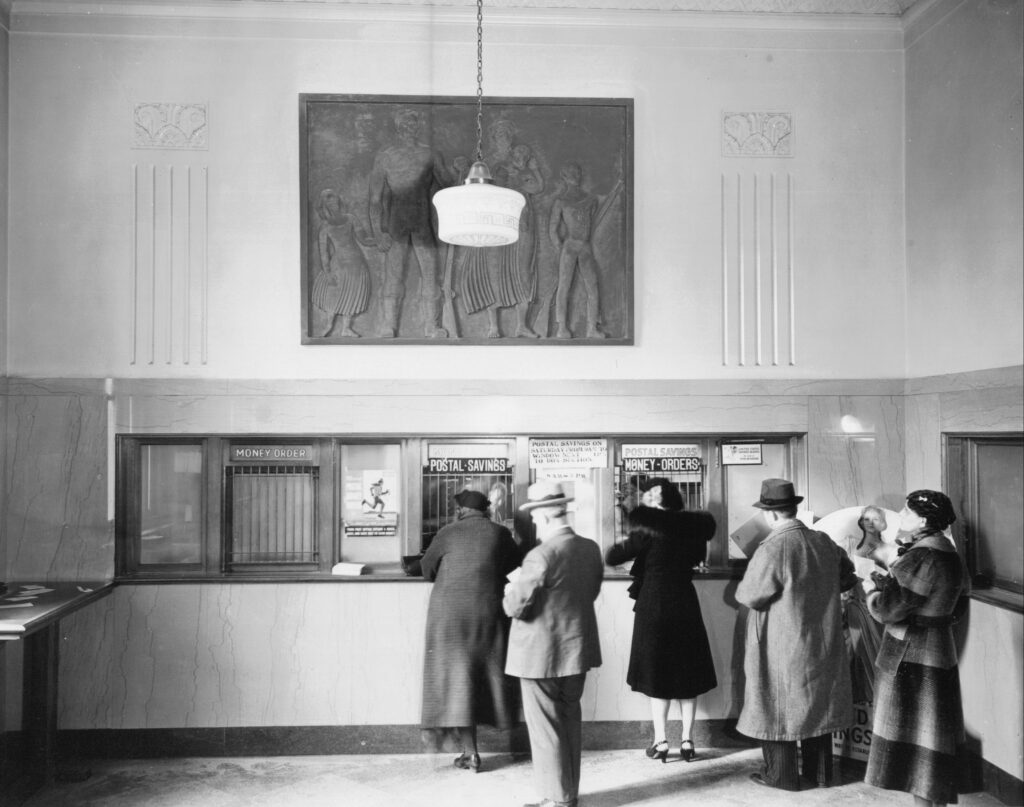
To lift the United States out of the Great Depression, President Franklin D. Roosevelt put Americans to work building roads and bridges, conserving forests and rivers, laying sewer pipes, and constructing schools, parks and airports.
But the U.S. needed something more, Roosevelt thought. It needed art. So his White House built a national gallery and museum, then scattered the works around the country, placing dazzling murals and sculptures in hundreds of post offices. The works brought visibility — and crucial paychecks — to the artists, and lifted morale during the depths of the Depression and the Second World War.
The vast majority of the works survive nearly a century later, but hundreds are missing or have been destroyed, sold or donated, according to U.S. Postal Service records obtained by The Washington Post. In recent years, senior postal officials weighed covering remaining images that some people find offensive — often those depicting Black labor.
Of the nearly 1,700 post office murals installed under Roosevelt’s New Deal program, nearly 200 are missing. Dozens more have been conveyed to other federal agencies, local governments, museums and nonprofits.
For many of the destroyed murals nationwide, the best surviving depictions of the work are photographs The Post obtained through the Freedom of Information Act. The Smithsonian American Art Museum also has a large collection of studies of the murals; other records reside at the National Archives.
“Traditionally, post office lobbies were frequently visited by community members from all walks of life, making those locations particularly accessible display sites for artwork,” a Postal Service spokesperson said in an unsigned statement. “While it is the policy of the Postal Service to preserve and protect the historic artwork in its collection for future generations, we are mindful that certain murals generate strong feelings for some of our employees and customers.”
In most post offices with New Deal murals, no information is displayed describing the art or even identifying the artist who made it. Often when the Postal Service vacates a building, it leaves the historic artwork behind.
The agency in recent years had explored working with historians from the Smithsonian National Postal Museum to “properly handle and safeguard the future” of the artwork, including those that have been covered in recent years.
The agency has contemplated installing “interpretive text” alongside some of the murals, the spokesperson said.
But those discussions largely ended without any results, a Smithsonian spokesman said.
“The Postal Service legally has to protect them,” said Daniel Piazza, the Postal Museum’s chief curator of philately, or stamps. “Whether people like them or not, whether they’re controversial or not, they’re federal property. They’re mandated to preserve them. Having this kind of interpretation can make them useful in a way for public discussion around the subject.”
Two murals depicting agriculture in Kentucky and Gen. Zachary Taylor, the 12th U.S. president, in the Everglades were installed in the Campbellsville, Kentucky, post office in 1937. When an addition was made to the building in 1965, the murals were taken down to prevent damage, then lost, said Betty Jane Gorin-Smith, a local historian in Taylor County, Kentucky.
“That’s what I can tell you,” she said. “In other words, I’d like to know, too, what happened to them.”
In 1972, seven murals celebrating the cultivation of raspberries in Hopkins, Minnesota, once known as the “Raspberry Capital of the World,” were boarded over and destroyed, according to Postal Service records.
Conservators saved a portion of one mural, which is displayed in Sen. Amy Klobuchar’s (D-Minnesota) office in Washington.
“I show it to everyone that comes in the office — everyone from school groups to CEOs to anyone that has come in there, which has been a lot of interesting people — I explain the story of how it hung in the post office,” Klobuchar said in an interview. “But I never knew they had to scrape it off the wall [to save it].”
In 1981, according to records reviewed by The Post, the postmaster of Laurinburg, North Carolina, had the mural “Fruits of the Land,” by Agnes Tait, removed from above the office door and shipped to the Smithsonian Institution in Washington.
The local NAACP chapter complained about the image, which showed Black workers farming watermelons and cucumbers, the cash crops of the region, said John T. Alford, who served as a county commissioner until 2024 and was vice president of the NAACP chapter at the time.
“It was beautifully done,” said Alford, who opposed removing the mural. “I grew up picking cotton and watermelons. It was a part of me. I wasn’t ashamed of it, and I’m not ashamed of it today.”
Others in town had different issues with the mural.
“Perhaps the most impractical feature is that of a hefty colored man leisurely pushing an open wheelbarrow loaded with big striped watermelons,” the Laurinburg Exchange wrote when the piece was installed in 1941. “Nobody ever saw anything like that here in actual life and nobody who knows melons would undertake the move them in an open wheelbarrow.”
In the San Gabriel Valley, three murals — “El Paysano,” “El Gringo” and “El Indio” — picturing the Mexican inhabitants of early California, White settlers and Indigenous people developing the land, were completed in 1938. The murals were most likely painted over in the 1960s or ’70s, a local high school class found during a 2022 summer school project.
In Saint Martinville, Louisiana, “Evangeline,” a portrait of the Acadian heroine depicted in Henry Wadsworth Longfellow’s 1847 poem of the same name, was moved from its original home to a different local post office. Four other paintings that originally accompanied the work — “Pelican,” “Azalea,” “Magnolia” and “Crawfish” — have been destroyed.
The post office in Osceola, Arkansas, caught fire in 1966; the building survived, but the mural “Early Settlers of Osceola,” by Orville Carroll, did not, according to Postal Service records. “Reforestation,” by Hollis Holbrook in Haleyville, Alabama, still hangs in the local post office but was painted over. A smaller reproduction of the painting was installed in 2010. The old post office building is now a public library.
The mail agency under Postmaster General David Steiner and predecessor Louis DeJoy is in the midst of a generational transformation that would further distance the modern Postal Service from the homespun department that Roosevelt tapped for his nationwide artistic vision.
In the 1930s, the post office was the only direct line communities in most of the country had to the federal government every day. Cross-country travel was difficult and expensive, making meeting and communicating with elected officials and bureaucrats in Washington cumbersome. Interactions with other federal offices, like the Internal Revenue Service or the Selective Service, were conducted mainly by mail.
Under DeJoy, who led the mail agency from June 2020 to March 2025, the Postal Service largely moved away from courting individual customers, and instead looked toward national package shippers to compete with express and e-commerce giants Amazon, FedEx and UPS. (Amazon founder Jeff Bezos owns The Post.) In the process, the agency has moved away from the smaller towns and backcountry outposts that once defined its character for modern facilities the size of aircraft hangars.
Where once the Postal Service advertised its sea to shining sea reach to every American address, its new campaigns plug its business-friendly agility.
The former was more in line with Roosevelt’s aim for the agency, so instrumental to his presidency that he appointed his campaign manager, political fixer and “the New Deal’s political muscle,” James A. Farley, as postmaster general.
A New York cosmopolitan, Roosevelt worried that his country lagged far behind European cultural capitals, especially as nationalism raged through the continent. France had produced Cézanne, Monet and Matisse. Spain had Picasso. Italy had Andreotti.
The U.S. had less artistic heritage. Edward Hopper and Georgia O’Keeffe were just beginning to appear on the international scene. Jackson Pollock, Mark Rothko and Andy Warhol were still relatively young. Norman Rockwell’s career didn’t take off until the 1930s.
So the New Deal arts programs were born, run out of the Works Progress Administration and the Treasury Department’s Section of Fine Arts. The works glorified the everyday, giving rise to a regionalist and modernist style that defined American art on a global stage.
Philip Guston, the acclaimed painter and draftsman, produced a mural in rural Georgia on the construction of the railroad. Anton Refregier created murals on American folklore and quilting for the Plainfield, New Jersey, post office, then a series of 27 murals on the “History of San Francisco” for the city’s Rincon Annex Post Office. Philip Evergood painted a post office mural. Arthur Getz, the famed magazine illustrator, painted three.
“The one place that all people came to do business was the post office. They were community gathering places in ways they have not been for decades,” said Virginia Mecklenburg, chief curator emerita at the Smithsonian American Art Museum. “It serves a different function from most art in that it was designed to speak to people who knew little or nothing about art, but they loved the places, and they loved the stories that their communities had to tell.”
The program was also a lifesaver for struggling artists. A mural could pay anywhere from $500 to $2,000. The median household income in 1939, according to the Census Bureau, was $1,200.
Some local governments and community groups have staged campaigns to save or restore murals.
More than two dozen murals, collectively entitled “Community Service,” in Cedar Rapids, Iowa, were painted over in 1951 after controversy over some of the images depicted, including one work that shows an execution by hanging. The city of Cedar Rapids acquired the building in 2011 and has restored all the paintings.
In Boone, North Carolina, the town government and historic preservation commission purchased the New Deal-era post office building — and its mural, “Daniel Boone on a Hunting Trip in Watauga County,” by Alan Tompkins — in 2009, and preserved the painting and some of the building’s original features.
The town’s post office has sat on the same family’s land since 1823, when the first post office was opened in what was then known as Councill’s Store, North Carolina.
And in some cases, individual connoisseurs have rescued postal artworks.
“A Massachusetts Countryside,” by Jean Watson, was removed from the Stoughton, Massachusetts, post office in 1978 when the building changed hands, and local officials declined to exhibit it in municipal offices.
“Post office mural too ugly for town hall,” a headline declared in a November 1989 issue of the Quincy Patriot Ledger.
The local historical society refused to take the painting, which displayed a waterfall crashing over a rocky gorge in greens and browns. One of the society’s members stashed the 13-by-5 foot canvas in the loft of his barn, where it sat for nearly three decades until the property was sold.
It spent two years outdoors in New England seasons leaned up against a storage container — until Jimmy Emerson, an itinerant Georgia veterinarian and self-described postal nerd, found it.
Emerson tracked the work down with plans to restore at least a portion of it at a personal cost of up to $30,000, he said. Instead, he persuaded the Postal Service to take it back and restore it. And if the agency rejects the mural, archivists have promised him first dibs to claim it once more.
The post The disappearing art gallery in your post office appeared first on Washington Post.