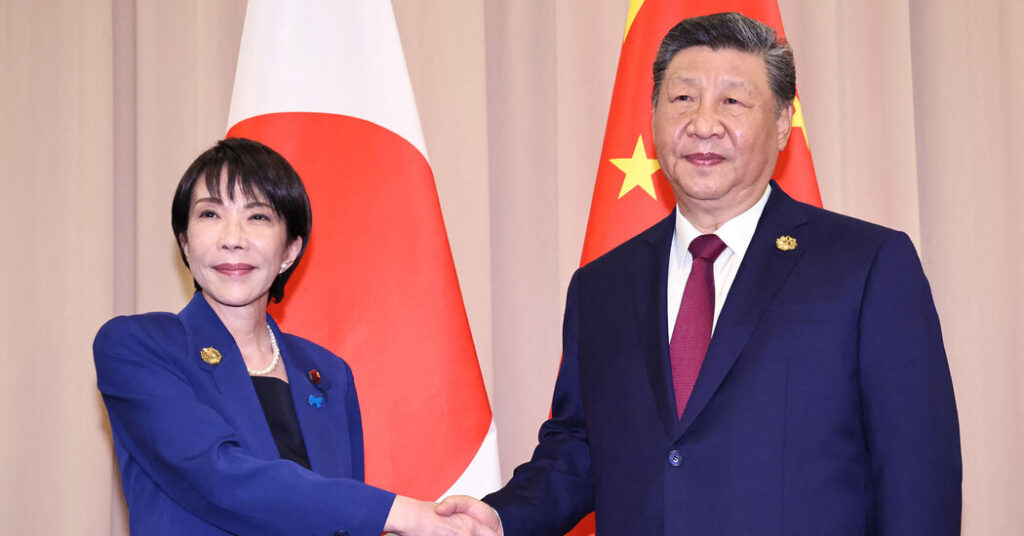
China is not on the ballot in the Japanese snap election on Sunday; but it looms large.
The Chinese government has sought to punish Japan recently over a remark Prime Minister Sanae Takaichi made about Taiwan, the self-governed democracy that Beijing claims is part of its territory.
Ms. Takaichi, known for her hawkish views on China, said in November that Japan could intervene militarily if China were to attack Taiwan. Her comment broke with a previous policy of avoiding any explicit mention of Taiwan in the context of “survival-threatening situations.”
Beijing unleashed a wave of reprisals, restricting Japanese seafood imports, discouraging tourism to Japan and signaling it could limit the export of critical minerals to Japan.
Ms. Takaichi’s handling of the matter has been an issue on the campaign trail. Her stance has helped win over some voters, including younger generations who have shown a willingness to question the nation’s longstanding pacifism.
Aoi Nakamura, a 22-year-old college student, said he supported Ms. Takaichi’s tough approach to China.
“Japan should maintain a firm stance without making any compromises,” he said on Sunday outside a community center in Tokyo, where he was voting.
Ms. Takaichi’s critics say that she has unnecessarily exposed Japan to Chinese economic coercion and that the dispute could threaten Japan’s access to rare earth minerals from China.
Ms. Takaichi’s allies hope that a decisive victory on Sunday could show Beijing that she has the backing of the Japanese public, and that Tokyo will not back down in the face of Chinese threats.
Hisako Ueno contributed reporting.
Javier C. Hernández is the Tokyo bureau chief for The Times, leading coverage of Japan and the region. He has reported from Asia for much of the past decade, previously serving as China correspondent in Beijing.
The post China’s Presence Looms Large in Japanese Election appeared first on New York Times.