By the age of two, most human kids have figured out pretend play. A cardboard box becomes a spaceship. An empty cup holds “tea.” Dolls become “babies.” Entire social worlds run on nothing but agreement and imagination.
For a long time, that ability sat comfortably in the human-only column. Pretend play looked like a cognitive ability tied to language, culture, and creativity. Chimps were clever, sure, but imagination felt like a different tier. A new study suggests that line may have been drawn too cleanly.
In research published in Science, scientists describe a series of experiments involving Kanzi, a bonobo known for his unusual upbringing and communication skills. Kanzi grew up in a research environment and learned to use graphic symbols to communicate with humans, combining them in ways that created new meanings. He also learned how to make simple stone tools, which already put him in rare company.
The new question was whether Kanzi could engage in pretend play, meaning acting as if something were real while understanding that it wasn’t.
That distinction is important here. Imitation is one thing. Mistaking an empty cup for a full one is another. Pretending requires holding those two ideas at once—and keeping them straight.
The Pretend Tea Party Experiment
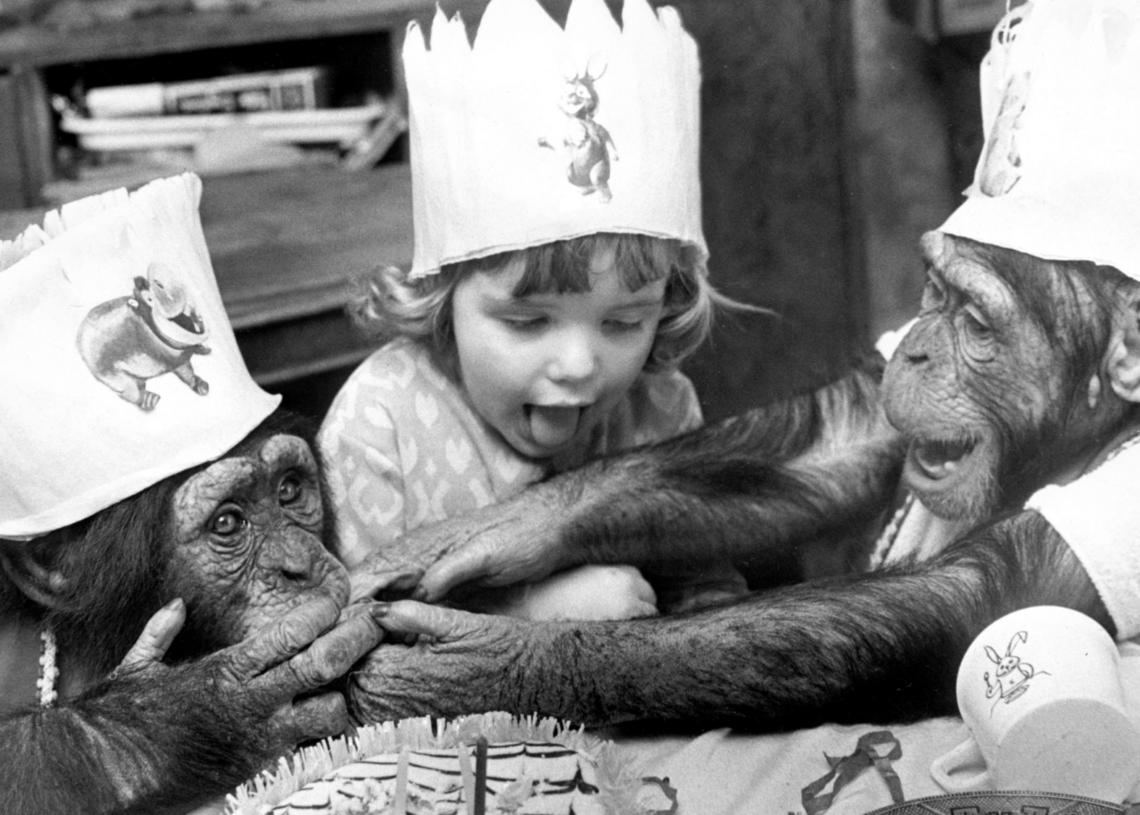
To test this, researchers borrowed methods used with young children and staged a pretend juice party. They mimed pouring juice into two cups, then acted as if only one cup had been emptied. When asked which cup he wanted, Kanzi pointed to the cup with pretend juice about 68 percent of the time. When the setup involved real juice, he chose the real thing nearly 80 percent of the time.
“That suggests that he really can tell the difference between real juice and imaginary juice,” said study co-author Amalia Bastos of the University of St. Andrews, speaking to ScienceAlert.
A similar setup using fake grapes led to similar results.
Christopher Krupenye, a cognitive scientist at Johns Hopkins University and co-author of the study, said the findings challenge long-held assumptions about imagination. “What’s really exciting about this work is that it suggests that the roots of this capacity for imagination are not unique to our species,” he said.
Not everyone is sold. Duke University psychologist Michael Tomasello, who was not involved in the research, argues that choosing between imagined outcomes may not equal full pretend play. In an email to ScienceAlert, he wrote that stronger evidence would involve Kanzi actively creating the pretense himself.
There’s also the issue of Kanzi’s life. Raised among humans, he was never a typical bonobo. Kanzi died last year at age 44, and researchers are careful not to overextend the findings.
Still, Bastos sees a door opening. “Kanzi opened this path for a lot of future studies,” she said.
For species facing extinction, understanding how their minds work may matter more than ever. Even an imaginary tea party can change how we define intelligence.
The post A Chimp’s Pretend Tea Party Is Raising Questions About Imagination appeared first on VICE.