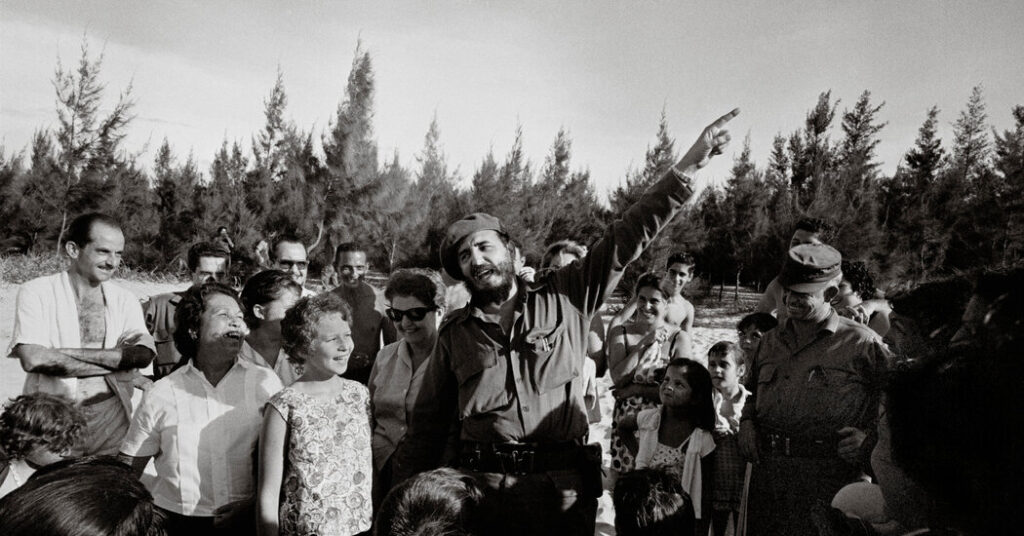
Celebrations broke out in front of Miami’s Versailles restaurant nearly 20 years ago after Fidel Castro announced that he was so sick he had to temporarily step down as president of Cuba.
Cuban exiles rejoiced again two years later when he quit for good — and once more when he died in 2016, though his brother Raúl Castro was president at the time.
Now, the country’s economy is in free fall, its electric grid is failing, millions of its citizens have left and the Cuban government is facing off against perhaps its most menacing foe: President Trump.
Mr. Trump has closed off Cuba’s access to oil shipments, helped cripple its vital tourism industry and declared that Cuba’s government is “going down for the count.”
The Trump administration and the many Cuban exiles who have been waiting nearly seven decades for the fall of Cuba’s Communist government said they believed this might finally be their moment.
After years of U.S. presidents trying various economic pressure tactics to hasten the demise of the Cuban government, the Trump administration’s cutoff of fuel has raised the ante drastically because oil keeps the country — from public transit to factories to farms — running.
Predictions of the demise of Cuba’s government have been made before, notably after the dissolution of the Soviet Union, which had been Cuba’s main benefactor, only to be proved wrong.
But this time, experts say, the survival of Cuba’s government appears very much in doubt.
Members of South Florida’s Cuban exile community say Trump administration officials have been assuring them that the Cuban government’s days are numbered.
The U.S. government “has determined that Cuba must be free before the end of 2026,” said Marcell Felipe, a prominent Cuban exile leader in Miami who chairs the American Museum of the Cuban Diaspora and said he had met with U.S. diplomats. “This is a plan in motion.”
Besides oil, Mr. Trump’s plans have also largely centered around eliminating Cuba’s access to hard currency from tourism and the country’s medical missions abroad, said a senior State Department official who spoke on the condition that his name not be published in order to discuss sensitive diplomatic matters.
Cuba’s tourism industry never recovered from the Covid-19 pandemic in part because of measures by the Trump administration making it harder for Europeans to travel to the United States after visiting Cuba.
After the U.S. military captured the Venezuelan leader Nicolás Maduro, Mr. Trump halted Venezuelan oil to Cuba. Venezuela had long kept Cuba afloat with 35,000 barrels of oil a day in exchange for medical services by Cuban doctors.
Mr. Trump also announced tariffs against any country that sends oil to Cuba. Taken together, the measures effectively cut off the only two suppliers of oil to Cuba — Venezuela and Mexico — just as Cuba has been enduring island-wide power outages. Cuba does produce its own oil, but only enough to meet 40 percent of its daily needs, and a lack of international shipments would eventually paralyze the country, analysts said.
Mr. Trump says the United States is in talks with top Cuban leaders, but has not elaborated.
“Cuba is a failing nation,” Mr. Trump told reporters recently. “It has been for a long time, but now it doesn’t have Venezuela to prop it up. So we’re talking to the people from Cuba, the highest people in Cuba, to see what happens.”
The Cuban government declined to comment for this article.
Cuba’s deputy foreign minister, Carlos Fernández de Cossio, told the EFE news agency that “messages had been exchanged” with the Trump administration, but denied any dialogue was taking place.
He ruled out any discussions of political or economic change, noting that the United States has no more say in such matters than Cuba would dictating how ICE agents should conduct migrant raids in Minneapolis.
“If people are thinking that there is division within the Cuban government, division within the political forces in Cuba, and a willingness,” he was quoted as saying, “to capitulate to the unjustified and immoral pressure and aggression of the United States, that’s a mistaken interpretation.”
Juan Triana, a professor at the Center for the Study of the Cuban Economy, at the University of Havana, noted that Cuba did not collapse even in the 1990s during the crisis known as the “Special Period” after the fall of the Soviet Union.
“Everyone looked to Cuba expecting it to fall, and they lost the bet,” he said. “President after president of the United States has lost it.”
Still, a rare news conference that Cuba’s president, Miguel Díaz-Canel, held last week seemed to acknowledge the severity of the country’s problems. He described plans to ration Cuba’s limited supply of domestic oil, and to expand solar and wind-powered energy, but made no mention of securing new oil imports.
The Cuban government has sent mixed messages to the Trump administration, posting sharply worded message on social media, but also issuing a more tempered statement.
Cuba proposed renewing cooperation with the United States on issues like counterterrorism, anti-money laundering, drug trafficking prevention, cybersecurity, human trafficking and financial crimes.
At the same time, Cuba has also targeted Mike Hammer, the head of the U.S. Embassy in Havana, with small groups of government supporters heckling him and calling him a “murderer.” Mr. Hammer’s diplomatic vehicle was surrounded by protesters five times as he left meetings in various Cuban cities, episodes known in Cuba as “acts of repudiation,” the State Department said.
A U.S. official who was not authorized to speak publicly about the administration’s interactions with Havana said Cuban officials were nervous because they were starting to realize their revolution was coming to an end.
The senior State Department official who discussed the White House’s strategy said most of the talks with the Cuban government were around technical issues, like repatriation flights, and were not substantive.
The problem is not that the two sides do not talk, but that there is a fundamental disagreement about what should be on the table, the State Department official said.
If Cuban officials were to approach the Trump administration with significant offers, such as allowing more private enterprise and competing political parties, the administration would be willing to engage more actively, the official said.
The Trump administration, the official said, was seeking discussions similar to talks taking place in Venezuela, where the interim government has agreed to take steps toward economic transformation and democracy.
But that approach would be difficult because there is no Cuban official in place like Venezuela’s interim leader, Delcy Rodríguez, who has been willing to placate the Trump administration, said Ricardo Zúniga, a former Obama administration official who helped lead secret negotiations with Cuba. Cuba’s government has sidelined any government official who appeared to have political aspirations.
Many experts point out another key challenge if Cuba’s government were to fall: It is unclear who would lead the country because the government has imprisoned most opposition leaders or driven them into exile.
Peter Kornbluh, an author of a history of secret negotiations between Cuba and the United States, said he believed talks were already underway.
“It makes sense that the U.S. and Cuba are engaged in back channel talks, even if they are the result of criminal coercion from the Trump White House,” said Mr. Kornbluh, a critic of U.S. hard-line economic policies. “Dialogue, even under duress, is preferable to overt U.S. aggression and offers a potential off ramp for both sides.”
The 2013 talks during the Obama administration were so secret that not even the State Department knew about them. The discussions, brokered by the Vatican and held there and in Canada, led to the renewal of diplomatic relations and a brief period of increased travel.
The discussions centered around the notion that opening Cuba to more private business and improving living conditions would lead to regime change, but the Cuban government ultimately stifled economic opportunities. Mr. Trump’s thinking, Mr. Zúniga said, is the opposite: that economic and social collapse will make the government fold, too.
“I think they are trying to create a condition of extraordinary stress, similar to a war, in Cuba to try to shake loose offers out of the Cuban government side,” he said. “But the Cubans have no vision for a plan that cuts them out of power.”
Ada Ferrer, a history professor at Princeton University whose book “Cuba, an American History” won the 2022 Pulitzer Prize in history, said it was true that past predictions of the fall of the Cuban government had been wrong. But now there is no benefactor waiting in the wings to save Cuba’s crashing economy like Venezuela did after the fall of the Soviet Union.
“This time,” she said, “feels different.”
Jack Nicas contributed reporting from Mexico City.
Frances Robles is a Times reporter covering Latin America and the Caribbean. She has reported on the region for more than 25 years.
The post Cuba’s Government Has Lasted 67 Years. Will It Fall Under Trump? appeared first on New York Times.