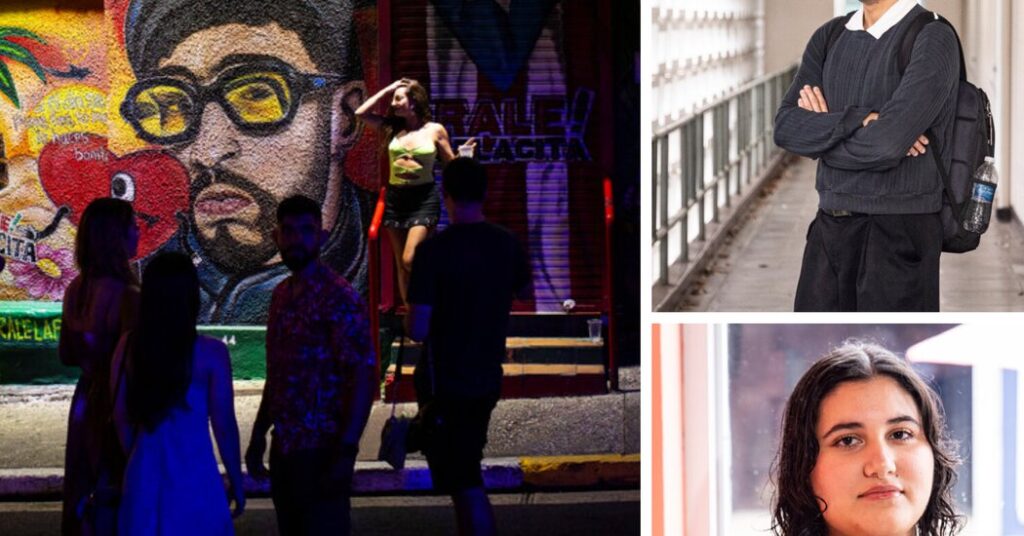
Benito Antonio Martínez Ocasio, better known as the superstar Bad Bunny, is a proud product of what Puerto Ricans call the “crisis generation”: those who grew up on the island in the 1990s and 2000s and have little memory of its better days.
He was 12 when Puerto Rico’s economy spiraled into an economic recession from which it has never recovered. By 2016, when he was 22 and started recording music, the island’s government was bankrupt. Hurricane Maria hit the next year, devastating the island and killing nearly 3,000 people. Then came political unrest, the coronavirus pandemic and rapid gentrification.
Members of his generation say that Bad Bunny, now 31, has given voice to their experiences and fears, all while opening the world’s eyes to Puerto Rico’s fraught territorial relationship with the U.S. government.
In making music about young Puerto Ricans’ shared challenges, “he has been able to put us on the map,” said Alejandro Bracero, a 23-year-old studying political science and economics at the University of Puerto Rico’s main campus in San Juan.
Bad Bunny sings and raps about the crisis generation’s struggles in many of his lyrics and talks about them in interviews and on social media. Entire industries in Puerto Rico shut down after a federal corporate tax break expired in 2006, which led residents to leave in droves to find jobs in the states. Severe budget cuts during the debt crisis led to school closures, streets pocked with potholes and frequent power blackouts.
The island’s population declined by 11.8 percent from 2010 to 2020, according to the census. Bad Bunny, an outspoken critic of President Trump’s immigration crackdown, dedicated his win at the Grammys for album of the year to “all the people who had to leave their homeland, their country to follow their dreams.”
Mr. Bracero remembers his grandmother, who was born in 1946, telling him stories about how Puerto Rico boomed in the decades after World War II thanks to a corporate tax break intended to foster industry. “There was a sense of prosperity,” he said, much different from the Puerto Rico he grew up in.
Mayra Vélez Serrano, the chairwoman of the University of Puerto Rico’s political science department, coined the term “crisis generation” in 2016. Since then, it has only become more apt, she said, describing a group of Puerto Ricans who are better educated than their predecessors, yet plagued by stagnant salaries and an unaffordable cost of living.
On average, a teacher in Puerto Rico might make $32,000 a year, Dr. Vélez Serrano said, compared with about $50,000 in Orlando, Fla., where many Puerto Ricans fleeing the island settle. But the average house in Puerto Rico costs about $300,000, compared with about $367,000 in Orlando.
“This huge gap between what we’re earning as professionals and the cost of living has led to the massive outflow of professionals of this generation,” she said, adding that most “are between 20-something and 40,” an age group that includes Bad Bunny.
In Bad Bunny’s “Debí Tirar Más Fotos,” the album that won at the Grammys last Sunday, the title track talks about wishing you had taken more photos of people before they left. Another song mentions not wanting to be forced to move. A third is defiant about not wanting to experience “what happened to Hawaii,” with lyrics about losing property to wealthy outsiders and the potential pitfalls if Puerto Rico were to become a state.
“There are people from the United States now living in Caguas,” Abdiel Vargas Sánchez, 24, said with astonishment about his hometown. Caguas, a city of about 120,000 in a mountain valley south of San Juan, was once hardly a destination. But an influx of mainlanders that accelerated during the pandemic, some of them most likely drawn by tax breaks for wealthy investors, has priced out local residents and driven up housing prices across the island.
“Bad Bunny could be the start of something beautiful” for Puerto Rico, Mr. Vargas Sánchez said. Yet he also worried that the artist’s commercial success would ultimately be “only that.”
There have already been signs that the crisis generation is changing Puerto Rican politics.
In 2019, young people, including Bad Bunny and other artists, were instrumental in organizing street protests that forced the resignation of Gov. Ricardo A. Rosselló after offensive chat messages between him and his aides, some of which mocked victims of Hurricane Maria, were leaked. Bad Bunny ended a tour early to join the protests, and he and two other artists recorded a song that became a street anthem.
Camila Herrera Biaggi, 24, was still a teenager at the time of the demonstrations but thinks of it as the start of her political awakening. “That was my first protest,” she said, recalling how Bad Bunny and others inspired her to participate. “I told myself that I needed to go.”
New political parties gained traction in the years that followed, as younger voters questioned whether establishment parties wanted to solve the island’s problems. In 2024, Bad Bunny paid for prominent billboards criticizing one of the old parties, the New Progressive Party, and called it corrupt. The party has been in power since 2017 and supports Puerto Rican statehood. He has supported candidates that favor Puerto Rican independence and included many pro-independence symbols in his music videos and lyrics.
Puerto Rico has been a territory of the United States since 1898, after U.S. forces invaded it during the Spanish-American War. In 1917, Congress extended American citizenship to Puerto Ricans, but they cannot vote in presidential elections, have only symbolic representation in Congress and do not have equal access to federal benefits.
Above all, young Puerto Ricans appear intent on re-examining Puerto Rico’s relationship with the United States, in light of two defining events of the past decade.
In 2016, Congress passed a law empowering a board appointed by the president to oversee the island’s finances, taking away much of its financial independence and stirring accusations that it was treating Puerto Rico like a colony. The bungled response to Hurricane Maria further eroded Puerto Ricans’ trust in the federal government.
Bad Bunny worked with Jorell Meléndez-Badillo, a Puerto Rican historian at the University of Wisconsin-Madison, on text-based videos for his album last year, explaining crucial periods in Puerto Rican history. Some were displayed on big screens during Bad Bunny’s concert residency in Puerto Rico over the summer.
Dr. Meléndez-Badillo called the artist’s Super Bowl performance an opportunity for Puerto Ricans — and everyone else — to have more conversations about the island’s current state and its future.
“I’m seeing this as a pedagogical thing that Benito is doing,” he said. “He’s not simply repping the Puerto Rican flag. He’s also inviting people to grapple with the beauty and messiness of Puerto Rican-ness. A lot of people in the United States don’t really know Puerto Rico’s relationship to the United States.”
Nathalia Méndez Rodríguez, a 23-year-old graduate student in public administration and law at the University of Puerto Rico, said she wanted Bad Bunny to keep explaining to the world what she and her peers want most: “to preserve our homeland and our culture and our country and our community.”
“Bad Bunny,” she said, “represents the anxieties of the Puerto Rican people.”
Patricia Mazzei is the lead reporter for The Times in Miami, covering Florida and Puerto Rico.
The post How Bad Bunny Gives Voice to Puerto Rico’s ‘Crisis Generation’ appeared first on New York Times.