Every Super Bowl takes on the culture of its host city. South Beach in Miami. The French Quarter in New Orleans. Hollywood in Los Angeles.
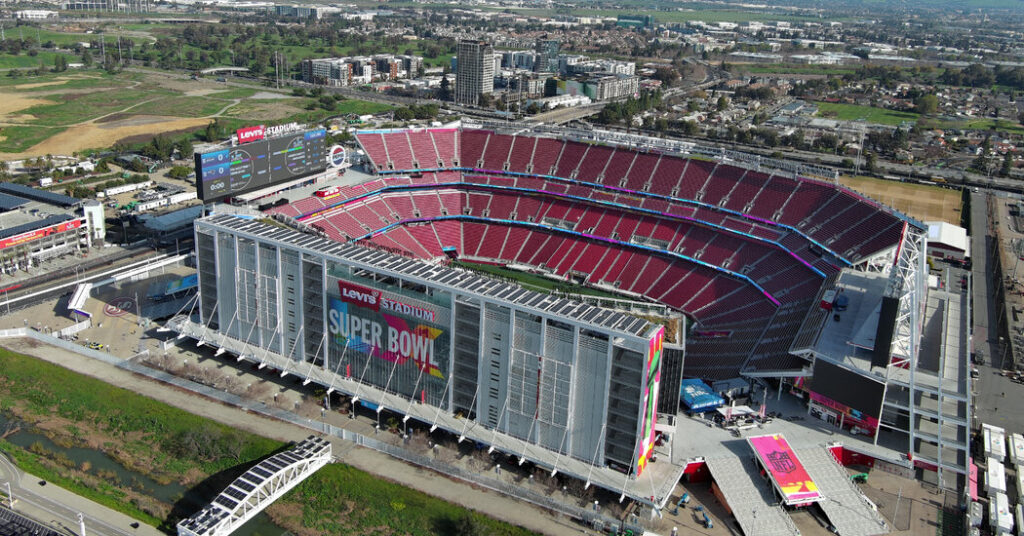
It will be no different on Sunday, when the New England Patriots and Seattle Seahawks will face off at Levi’s Stadium in Santa Clara, Calif., nestled in Silicon Valley an hour’s drive south of San Francisco. The proximity to some of the world’s biggest technology companies, venture capital firms and entertainment businesses will guarantee a who’s who of corporate executives and celebrities and those hoping to rub shoulders with them.
“The Super Bowl in the Bay Area is the perfect juxtaposition of ‘Ballers’ meets ‘Billions’ meets ‘Silicon Valley,’” said Venky Ganesan, a partner at Menlo Ventures, a Silicon Valley investment firm. “Just like those three shows, all the characters that make those caricatures come true are showing up at the stadium.”
Mr. Ganesan said he planned to attend the game as a guest with several “prominent” friends from the tech world, though he declined to name them. The game, he said, is irresistible in his work circles.
The Super Bowl in Silicon Valley “is tech billionaires who got picked last in gym class paying $50,000 to pretend they’re friends with the guys who got picked first in gym class,” he said. “And for the record, I, too, was picked last in gym class.”
Some of those tech titans are expected to be Neal Mohan, the chief executive of YouTube, which pays the N.F.L. at least $2 billion a year to broadcast the Sunday Ticket package of games, who will be in the suite of the N.F.L. commissioner, Roger Goodell; Eddy Cue, the senior vice president of services at Apple — which sponsors the halftime show — and his boss, Tim Cook; and Alan Waxman, the chief executive of the San Francisco-based private equity group, Sixth Street, which bought 3 percent of the Patriots in November. Lewis Hamilton, the F1 driver, and Justin Bieber are also expected to attend.
Some started the pregame celebrations early. On Friday evening, the streets of San Francisco’s Embarcadero roadway along the waterfront were clogged with self-driving Waymos, many carrying passengers to corporate-sponsored parties. Gavin Newsom, the governor of California, stopped by the FanDuel x Spotify party at Pier 29, chatting with tech executives in the V.I.P. section as Green Day played an hourlong set. Companies like Uber and Fanatics hosted performances by Olivia Dean, Cardi B and SZA that continued on Saturday.
For those on the A-list in the Bay Area, getting a ticket to the game involves little more than a phone call. But for most everyone else, getting a ticket will be harder than usual because so many well-heeled fans, league sponsors and rights holders are concentrated in California. Fans of both teams also want to witness their heroes lifting the Lombardi Trophy, and fans living in the area have a rare chance to attend the Super Bowl in their backyard.
Another constraint on getting a ticket: Space has to be set aside for additional television cameras, the thousands of people from the media, booths for international broadcasters and extra security. The capacity for Sunday’s game will be close to 65,000 instead of the 70,000 tickets typically available for regular season games.
Only about one-quarter of the tickets are available to the general public, with the rest going to N.F.L. teams.
The Patriots and Seahawks received 17.5 percent of the tickets, or 11,375 per team. The host team — the 49ers — got another 5 percent, or about 3,200 tickets. The 29 other N.F.L. teams each received 1.2 percent, or 34.8 percent in total, of the available seats. That’s another 22,500 tickets.
Teams use the tickets in various ways. The owner, team senior executives and players buy many of them. Some teams create lotteries that allow season ticket holders and luxury box holders to buy tickets.
This leaves just 16,380 tickets, or a little over 25 percent of the stadium, for everyone else, and prices aren’t cheap. As of Friday, the average resale ticket price to the game was $6,687, according to SeatGeek, a secondary ticket reseller. The cheapest ticket available is $4,237 with fees.
The largest concentration of fans who bought tickets — 27 percent — came from nearby Washington State. Fans from California made up the second largest group, with 16 percent. A good number of those buyers live in Los Angeles. Fans from Massachusetts represented just 7 percent of sales. In addition to the distance to California, the Patriots have already played in nine Super Bowls this century, so some fans have already crossed the game off their bucket lists.
The price of tickets on the secondary market is about 20 percent lower than this point last year, a function of the mix of teams and their proximity to the Super Bowl city. Las Vegas, which hosted the game for the first time two years ago, was an usually expensive ticket because of the novelty of playing there.
Typically, prices shoot up after the teams qualify two weeks before the Super Bowl, and some ticket holders try to resell their tickets for a big profit. The prices then steadily dip until hours before the game, when last-minute buyers rush in.
There may be more of them this year because many wealthy fans live near the stadium, said Chris Leyden, the director of growth marketing at SeatGeek.
“They’ll wake up Sunday morning and decide to go,” he said. “Five thousand dollars might be very different to someone in a different income bracket.”
The concentration of money, powerful companies and nice weather in the Bay Area all but insures the Super Bowl will return, said Andy Dolich, who worked for the Oakland A’s, Golden State Warriors and 49ers.
“If the N.F.L. had looked into the future and had a game that’s bicoastal, has great history in a marketplace that is the center of technology, with a significant of money and a local team that has won multiple Super Bowls, in weather that would make people think about relocating, then Super Bowl 60 worked out well.”
Lauren Hirsch, John Koblin and Tripp Mickle contributed reporting.
Ken Belson is a Times reporter covering sports, power and money at the N.F.L. and other professional sports leagues.
The post A Super Bowl in Silicon Valley Filled With Valley Billionaires appeared first on New York Times.