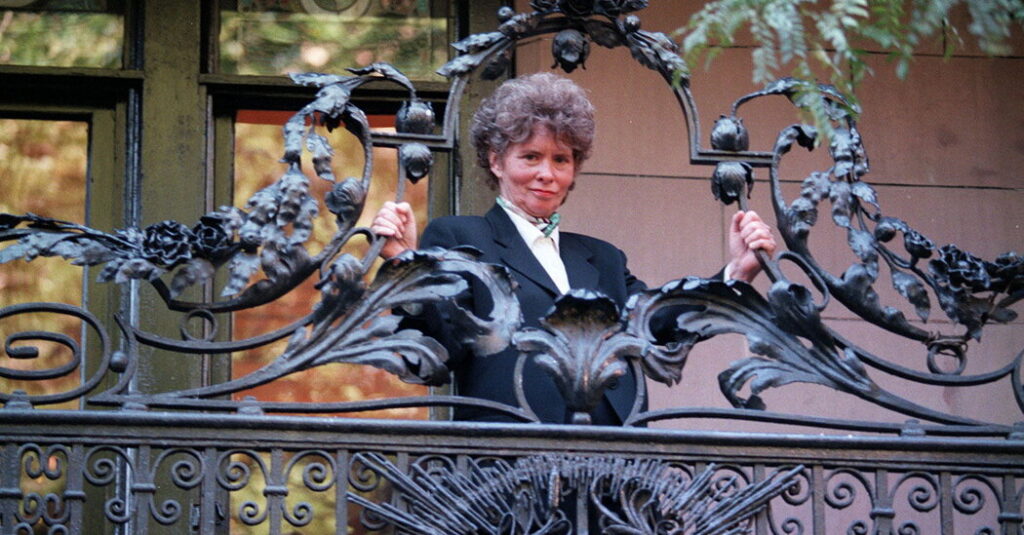
Suzannah Lessard, an author and writer for The New Yorker who examined the ways in which people are marked by place — and the ways in which they, in turn, mark the landscape — and whose best-selling memoir, “The Architect of Desire: Beauty and Danger in the Stanford White Family,” explored the dark history of Mr. White, the Gilded Age architect who was her great-grandfather, died on Jan. 29 in Manhattan. She was 81.
Ms. Lessard’s death, in a hospital, was caused by complications of endometrial cancer, Noel Brennan, her wife, said.
Ms. Lessard grew up in an extraordinary landscape, on a rambling compound that her family called “the Place” — much of it created by Mr. White — in a township on the North Shore of Long Island where her ancestors had settled in the 17th century.
The extended White clan was artistic and aristocratic, the family tree dappled with Astors and Smiths. Ms. Lessard, her five sisters and their parents lived in a 19th-century farmhouse known as the Red Cottage. It had sloping floors, patched plaster walls and a fraught atmosphere, largely created by her father, who required quiet for his work as a composer, as well as other, more brutal concessions from his daughters.
The centerpiece of the compound was Box Hill, a gabled confection designed by Mr. White, who was famous for the Beaux-Arts palaces he and his firm, McKim, Mead & White, created for America’s newly minted merchant-royals in the late 19th century — and for the scandal of his death.
In 1906, while attending a musical performance on the roof of Madison Square Garden, one of the many Manhattan monuments of his design, he was fatally shot by Harry K. Thaw, a mentally unstable millionaire from Pittsburgh whose 21-year-old wife, the showgirl Evelyn Nesbit, had been sexually assaulted by Mr. White when she was 16.
Mr. Thaw’s trial ended in his acquittal on the grounds of insanity, but it was mostly a referendum on Mr. White’s rapacious appetites, particularly for young girls, breathlessly covered by the press as the “trial of the century.” The scandal and Mr. White himself were rarely mentioned at the Place, although his fame and artistry permeated the seductive geography.
But his story, and those of Ms. Lessard’s eccentric and erratic family, were part of the environment: Willie Chanler, who threw his wooden leg to get a waiter’s attention; Uncle Johnny, who shot a horse because his mother mentioned that its upkeep was getting expensive; Amélie Rives, a novelist who by day took to bed and the succor of morphine, and by night roamed the woods in a white robe, where she was said to have been nearly shot by a servant who mistook her for a ghost.
Ms. Lessard’s memoir was decades in the making. It was the book she could not write, and yet felt compelled to write, and the writer’s block she suffered often compromised her other work; for much of the time she was struggling with it, she was a staff writer at The New Yorker.
She had grown up feeling nurtured and untethered by the beauty of the Place and the weight of its histories. In writing the book, she tried to untangle the roots of that precariousness, uncovering a legacy of destructive behavior and a code of silence that had been passed down from generation to generation.
“Underneath the entrancing Stanford White surface is predation,” she wrote. “Behind the aesthetic sophistication of a Stanford White interior is the blindly voracious, irresponsible force, both personal and that of a whole class, a whole nation out of control.”
Ms. Lessard had never previously spoken about how her father had visited her in her bedroom when she was a child. Yet on New Year’s Day in 1989, one of her sisters called a meeting of the siblings and, one by one, each sister confided that she, too, had experienced sexual encounters with their father.
Over the years, each had tried to convince herself that the encounters weren’t abuse — that their childhoods had been safe and that their father’s behavior was somehow normal. Their memories, finally voiced, gave Ms. Lessard “a sense of something like the sound barrier breaking,” she wrote, “a psychic reverberation.”
She added: “With it, the world cracked open, and inside was the world.”
Until then, she told The New York Times in 1996, when the book was published, the writing had felt like a form of torture or madness.
“The Architect of Desire” was celebrated by critics and became a best seller. Christopher Lehmann-Haupt, in his review for The Times, called it “emotionally transporting.”
The response from Ms. Lessard’s extended family was less laudatory. Some quibbled with her fact-checking — when Mr. Chanler threw his wooden leg at a waiter, it was not at Delmonico’s in New York, as she wrote, but at Maxim’s in Paris, for example — and protested the airing of Mr. White’s transgressions, though his notorious behaviors were hardly a secret. The Lessard sisters and their mother were completely supportive.
“We tried not to get into the crossfire,” her sister Hester Lessard said in an interview.
“It was a hard time for Suki,” she added, using Ms. Lessard’s nickname. “She found herself isolated from this large family that she had been a part of for so long.”
In time, attitudes changed, she said: “The family softened and was proud of her. The only lasting and permanent estrangement was between Suki and my father, and that was never healed.”
In addition to her sister Hester and Ms. Brennan, a former immigration judge, Ms. Lessard is survived by her son, Julian Soeiro; and four other sisters, Griselda Healy, Sophie Lessard, Laura Lessard and Jenny Lessard. Her marriage to David Soeiro ended in divorce.
After the sisters’ revelations, the family entered therapy, but their father claimed not to remember the encounters they described. (The Lessards had divorced decades earlier.) Ms. Lessard said that exposing her father in her book was not an act of revenge but of survival.
“I was not willing to spiritually and creatively die in order to spare my father this pain,” she told The Times. “It’s what it came down to. I am really, really sorry because of the pain, but I was not willing to spiritually die. I was unable to thrive. I was unable to have a life.”
Suzannah Terry Lessard was born on Dec. 1, 1944, in Smithtown, a town in Suffolk County, N.Y., that had been settled by her great-grandmother’s family. Her mother, Alida (White) Lessard, an opera singer, was one of eight children of Stanford White’s only son, Lawrence, known as Larry. Her father, John Lessard, was from California.
Suzannah attended Manhattanville College of the Sacred Heart (now Manhattanville University) in Purchase, N.Y., a school that was housed in a French-style chateau designed, as it happens, by Stanford White in 1892. She received an undergraduate degree in English literature from Columbia University’s School of General Studies in 1969.
After college, Ms. Lessard wanted to be a poet and gave herself a year to investigate the form. Then she turned to journalism. With John Rothchild and Taylor Branch, she was one of the original editors of Washington Monthly, the iconoclastic magazine founded in 1969 by Charles Peters to poke holes in political orthodoxies and hold politicians to account.
One of her first articles was about the gay liberation movement a year after the Stonewall uprising. It ran with the headline “Gay Is Good for Us All.”
“It was stunningly radical for the time,” Mr. Branch said in an interview. “Her pieces were always deeply personal, and focused on people rather than policy. She took a long time to write. She would examine an idea like a jewel.”
At The New Yorker, which she joined in the mid-1970s, Ms. Lessard had an enviable range: She wrote about Vietnam and the Cold War. She also wrote a meditation on waiting — for her baby, for a house to be built, for the Iran hostage crisis to end. She wrote about a ceramist who survived Stalin’s prisons. She wrote a social history of the two neighborhoods divided by 96th Street and Park Avenue, a vivid tale of wealth and scarcity.
“She was a true eccentric, in the best way,” her friend Daphne Merkin, the author and essayist, said. “She thought originally and made connections that weren’t immediately apparent. She roamed in her mind, always looking for a bigger context.”
Ms. Lessard’s most recent book, “The Absent Hand: Reimagining Our American Landscape” (2019), was a collection of essays in which she plumbed the country’s layered geographies, noting the anomie of a bedroom in a hotel chain; the complicated history of Gettysburg, Pa.; and gentrification on the stoops of Brooklyn.
“The connection to place remains deep,” she wrote, “touching the core of our being. Landscape is our mirror, our book of revelations, as always. This is where reorientation starts.”
Penelope Green is a Times reporter on the Obituaries desk.
The post Suzannah Lessard Dies at 81; Stanford White Descendant Who Wrote a Haunting Family Memoir appeared first on New York Times.