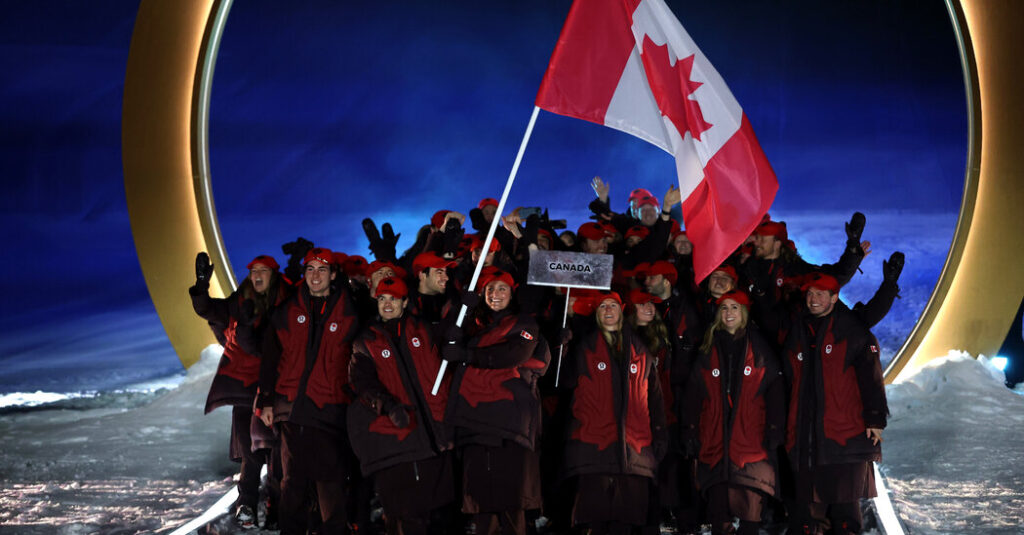
At the Milan-Cortina Olympics, Canada is facing the usual winter heavyweights: Norway, Sweden, Germany, the host nation Italy and the United States, which more than any other country draws out Canada’s good-guys-in-red energy.
For over a year, President Trump has repeatedly threatened Canada’s economic stability and sovereignty. And while tariffs and trade deals are important, for the next 16 days there will be battles on the curling rink, skeleton track and in the hockey arena that will bring some joy to the broader fight.
[Read: Trump Threatens Canada With Tariffs as Post-Davos Fallout Continues]
[From The Athletic: The Olympic Skeleton Controversy Between the U.S. and Canada]
There are 206 athletes representing Canada, from the youngest — the 18-year-old snowboarders Eli Bouchard and Felicity Geremia — to the oldest, the curler Marc Kennedy, 44. It is likely the last Olympics for the freestyle skier Mikaël Kingsbury, a three-time medalist, and the first Olympics for Cassie Sharpe, who won gold and silver in ski halfpipe at the last two Winter Games, since she became a mom.
At the opening ceremonies yesterday, my colleague Motoko Rich reported: “a genuine crowd-goes-nuts moment when Canada’s contingent enters the stadium in Milan.” And my colleague Patricia Mazzei noted: “The spectators in Livigno greeted Team U.S.A. with a whole lot of silence.”
On the world stage, the U.S. hasn’t historically cared much about beating Canada over anyone else, though that is certainly changing. But Canada has always cared very much about beating the U.S.
I grew up in the 1970s and ’80s, seduced by American exceptionalism that arrived via over-the-air channels from Buffalo and Detroit. Yet, I feel delight and validation when things I love — a band, a team, a TV show called “Heated Rivalry” — blows up in America.
[Read: The Secret Sauce in ‘Heated Rivalry’? Canada.]
But because of Mr. Trump, our need for approval has faded, and our desire to defeat the U.S. in hockey, and everything else at the Olympics, is boiling over.
Bruce Kidd, Canada’s foremost Olympic historian and a retired professor of sport policy at the University of Toronto, tells me that this need is hard-wired.
“There is a history of rejecting the American experiment and wanting to create our own society with our own distinct laws, culture, peace, order and government,” Mr. Kidd says. “And sports confer what the sociologists call representational status.”
At the 1987 Canada Cup, Mario Lemieux and Wayne Gretzky combined on a beauty of a goal to beat the longtime hockey adversary the Soviet Union. That triumph hardened what Canadians sometimes doubted — that when the world was watching we could be better than anyone else. It was a turning point in the nation’s consciousness.
“That was Canada,” Mr. Kidd said. “Now Canada is confident. We know we can fight. We can win on any stage. That’s what sports does.”
In the subsequent final Canada Cup, in 1991, Canada beat the U.S., seeding a new rivalry. But that tournament also felt so good because Olympic hockey had been so bad. Canada didn’t win a gold medal after the Oslo Games in 1952 until they beat the U.S. at the Salt Lake City Games 50 years later. The Vancouver Games in 2010 were “our” Olympics, eternalized by Sidney Crosby’s golden goal, which beat the U.S. in overtime.
Canada’s women’s hockey team — led by Marie-Philip Poulin, the game-winning goal scorer in three of her four Olympics — has dominated, winning five of seven gold medals, all against the United States.
You know how we all want this to go.
Over the last 12 months, amid Mr. Trump’s threats and social media fits of pique, Canada’s sports scene has given citizens the happy buzz of two double Caesars on a hot afternoon at the cottage.
[From NYT Cooking: Caesar Cocktail Recipe]
[Read: Canadians Mourn a Loss By Underdogs Who Brought a Nation Together]
The Blue Jays’ October run to a World Series Game 7 loss to the Dodgers was an intoxicating glue for the nation.
In February, after Mr. Trump had been talking for a few months about making Canada the 51st state, Canada and the U.S. were trading goals and punches at the Four Nations tournament. Connor McDavid, who will star in Milan, scored in overtime to down the U.S.
“I don’t think people quite understand how much that tournament meant to us, the players,” Mr. McDavid wrote this week in The Players’ Tribune. “In that moment, with everything on the line, I think we all remembered what it was to be a hockey fan. To be a Team Canada fan. To be Canadian.”
Barring an unusual development, the women’s Olympic hockey final (Feb. 19 at 1:10 p.m. Eastern time) and the men’s final (Feb. 22 at 8:10 a.m.), should feature Canada and the United States. The Canadian men and the American women are favored to win gold.
This clever Olympics ad, co-produced by NBC Sports and the N.H.L. and starring the actor Jon Hamm, conveys the antagonistic spirit of the Canada-U.S. rivalry in this moment. Beating Canada suddenly matters very much.
The Milan-Cortina Games may be the most consequential international sporting event since that ’87 Canada Cup, with a rival fit for the times and some familiar themes. Canada that year was deep in angst over a proposed free trade deal with the United States; many feared that Canada would lose its cultural identity and control of its economy and natural resources. The Canada Cup spurred a gentle national chauvinism.
[Read: Canada Flexes on Global Stage With an Eye to Its Own Survival]
[Read: Canada’s New Reality]
“1987 gave us tremendous confidence and presence internationally,” Mr. Kidd said. “Sports lends itself to the expression of a distinct identity and distinct values and a distinct sense of geography. It gave us the opportunity to express that we are our own self.”
A few weeks ago, Prime Minister Mark Carney turned the spotlight on Canada with an indelible speech at the World Economic Forum that made clear how Canadians see themselves now, in this world.
For the next few weeks, it will be up to sports.
Trans Canada
This section was compiled by Ian Austen, a Canada correspondent based in Ottawa.
-
In his latest move to lessen Canada’s economic independence from the United States Prime Minister Mark Carney announced a new automotive industry strategy that focuses on electric vehicles. It also distances Canada from President Trump’s efforts to double down on cars and trucks powered by fossil fuels.
-
Eight Toronto police officers, including a father and son, have been charged with criminal corruption, bribery, drug trafficking, harassment and unauthorized access to personal information, Vjosa Isai reports.
-
In Opinion, Stephen Marche examines the globalization of Canadian rage, and says the world is catching up with Canada.
-
My colleague Sopan Deb writes that despite its popularity “Heated Rivalry” underscores how “little has changed in the locker room culture of men’s professional sports, one of the last bastions of contemporary society where being openly gay does not guarantee acceptance.”
-
And Shivani Gonzalez reports on the fan demand for the fictional Team Canada Olympic fleece jacket that appears in “Heated Rivalry.”
-
Conservative Party members have resoundingly endorsed the leadership of Pierre Poilievre, despite his low popularity in polls of the general public.
-
David Pierson and Berry Wang write from Hong Kong on how allies of the United States, including Canada, are drawing closer to China as a hedge against President Trump’s administration.
-
Alex Travelli reports from New Delhi on how Mr. Trump has led Prime Minister Narendra Modi of India to shed that country’s traditional aversion to free trade deals to secure new allies, including Canada.
-
A study has found that the rate of new diagnoses of psychotic disorders among people ages 14 to 20 in Ontario increased by 60 percent between 1997 and 2023. A researcher says the results suggest that there is a need for to examine the effects of greater cannabis use by young people.
-
Jackeline Luna with a video story on an enormous Atlantic halibut caught in Quebec that weighed in at a record-breaking 244 pounds.
-
Jeffrey Gettleman and Maya Tekeli report that Greenland’s mini diplomatic scene is about to get more lively as Canada and France set up consulates, following threats by President Trump to take over the island.
-
Indigenous architects are redesigning Canada in ways that reflect the legacies of their culture, Michael Kaminer reports.
-
Canadian pop singer Tate McRae’s commercial for NBC promoting the U.S. Olympic team has not gone down well with many people back in Canada.
-
China’s highest court overturned a death sentence against a Canadian man convicted of drug smuggling, ending a longstanding source of diplomatic friction between Beijing and Ottawa.
Shawna Richer is an editor on the International desk at The Times. She lives in Toronto and has been editing and writing about sports for more than 25 years.
How are we doing? We’re eager to have your thoughts about this newsletter and events in Canada in general. Please send them to [email protected].
Like this email? Forward it to your friends, and let them know they can sign up here.
Shawna Richer is an editor working on coverage of sports in America.
The post Canada’s Olympians Take the World Stage appeared first on New York Times.