Japan said it has taken a significant step in the controversial and complex race to mine the world’s ocean floors for valuable minerals.
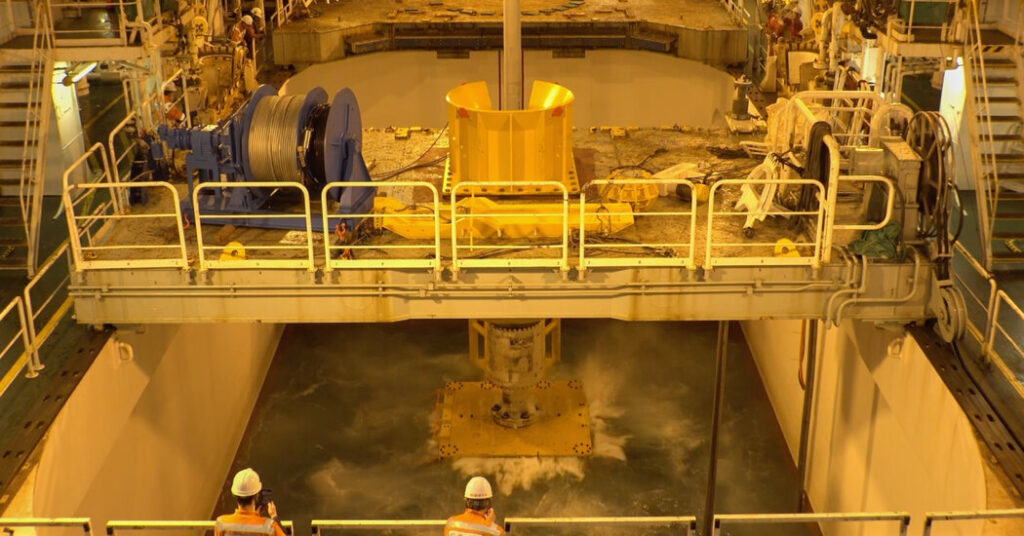
Near the remote Japanese island of Minamitorishima, a team of scientists said in recent days that they had successfully pumped up mud from the seafloor, 6,000 meters beneath the waves, that is rich in rare earth elements.
Japan’s prime minister, Sanae Takaichi, hailed the government-led effort in a statement calling it a “world’s first.” She said it could pave the way for Japan to develop new sources for the valuable elements used in technologies like electric vehicles, smartphones and military equipment.
China currently dominates the global supply of rare earths, an economic vulnerability that Japan has long tried to remedy. It recently announced a partnership with the U.S. and the European Union after Beijing sparked global concern by throttling exports of rare earths of last year.
President Trump has made seabed mining a priority. The administration is speedily moving to issue commercial permits for companies to mine the ocean floor in international waters — a plan that has drawn sharp criticism from other countries. (Japan’s test, which runs for another week or so, is taking place in the country’s own territorial waters.)
Vast stretches of the ocean floor are rich in minerals but mining would be costly and technologically complex, and there is currently no commercial seabed mining. Researchers in Japan and various mining companies around the world have spent years developing systems capable of reaching such depths.
It is also controversial. Scientists and environmentalists say scouring the seafloor could damage deep-sea ecosystems, stirring up sediment or causing pollution that might affect important industries, like fishing. Dozens of countries have called for a moratorium.
When it comes to mining in international waters — outside the territory of any one nation — most countries have agreed to follow the rules created by the International Seabed Authority, a organization created by a global treaty. It has spent years negotiating commercial mining rules, but has yet to finalize them.
Japan has ratified that treaty but because it plans to mine within its territorial waters, no international permit is required. Other countries, such as Papua New Guinea and Norway, have also considered seabed mining in their waters, but those efforts are currently halted.
The United States has not ratified the treaty and is not committed to following the international authority’s rules. It is also weighing possible mining leases in national waters near Alaska and American Samoa.
Japan’s deep sea project is seven years and 40 billion yen, or roughly $255 million, in the making. It is led by the Japan Agency for Marine-Earth Science and Technology. The efforts began after researchers discovered the seabed near Minamitorishima — a small, triangle-shaped landmass more than 1,000 miles out in the Pacific — was flush with minerals and rare earths. A 2018 paper found enough yttrium, europium, terbium and dysprosium to supply global needs for potentially hundreds of years.
The project is using a research vessel fitted with a pump-based mining system that pulls up a layer of mud a few meters below the seabed and the sediment on top of it. When it returns to port on Feb. 15, the collected mud will be tested for the sought-after rare earth elements.
The expedition is focused on testing the ship’s ability to bring up the mud, as opposed to collecting commercially viable volumes of it, the agency said. By this time next year, it intends to try retrieving hundreds of tons of seafloor sediment a day.
Still, it’s a relative drop in the bucket. A 2016 report found the endeavor could be economically viable if 3,500 tons of sediment were retrieved a day and rare earth prices remained high.
The broader deep sea mining industry is full of hopeful start-up companies that want to collect polymetallic nodules, which are fist-sized lumps that contain heavy metals like manganese, nickel, cobalt, copper. Japan is not yet collecting the nodules found near Minamitorishima.
Critics say the environmental risk and technological cost of seabed mining is too high given the industry’s unproven profitability. Studies show the marine environment is slow to recover and collecting nodules reduces the biodiversity and abundance of seafloor life-forms by more than 30 percent.
Mining proponents often claim seabed mining could be a better alternative to land-based mining, which has been tied to human-rights abuses as well as pollution and habitat destruction. For example, rare earth mines on land can have high levels of radioactive elements, which researchers say isn’t the case in the rare earth mud near Minamitorishima.
Scientists are studying how Japan’s mining approach might effect deep sea ecosystems, but comprehensive information is not yet available. The Japanese agency has developed a monitoring system that is attached to the mining ship and simultaneously monitors the water for environmental changes.
Sachi Kitajima Mulkey covers climate and the environment for The Times.
The post Japan Ocean-Mining Test Successfully Hauls Up Potentially Valuable Mud appeared first on New York Times.