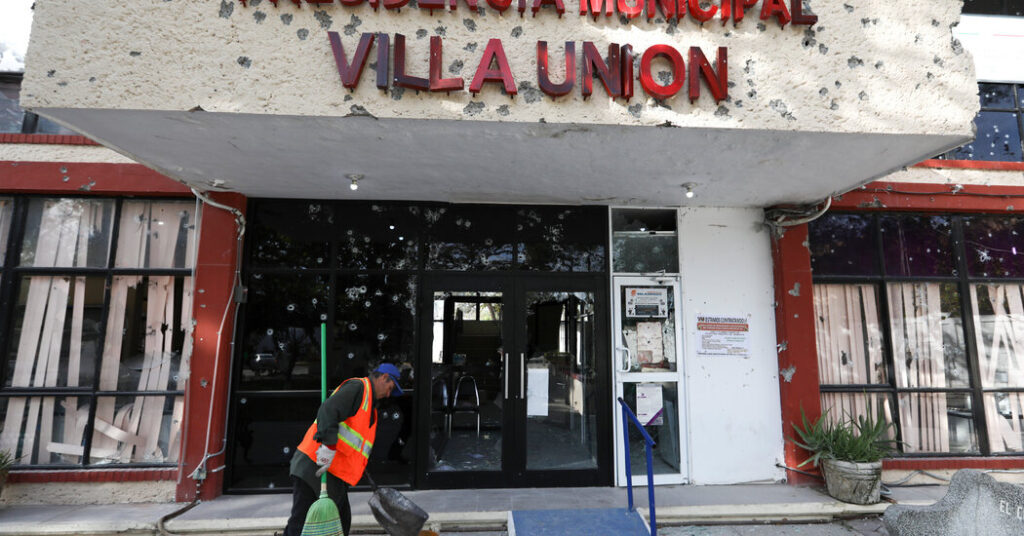
On the morning of Nov. 30, 2019, a convoy of pickup trucks carrying men armed with a heavy machine gun and powerful .50-caliber rifles entered the Mexican town of Villa Unión and opened fire.
The men had been sent on a mission of intimidation: They planned to set fire to the town hall. Their superior firepower pinned down state and local police officers as they waited for military reinforcements. Terrorized residents scrambled to take cover from the hail of bullets.
The smell of smoke filled the streets and spent casings covered the ground like “fallen leaves,” said Luis Manzano, a Mexican journalist who drove into town during the shooting. But his most vivid memory was the thunder of .50-caliber guns. The “ground trembled” as they fired, he said. “I had never experienced anything like that.”
The military drove off the assailants. In the end, four police officers, two civilians and 19 cartel members were killed. Afterward, as investigators collected evidence from the scene, they gathered at least 45 .50-caliber casings stamped with the initials “L.C.”
The letters stood for the Lake City Army Ammunition Plant, a sprawling facility just outside Kansas City, Mo., that is owned by the U.S. government and is the largest manufacturer of rifle rounds used by the American military.
It has also been a major supplier of ammunition for American consumers, including .50-caliber cartridges. These powerful rounds — as big as a medium-sized cigar and designed to be used by the military to destroy vehicles and light aircraft — are currently available for purchase by civilians across the United States.
Millions of pages of court documents, seizure records and government data obtained by the International Consortium of Investigative Journalists and The New York Times show how agreements between the Army and the private contractors that run Lake City have allowed .50-caliber ammunition and components made at the plant to enter retail markets and fall into the hands of Mexican cartels.
Mexico’s government has also purchased Lake City ammunition, the documents show, although they do not indicate the caliber.
The U.S. domestic market for the ammunition is small: .50-caliber rifles, which have limited civilian application, typically retail for thousands of dollars, and heavy machine guns like the one used in Villa Unión cost considerably more. The guns’ standard cartridges average between $3 and $4 apiece and are rarely purchased by American gun owners.
But in Mexico, where cartels have deep pockets and a seemingly endless appetite for .50-caliber firearms, demand is high.
Cartel gunmen armed with .50-caliber firearms have downed helicopters, assassinated government officials, shot at police and military forces, and massacred civilians.
Since 2012, the U.S. Bureau of Alcohol, Tobacco, Firearms and Explosives has seized more than 40,370 rounds of .50-caliber ammunition in states bordering Mexico, according to data obtained through public records requests. Lake City’s product accounted for about a third of them, a larger share than any other manufacturer.
While .50-caliber ammunition from other companies — located primarily in Brazil and South Korea — has also made its way to Mexican cartels, the data makes clear that the U.S. Army plant has been a major source of the destructive ammunition being used to wage military-style battles with Mexican authorities.
This includes a particularly powerful version of Lake City’s ammunition — incendiary rounds capable of piercing armor, which were used in an attack on Mexican police in 2024 and are for sale online today.
In February of last year, the Trump administration declared six Mexican cartels to be foreign terrorist organizations, yet these same organizations are acquiring ammunition made at the plant owned by the U.S. Army.
At least 16 online retailers have sold armor-piercing ammunition made at Lake City or made with components from the plant, according to a count by ICIJ and The Times.
Vasily Campbell, who owns one of those businesses, said he stopped selling the ammunition “about two years ago once we found out where it was going and how it was getting there.”
He said he became suspicious when buyers began asking to have 100-round ammo cans delivered to residential addresses. “That’s not a normal purchase,” he said. “There’s several orders I straight-up canceled.”
The U.S. Army did not respond in detail to questions about the use of Lake City ammunition by drug cartels. In an email, a spokesperson said that allowing commercial sales from the plant has saved taxpayers around $50 million annually, primarily by lowering the government’s cost for ammunition.
Successive presidential administrations have pledged to crack down on the flow of arms to Mexico. And in September, Secretary of State Marco Rubio announced a new initiative with the Mexican government to stop gun trafficking to the country.
The number of .50-caliber rounds seized is small compared with that of other cartridges. But it’s the power of the .50-caliber ammunition, not its quantity, that has made it a game changer for the cartels, giving them the ability to overwhelm police and even the military, according to Chris Demlein, a former A.T.F. agent who spent years investigating gun smuggling to Mexico.
“The impact that one .50-cal has in a firefight is outrageous,” he said. The weapons allow cartels to engage with targets at distances of more than a mile. “They really, really tip the scale.”
ICIJ and The Times obtained investigative files from three incidents involving .50-caliber rifles, including the assault on Villa Unión. In each of them, Mexican authorities reported finding casings marked with the Lake City imprint.
In a fourth example in early 2024, gunmen used the more destructive variant, .50-caliber armor-piercing incendiary rounds, from Lake City to attack a police convoy, according to a press briefing given by the defense secretary at the time, Luis Cresencio Sandoval. One of the bullets pierced an armored vehicle, killing one of the crew members and wounding three others. “The armor that we have cannot protect our personnel from this kind of penetration,” he said.
Brenda Aparicio Villegas is all too familiar with the devastating power of .50-caliber weapons. Her husband, Edder Paul Negrete Trejo, was a police officer who died on Oct. 14, 2019, when he and his fellow police officers were ambushed in the western state of Michoacán. The authorities blamed the attack on the New Generation Jalisco Cartel.
Her husband and his colleagues — who often had to purchase their own bullets — did not stand a chance against the cartel’s .50-caliber rifles, she said. Mr. Negrete, the father of three children, died from a gunshot wound to the chest. Twelve other officers were also killed in the attack, including one who burned to death. Investigators later found .50-caliber casings from Lake City at the scene.
Not enough has been done to stop the flow of guns and ammunition to Mexico, Ms. Villegas said. “Sadly, many of us pay the price.”
Congress Bans Some Sales to Civilians
The .50 BMG cartridge was developed in the early 20th century for a heavy machine gun used to attack tanks and aircraft.
For decades, the spent brass casings of .50-caliber rounds were rarely found beyond military training grounds and battlefields. However, that began to change in 1982 with the invention of the first .50-caliber rifle. The gun was almost five feet long and weighed around 30 pounds, making it difficult to fire from a standing position. But its greatly reduced recoil allowed users to shoot the heavy cartridges with sniper-like accuracy.
The rifle made its official battlefield debut during the first Gulf War in the early ’90s.
It had already developed a cult following among gun hobbyists, who used it in long-range target shooting contests. There weren’t many sources of ammunition for civilians: the rifles’ owners sought out antique and imported rounds, bought them from boutique manufacturers or made their own, using bullets and casings purchased from specialty shops.
Then there was the U.S. military.
In the late 1990s, government auditors found that Talon Manufacturing Co., a company contracted by the Department of Defense to demilitarize unneeded ammunition (a process that destroys a weapon’s military capabilities by means such as scrapping or disassembling it), had sold some of it to civilian retailers, including over 100,000 armor-piercing incendiary .50-caliber rounds. Rather than scrapping the ammunition, the company had broken it down and then built new cartridges with the components.
Ammunition dealers told undercover government investigators that the armor-piercing bullets could shoot down a helicopter or penetrate an armored limousine. In effect, “the U.S. military is indirectly arming civilians with some of the most powerful and destructive ammunition currently available,” a congressional report concluded.
In 2000, Congress passed a bill that prohibited the Pentagon from selling armor-piercing ammunition for .50-caliber weapons to the public. It instructed the Defense Department to require anyone receiving armor-piercing ammunition or components from it to pledge not to transfer the materials to “any purchaser in the United States other than a law enforcement or other governmental agency.”
The legislation did not address standard, non-armor-piercing cartridges, known as “ball” rounds. Talon continued selling that ammunition, made with Lake City components, until 2007, when environmental and safety concerns led the company to stop operations.
A new supply of Lake City rounds soon emerged, however. Concerned about the potential for ammunition shortfalls during the global war on terror, Army planners allowed Lake City’s operator, ATK, to ramp up commercial activity at the plant in exchange for guarantees that the company would maintain the ability to produce more than 1.6 billion rounds of ammunition a year. That included 60 million .50-caliber cartridges.
By the end of 2008, ATK had begun selling some of that ammunition to retailers.
A Surge in Violence
Authorities soon began intercepting Lake City ammunition headed for the southern border.
In October 2009, American officials seized 100 rounds of Lake City ammunition from a smuggling ring that had run hundreds of guns, including at least one .50-caliber rifle, to Mexico. Authorities there found the weapon in a raid of cartel forces that had attacked government officials, according to U.S. District Court documents.
As the years went by, incidents of cartel violence increased substantially, and attacks with .50-caliber weapons became more frequent.
In May 2011, cartel members forced down a Mexican Federal Police helicopter in the western state of Michoacán. A few days later, gunmen armed with weapons, including a .50-caliber rifle, fired on four more helicopters.
Back in the United States, Lake City was becoming a major source of the .50-caliber ball ammunition. By 2013, 10-round boxes of the cartridges had become so widely available that they even showed up in some Walmarts.
Online, cartridges linked together for use in a machine gun were available in 100-round ammo cans, just like those used by the military, often at significant discounts compared to other manufacturers.
One popular website, Lucky Gunner, extolled Lake City ammunition’s power: “If you’re looking to stop a Jeep dead in its tracks, then you’re looking at the right round.”
Starting in 2015, Mexico saw a steep escalation in violence, with homicides climbing for three consecutive years, according to official data. In border states, U.S. agents soon began monitoring bulk ammunition vendors as a way to find gun smuggling operations, according to Jason Red, a former investigator at the Department of Homeland Security in Arizona.
In a typical scenario, retailers would sell ammunition to a civilian, who would then give it to a smuggler. With few exceptions, almost any U.S. citizen or legal resident 18 or older can buy any type of rifle ammunition — even of the armor-piercing variety — in any quantity, but taking it across the border requires a license.
“Our mantra became, follow the ammo and you’ll get to the guns,” Mr. Red said in a recent interview. “We were tracking shipments from all over the country.”
The team seized hundreds of thousands of rounds of ammunition likely bound for Mexico, according to Mr. Red and court records. The vast majority of the ammunition was 7.62-mm rounds, most commonly used in AK-47s, he said.
Seizures of .50-caliber ammunition were small and infrequent at the time, according to A.T.F. and Customs and Border Protection records.
But as American authorities introduced new initiatives and increased resources aimed at reducing gun trafficking to Mexico, the numbers grew.
Between 2019 and 2024, the A.T.F. seized more than 36,000 rounds of .50-caliber ammunition in border states. About a third of them were identified as coming from Lake City.
During the same period, customs officials seized nearly 21,400 units of .50-caliber ammunition. This included 2,850 of the armor-piercing incendiary rounds.
Another Surge of Ammunition
In September 2019, the Army awarded Lake City’s $8 billion operating contract to the ammunition maker Olin Winchester, which took over the facility from the defense contractor Northrop Grumman.
As Lake City changed hands, a small ammunition distributor, SGAmmo, negotiated the purchase of armor-piercing incendiary .50-caliber rounds from Northrop Grumman.
In a newsletter, the distributor’s owner, Sam Gabbert, urged his customers to “get some before this stuff gets banned,” adding that “this is one of those products that actually surprised me when the deal went through.”
The haul, he wrote, resulted from a “government contract that ended up being canceled due to Covid-19 and left the factory hanging with the inventory.” Securing the deal involved monthslong negotiations, he said.
Another retailer, American Marksman, had also begun selling armor-piercing incendiary .50-caliber ammunition made with Lake City components.
Northrop Grumman had contracted with the company to demilitarize unneeded ammunition from Lake City, American Marksman wrote on its website, adding that it “gets many of its components from its Lake City recycling operations.” That included components for its armor-piercing incendiary rounds.
Olin Winchester’s policies on the sale of .50-caliber ammunition from Lake City are unclear. The company’s catalog does not offer the rounds for sale to civilians. But Lake City cartridges and components, including armor-piercing incendiary rounds and bullets, have continued to appear on the market.
Pallets of the armor-piercing incendiary ammunition, labeled with a code denoting they were manufactured by Olin Winchester at Lake City, were being sold by at least one online retailer in March 2023. And American Marksman continues to sell armor-piercing incendiary ammunition on its website. (It is unclear which Lake City contractor manufactured the components used to make those rounds.)
In January 2022, the Department of Justice announced the indictment of members of a gun trafficking ring, run by a former U.S. Marine, that sold guns and ammunition, including .50-caliber rifles, to the Jalisco cartel, the same group that was accused of killing Ms. Villegas’s husband, the police officer. Four months later, the Marine pleaded guilty.
During the operation, U.S. federal agents seized approximately 10,210 .50-caliber armor-piercing incendiary rounds with Lake City markings. There is no indication that the ammunition came from American Marksman or SGAmmo.
In an email, the Army said that Lake City’s contractors are “required to comply with all federal and state regulations governing the sale of commercial ammunition. While the operating contractor does not sell directly to the public, it sells to distributors, resellers, and retail stores, which are also required to adhere to federal, state, and local laws regulating ammunition sales.”
Olin Winchester did not respond to a detailed list of questions about its Lake City operations and its policies on the sale of .50-caliber ammunition and components made at the facility.
In an email, Northrop Grumman said that it “fully complied with government contract obligations in its sales of ammunition” during the two years it ran Lake City. SGAmmo did not respond to multiple emails about its purchases of .50-caliber ammunition. American Marksman also declined to comment.
‘The Best Weapons’
Villa Unión’s former mayor, Sergio Cárdenas, was frying pork rinds in his butcher shop when he thought he heard a car backfire. It was a gun.
On the street, pickup trucks rolled past. Stamped on their doors in white capital letters were the initials C.D.N.: the Cartel del Noreste.
“I hid behind the freezer, where they couldn’t see me, and I watched them go by,” Mr. Cárdenas recalled. “You could hear the .50-caliber rounds. Every now and then, a bullet or two would whiz by overhead. They ripped the air apart because they’re so big.”
As soon as the convoy passed, he slammed the shop’s door shut. The chicharrones were left to burn. Outside, the streets fell silent as the town went into lockdown. People barricaded themselves in their homes for the rest of the day.
The cartel’s foot soldiers failed in their attempt to burn down the town hall. But they riddled it and surrounding buildings with bullet holes, some larger than a fist.
Authorities traced one of the .50-caliber guns used in the assault to a store in Texas. The owner, investigators found, had sold nearly 500 guns that ended up in the hands of the C.D.N., including a .50-caliber machine gun and at least six .50-caliber rifles. A federal court sentenced him to 10 years in prison, following a guilty plea.
American authorities indicted 14 members of the gun-smuggling ring, seizing over 2,300 rounds of Lake City ammunition.
Upon learning that the .50-caliber rounds he had heard in Villa Unión came from an ammunition plant owned by the U.S. Army, Mr. Cárdenas did not seem surprised.
“The drug traffickers can get their hands on anything,” he said. “And they get the best weapons from the United States.”
Reporting was contributed by Paulina Villegas and Jack Nicas of The Times; Mathieu Tourliere of Proceso; and Jesús Escudero, Miguel Fiandor Gutiérrez and Delphine Reuter of ICIJ.
Emiliano Rodríguez Mega is a reporter and researcher for The Times based in Mexico City, covering Mexico, Central America and the Caribbean.
The post Mexican Cartels Overwhelm Police With Ammunition Made for the U.S. Military appeared first on New York Times.