Months before Prince’s Super Bowl halftime performance amid a Florida downpour in 2007, Bruce Rodgers told producers that he wanted only a few backup dancers and props onstage. “This guy in a gigantic stadium was like a little gladiator,” Rodgers had said, “and he’s going to slay the room.”
More than a dozen years later, in 2023 in Arizona, Rodgers convinced Rihanna’s creative team to hoist her on floating platforms, in hopes of protecting a delicate grass field. “I said, ‘We could hang a freight train over the field,’” Rodgers recalled.
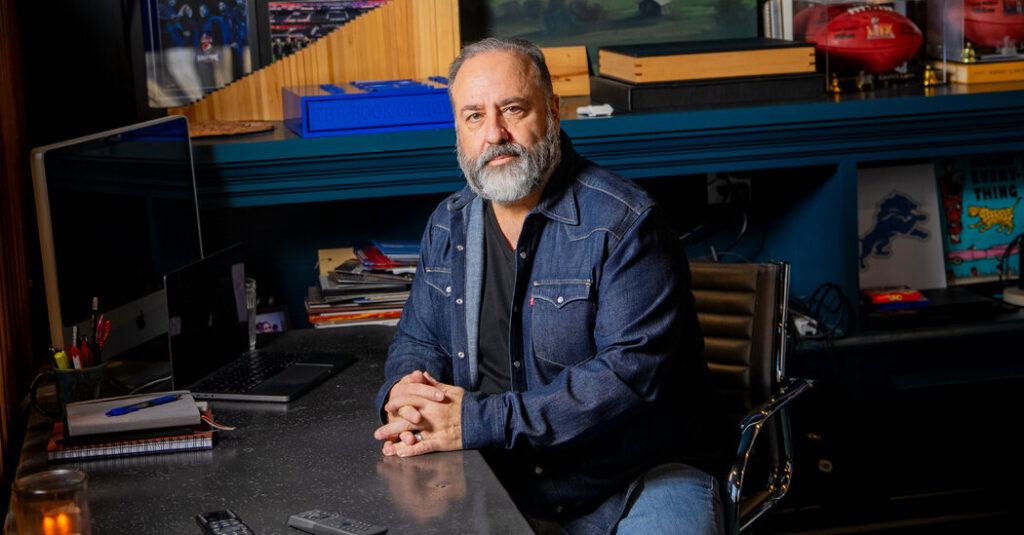
As the set production designer for the Super Bowl halftime show since 2007, Rodgers has transformed ideas and sketches from the likes of the Who, Lady Gaga and Dr. Dre into the physical stage seen, often in awe, by more than 100 million people. Colleagues described Rodgers — whose 20th Super Bowl production will be headlined by the Puerto Rican star Bad Bunny in Santa Clara, Calif., on Sunday — as the show’s glue, a gentle yet authoritative figure who deftly navigates deadlines, technical challenges and outsize egos.
“Bruce makes the impossible possible,” said Jesse Collins, the halftime show’s executive producer. “He’s been doing it a long time, but he’s not stuck in the past. He’s always looking to push the envelope.”
The Super Bowl halftime show, with its captive television audience and considerable technical constraints, presents challenges far beyond what most musical performances in stadiums and arenas do.
The stage must be assembled in about eight minutes, using rolling carts equipped with pneumatic tires. The field, already asked to withstand giants colliding into one another at top speed, can hold only so much additional weight. After the 12-minute performance, the stage must be torn down quickly before the second-half kickoff.
Rodgers said the logistical challenges meant that he often must convince artists to adjust, even scale down, their ambitions while keeping their core wishes intact.
But the limitations can also mean breathtaking innovation. Rihanna’s halftime show was acclaimed for its ambitious staging: seven silver platforms hanging from the roof of State Farm Stadium, above a minimalist runway on the ground.
The grass the N.F.L. had grown specifically for the game in Glendale, Ariz., could not hold as much weight as a more standard field. So Rodgers was allowed to use only 15 carts, he said, rather than the typical 40 or more. He suggested an aerial approach because of the venue’s distinctive domed roof, which uses 700-foot-long support beams known as Brunel trusses.
“People are hungry for spectacle and excitement and things they can talk about the next day,” Rodgers said. “They recognize when something maybe is a little bit half. I never want to be part of the half. I want to be part of, ‘Succeed by the skin of our teeth, but we are going to succeed.’”
The N.F.L., its production partners and the creative team of the headlining musician work with Rodgers each year. Aspects of the halftime show are tightly guarded beforehand, and Rodgers would not discuss detailed creative elements related to Bad Bunny.
Rodgers lives in a wooded home in Salem, Conn., where his three French bulldogs often invade virtual meetings, and where his memorabilia includes models of the rapper Kendrick Lamar’s video-game-like stage from last year’s Super Bowl and at least four Emmy Award statuettes.
He was raised in Odessa, Texas, the oil-industry town that serves as the setting for the TV series “Landman” and the inspiration for the show “Friday Night Lights.” Rodgers studied architecture and theater set design at Texas Tech University before helping to design an exhibit in Atlanta for the 1996 Summer Olympics. Soon after, he and his wife started a design company, Tribe, that today has seven employees, including their 25-year-old daughter.
Tribe’s early projects, which included shows for Fleetwood Mac, Ricky Martin and Madonna, caught the attention of Don Mischer, a renowned television producer who worked on Michael Jackson’s Super Bowl halftime show in 1993. Mischer asked Rodgers to be involved for Prince’s halftime show, where Rodgers pushed for Prince to appear primarily solo on a stage in the shape of the unpronounceable symbol that at the time was the artist’s name.
“I thought this was an opportunity to have this guy in the middle of this enormous stadium by himself, and for this guy to be able to prove to this giant stadium that he’s the baddest in the entire room,” Rodgers said, emphasizing his point with an expletive.
Prince’s show was widely praised, and Rodgers and Tribe were retained to work on other Super Bowl productions. In 2019, the N.F.L. entered a partnership with Roc Nation, the entertainment company founded by the rapper Jay-Z, to curate the halftime show. Rodgers had worked with Roc Nation before, including on Jay-Z’s tour with Eminem in 2010, so his job was safe.
“He’s just a genius, and we were like, ‘OK, one thing that doesn’t need to be fixed,’” said Desiree Perez, the chief executive of Roc Nation, referring to Rodgers.
She added, “Envision an architect meeting designer meeting contractor — you usually have three people in that role, and he can actually do all three.”
Since Roc Nation, whose Super Bowl halftime shows have included Usher, Dr. Dre and Jennifer Lopez, has been involved, Jay-Z has selected the headlining artist. At a sports business conference in October, Roger Goodell, the N.F.L. commissioner, said he never challenged Jay-Z’s decisions.
Once Rodgers learns who the artist is — usually in early August or September, at the same time that the rest of the world does — he meets with that person’s creative team to discuss an initial vision. By Thanksgiving, Rodgers said, he needs a finalized concept so that the props can be built in time.
Rodgers said that for last year’s halftime show featuring Lamar, he traded about 1,000 emails with Mike Carson, a co-creative director on the production alongside Lamar’s longtime business partner, Dave Free. Carson said he and Rodgers studied about five previous halftime shows, including Beyoncé’s 2013 performance, which took place in the same New Orleans stadium as Lamar’s.
When Carson showed Rodgers a design proposal that included several streetlamps, Rodgers suggested stabilizing them with a particular system so that they could keep performers safe while retaining the proper aesthetic.
“I don’t think it gets across the finish line if he doesn’t tell the N.F.L. or Roc Nation, ‘This is possible,’” Carson said.
Rodgers said he could remember similar conversations ahead of every halftime show over two decades. The Weeknd in 2021 with masks and social distancing. Madonna’s smoky, Egyptian-themed production in 2012. Katy Perry with a mechanical lion and dancing sharks in 2015.
“Because I’ve been around so long,” Rodgers said, “I don’t want to be that guy that wrecks them all the time. I want to be the supportive guy. I want to push for a little crazy.”
Emmanuel Morgan reports on sports, pop culture and entertainment.
The post Super Bowl Halftime Is the World’s Biggest Stage. He Designs It. appeared first on New York Times.