If the planet is getting warmer, why is it so cold this winter?
The seeming contradiction comes up often when talking to Judah Cohen, a research scientist at M.I.T. who has been studying how global warming might also be causing colder winters in the eastern United States.
The idea, explained Dr. Cohen, is that a warming Arctic can cause a high-altitude ribbon of air called the polar vortex to stretch and wobble. That wobble can affect the flow of the jet stream that controls much of the atmospheric conditions over the United States, causing waves of high and low pressure that affect our daily weather.
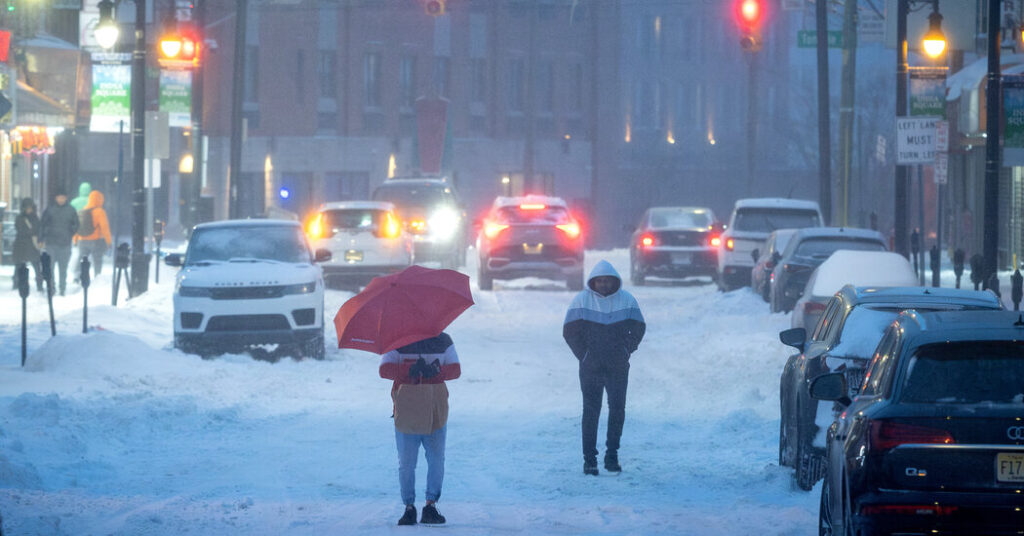
For weeks, a mass of frigid air over the North Pole has dipped into eastern North America, bringing record cold temperatures for a prolonged period. In the West, a ridge of warm, dry air has stalled for weeks, panicking ski resort operators and prompting concerns for communities that rely on a healthy snowpack for drinking water in the summer months.
The polar vortex stretched and wobbled in February 2021, causing a prolonged deep freeze that killed 248 people in Texas and knocked out power for millions. The same wobble reappeared in the winter of 2024-2025 and again last month, causing blizzard conditions across the East and an icy blast.
Dr. Cohen expects the grip of cold temperatures to continue throughout February.
“It’s weird what’s going on now in the stratosphere,” Dr. Cohen said. “These stretching events happen every winter, but just how the pattern is stuck is really remarkable.”
Climate warming in the Arctic is causing this disruption of the polar vortex, Dr. Cohen said. With more snowfall in Siberia and melting sea ice in the Barents and Kara seas, just north of Norway and Russia, the ocean is feeding more heat into the atmosphere, setting up a weather pattern that leads to a burst of extreme cold in North America.
Dr. Cohen cowrote a study in the journal Science last year that linked the stretching of the polar vortex to more frequent severe winter weather in the United States in the past decade. A new analysis by Dr. Cohen and colleagues finds that a warming Arctic is also making the wobble in the polar vortex last longer.
“This is very consistent with this winter,” he said.
Not all scientists agree.
“These are interesting ideas,” said Russell Blackport, a research scientist at Environment and Climate Change Canada. “But I’m very skeptical. When I look at these papers, they’re often not that convincing.”
Dr. Blackport said that the long-term temperature trends and climate models show the exact opposite, that extreme cold events are becoming less likely as the planet heats up from human-caused greenhouse gases. The Earth has warmed on average by about 1.4 degrees Celsius, or 2.52 degrees Fahrenheit, since the Industrial Age, according to Europe’s Copernicus Climate Change Service. That warming has been largely driven by the burning of oil, gas and coal.
“Climate models have long predicted that we should see these extreme cold events less often, they should be less severe than they used to be, and that’s exactly what we’re seeing in these longer term observations,” said Dr. Blackport, who published a 2024 study in the journal Science analyzing the trends of extreme winter weather in North America.
Jennifer Francis, a senior scientist at the Woodwell Climate Center in Falmouth, Mass., said it is too soon to tell whether the deep freeze in the East is linked to climate change, but agrees that long-term warming is changing seasonal weather patterns.
“It’s going to take some pretty in-depth work, research with models and so forth to untangle all of the different factors that could be playing a role,” Dr. Francis said.
Dr. Francis noted that a persistent patch of warm water in the North Pacific Ocean is causing ripples in the jet stream, with a bulge of high pressure in the west and a dip of low pressure in the east.
“Just like taking a jump rope and flicking it, you create a wave in one place and it tends to ripple downstream,” Dr. Francis said.
Amy Butler, a research scientist at the National Oceanic and Atmospheric Administration’s chemical sciences laboratory in Boulder, Colo., cautions that it’s difficult to link a given weather event, such as a cold spell, to climate change.
“What the data shows is that these cold extremes are getting less extreme, and they will continue to get less extreme,” she said.
For his part, Dr. Cohen is forecasting a slight contraction of the polar vortex over the next week, which will lead to milder temperatures. That will be followed by another stretch and wobble, followed by a new blast of cold air across the Midwest, Great Plains or eastern United States.
“I think in late February into early March, I would look for another one,” he said.
The post What’s Up With This Big Freeze? Some Scientists See Climate Change Link appeared first on New York Times.