We all sense that the world is entering a more uncertain phase. Alliances feel shakier, trade is fragmenting, and great powers are jostling more openly. But beneath these visible shifts lies something less discussed and more dangerous: the slow collapse of nuclear stability.
For much of the Cold War, people were terrified that a world with nuclear weapons would inevitably lead to proliferation and that wars would end up nuclear. After all, rarely in human history has a weapon sat unused in arsenals. But that is what happened. The arsenals remained, but they were bound by treaties, habits and doctrines about restraint. Arms control agreements capped numbers. Deterrence relationships were relatively clear. Proliferation was constrained, if imperfectly, by norms and pressure. It was not a safe world — but it was a stable one.
That era might be at an end.
The clearest marker was the expiration this week of New START, the last remaining nuclear arms control treaty between the United States and Russia. There are now no legally binding limits on the world’s two largest nuclear arsenals for the first time in more than 50 years. Some hope this will be a brief interregnum, and efforts have begun to find a successor agreement. But the broader context is not encouraging.
When New START was signed in 2010, it reflected a different world. Russia’s strategic weapons were aging. China’s nuclear arsenal was small and oriented toward what was called “minimum deterrence.” Now, as Eric Edelman and Franklin Miller write in Foreign Affairs, that world “no longer exists.”
Russia has modernized roughly 95 percent of its strategic nuclear forces, at least according to President Vladimir Putin. More worrying, Moscow has built a vast regional nuclear arsenal — experts estimating some 1,500 tactical weapons deployable from land, air and sea. These systems fell outside New START altogether. During the war in Ukraine, Putin has repeatedly invoked nuclear threats, engaging in a scary game of blackmail.
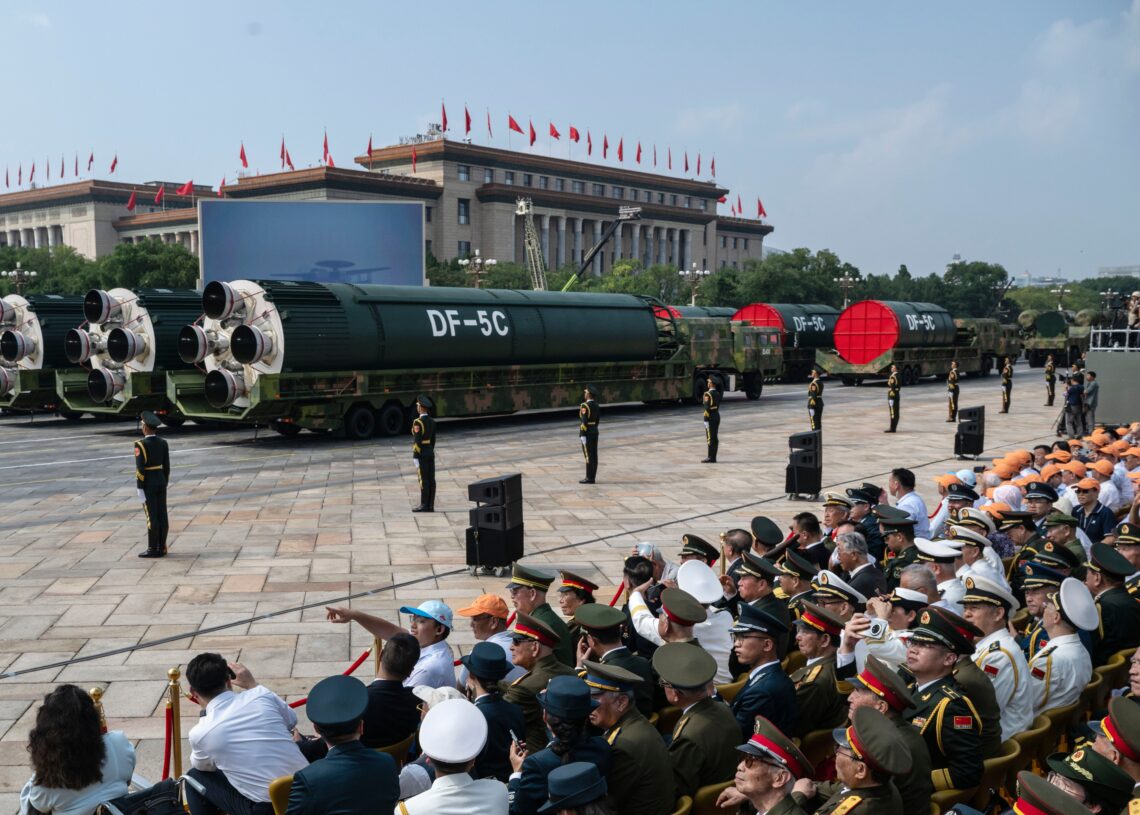
China’s trajectory may be even more consequential. When Xi Jinping came to power in 2012, China possessed roughly 240 nuclear warheads. Today it has more than 600 and is on track to reach 1,000 by 2030, according to U.S. estimates. China is fielding a full nuclear triad — land-based missiles, ballistic-missile submarines and air-launched weapons — and moving toward more frequent levels of high alert, including the capacity for “launch on warning”: launching while an adversary’s missiles are still in the air.
The Biden administration sought to slow this buildup through dialogue, pressing Beijing to enter nuclear arms discussions. The response was blunt. China would seriously talk only when its arsenal matched more closely that of the U.S. and Russia. As Edelman and Miller note, Beijing views transparency and verification not as confidence-building measures but as vulnerabilities. Arms control is seen as a constraint to be avoided.
The result is a three-sided nuclear competition, far more complex than the bipolar standoff of the Cold War. The Economist captures the shift with a vivid image: What Robert Oppenheimer, the father of the atomic bomb, once called “two scorpions in a bottle” has become three — the more crowded bottle means the scorpions are less predictable.
This matters because deterrence grows more fragile as the system grows more complex. A bipolar nuclear world was dangerous but legible. A tripolar — or multipolar — one is not. Russia and China are cooperating more closely, exchanging technology and conducting joint military exercises, sometimes involving nuclear-capable forces. A bipartisan U.S. Strategic Posture Commission warned in 2023 of the risk of “opportunistic aggression” or even coordinated pressure across multiple theaters. American nuclear forces, designed for a largely bilateral rivalry, weren’t meant to deter two peer adversaries simultaneously.
Arms races are dangerous. Numbers creep up. Doctrines blur. The risk of miscalculation rises — not just in war but also in crises, exercises or moments of panic. Modern nuclear systems are increasingly entangled with cyber networks, space-based sensors and compressed decision timelines. A false alarm or misread signal can escalate far faster than in the past.
The danger does not stop with the major powers. According to the New York Times, about 40 countries have the technical skills to produce nuclear weapons.
For decades, nuclear nonproliferation rested on a bargain: Most countries would forgo nuclear weapons in exchange for security guarantees and the promise that nuclear states would manage their arsenals responsibly. Both pillars are now under strain.
As doubts grow about America’s willingness to protect allies consistently, some are quietly reassessing their options. In South Korea, debate about acquiring an independent nuclear deterrent has moved from the margins toward the mainstream. In Japan, once-unthinkable discussions are now whispered among strategists. If such moves begin in northeast Asia, they will not end there.
We are drifting from managed deterrence toward competitive rearmament, from limits toward accumulation, from predictability toward improvisation.
For decades, we lived under the shadow of the most powerful weapons in history and learned, imperfectly, how not to use them. That achievement is a landmark but may prove to be fragile and temporary.
The post The post-Cold War nuclear era might have just ended appeared first on Washington Post.