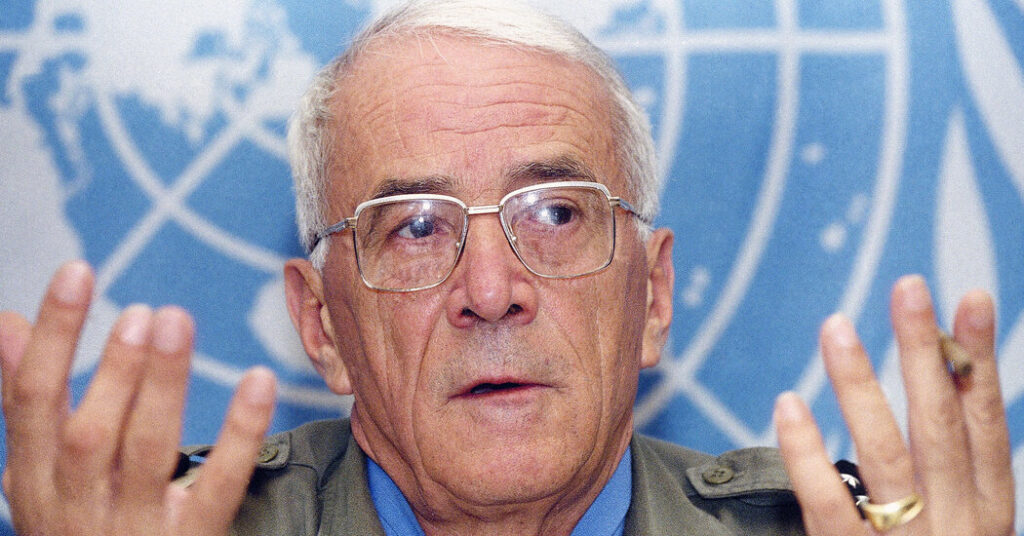
Philippe Morillon, a French Army general whose vow in 1993 to protect a Bosnian town during that country’s civil war made him a hero, until nearly 8,000 of its Muslim men and boys were killed two years later — long after he had left — in Europe’s worst massacre since World War II, died on Jan. 29 in Saumur, a town in western France. He was 90.
His death was announced by President Emmanuel Macron of France, who said General Morillon had “represented, for our fellow citizens, the embodiment of the spirit of Resistance in the face of the unjust forces of History.”
Official France had not always looked so kindly on the general, who lived to regret his promise, and was torn by guilt over having made it. It had been a rare moment of decisive action by the United Nations, and the general and others paid for it.
The war had begun after the breakup of the former Yugoslavia in 1991, with separatist Serbs conducting a brutal campaign for independence from the Republic of Bosnia and Herzegovina, itself newly independent in 1992. U.N. peacekeepers arrived in Sarajevo that June.
On March 12, 1993, surrounded by besieged Muslim citizens in Srebrenica, General Morillon, then commanding the U.N. peacekeeping forces in Bosnia, stood in the second-floor window of the post office and declared, “You are now under the protection of the United Nations.” He added, “I will never abandon you.”
The town was starving. More than half its 60,000 residents were already refugees from other massacres and depredations. The people faced slaughter at the hands of the Serbian troops, who were already well versed in ethnic cleansing and were laying siege.
He had no authority and no authorization from his superiors to make such a declaration, or even the permission to enter the town in the first place. The general’s bosses in Paris and at the U.N. were “furious,” the journalist David Rohde, who received a Pulitzer Prize for his coverage of the Srebrenica massacre, wrote in his 1997 book about the town’s fate, “Endgame.”
However, the citizens of Srebrenica were overjoyed. General Morillon stayed on for nearly two weeks, through the end of March 1993. He negotiated the arrival of food convoys through Serb lines and became a hero to the citizens there and in France, where the television networks called him “General Courage.”
A contemporary dispatch in The New York Times was headlined “France Finds a Hero in Balkan Town.” General Morillon walked the streets of Srebrenica with bouquets of flowers in his hand, Mr. Rohde reported in his book.
General Morillon had tried to leave the day before he made his speech, but his armored car was surrounded by frightened citizens.
Fatima Husejnovic, a local activist, recalled years later on Radio Deutsche Welle: “We had no water, electricity or food. We were shelled from Serbia every day, people were dying. The idea came to my mind that we should not let the general leave the city.”
Then, General Morillon tried to walk out of the town at night but, shocked at the suffering he witnessed, reconsidered his escape. “I was there, walking in the snow, in the pitch darkness, and I suddenly realized that they were the ones who were right,” he said later in an interview with the French newspaper Libération. He made his famous speech the next day.
Despite the grumbling from his superiors, General Morillon’s pronouncement about protecting residents had immediate repercussions. In mid-April, after he had left the town, the U.N. Security Council voted to make Srebrenica the world’s first U.N. “safe area.” It was a vague term and, in the end, it proved a hollow promise.
The general was relieved of his command that July, “largely because of his actions in Srebrenica,” Mr. Rohde wrote.
“Many of his peers never forgave him his moment of media glory and his ‘personal initiative,’ which forced Paris and the U.N. into recognizing a fait accompli,” the journalist Marc Semo wrote in Libération three years later, having interviewed General Morillon just after his retirement from the army.
The year before, in 1995, a contingent of outnumbered and lightly armed Dutch U.N. peacekeepers had stood by, inert, as Serbian forces under Gen. Ratko Mladic entered Srebrenica and systematically massacred all the men and boys they could find. The remaining women were raped. That same year, the Dayton peace accords, negotiated with American help and after NATO bombardments, ended a war that had killed more than 100,000 people.
In 2017, General Mladic was found guilty of war crimes, crimes against humanity and genocide by the International Criminal Tribunal for the Former Yugoslavia in The Hague, for his role there and in the shelling of Sarajevo. He was sentenced to life in prison.
General Morillon was left to ponder whether had made the right decision in vowing to protect the citizens of Srebrenica, in March 1993.
“This is a painful memory,” he said on France 2 television in 2004. “Unfortunately, I was only able to save the population provisionally, for two years,” he said. “Perhaps I exceeded my mandate,” the general mused.
“I’ve got this feeling that I unnecessarily prolonged the calvary of the inhabitants of that enclave,” he told Mr. Semo, referring to the religious experience of intense suffering.
In 2010 General Morillon, a devout Catholic, went back to Srebrenica to ask for forgiveness. He was chased away under a hail of insults from the town’s grieving widows.
Philippe Morillon was born on Oct. 24, 1935, in Casablanca, in what was then the French protectorate of Morocco, the son of an officer in the Indigenous Affairs directorate killed during the fall of France in 1940.
An uncle wounded and decorated during the French military debacle of Dien Bien Phu in 1954, along with a “profound contempt for the bourgeois who thinks only of his comfort,” inspired him to pursue a military career, he wrote in his 1996 book “Paroles de Soldat” (“A Soldier’s Words”).
He graduated from the elite French military academy at Saint-Cyr in 1956, served in France’s colonial war in Algeria, and supported the generals who staged a failed putsch in 1961 against President Charles de Gaulle over his plan to grant Algerian independence.
“I learned from this putsch that the military, which has the force of arms, should never be the ones who decide how to use it,” he said on France 2.
He left the army briefly over bitterness at the Algerian debacle, graduating from France’s advanced electrical engineering school, Supélec, in 1964, and then rejoined the military, commanding a tank regiment in Germany near the Czech frontier. He graduated from the French Army Staff College in 1974.
After his military retirement as a five-star general, he helped organize the Catholic Church’s World Youth Day in Paris in 1997; testified in 2004 at the international court in The Hague examining the crimes committed in the Bosnian war; and was elected to the European Parliament as a member of the center-right UDF deputy in 1999, then re-elected five years later.
He is survived by his wife, Christine (Gaudry) Morillon; three daughters, Ellinor, Elisabeth and Marie-Alix; 21 grandchildren; and 19 great-grandchildren.
The centrist French politician Jean-Louis Bourlanges, a close friend, wrote in a tribute published in the Catholic daily La Croix that Srebrenica’s “wound had never closed” for General Morillon. Mr. Bourlanges extolled the general’s humanist values.
“Man will remain a wolf for other men,” General Morillon wrote in his book. “So it’s worthwhile that there will continue to be those who, joining military service, are motivated by the ideal of justice, and the defense of human dignity.”
Adam Nossiter has been bureau chief in Kabul, Paris, West Africa and New Orleans and is now a writer on the Obituaries desk.
The post Philippe Morillon, General Who Made Fateful Protection Promise, Dies at 90 appeared first on New York Times.