The director of a Colorado funeral home was sentenced to 40 years in prison on Friday as family members spoke in court of their anguish after detectives discovered nearly 200 decomposing bodies stored improperly and that fake ashes had been delivered to grieving loved ones.
“Every time I approach this case, I am bowled over again by the enormity of the harm that was inflicted,” Eric Bentley, a district court judge in Colorado, said during the sentencing. “This is not ordinary harm.”
Jon Hallford, 46, who is serving a 20-year prison term on federal fraud charges, and his wife, Carie Hallford, 49, were the owners of the Return to Nature Funeral Home in Colorado Springs.
They were arrested on Nov. 8, 2023, on suspicion of abuse of a corpse, theft, money laundering and forgery.
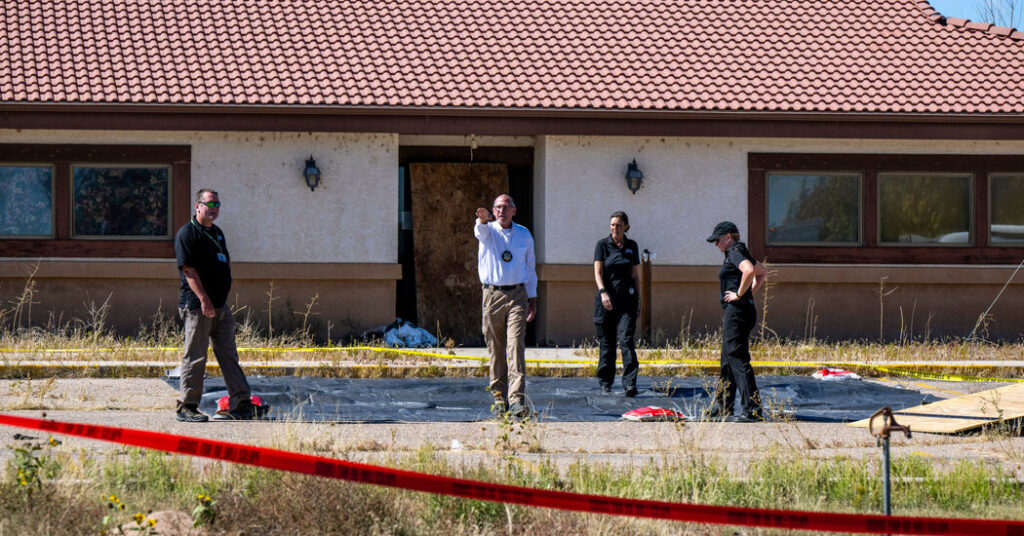
The charges stemmed from an investigation that was initiated in 2023 after reports of a foul odor coming from the funeral home’s facility in Penrose, Colo. Fremont County deputies found 189 decomposing bodies improperly stored there and two bodies improperly buried, the authorities said.
In December, the couple separately entered guilty pleas in their state criminal cases, which are being prosecuted in El Paso County. Ms. Hallford pleaded guilty in August in federal court and will be sentenced on March 16.
Under a plea agreement in state court, Mr. Hallford faced a sentence of 30 to 50 years, while Ms. Hallford faces a prison sentence of 25 to 35 years when she is sentenced on April 24.
Judge Bentley sentenced Mr. Hallford to the middle of the range, 40 years, which will run concurrently to the federal sentence.
“I consider 40 years to be an extraordinary sentence,” Judge Bentley said, noting that sentences this long are usually reserved for violent crimes, like murder and attempted murder.
The charging documents in Mr. Hallford’s state case showed more than 200 counts between August and October 2023 of money laundering, theft, forgery and abuse of a corpse, defined under state law as treating “the body or remains of any person in a way that would outrage normal family sensibilities.”
Judge Bentley handed down his sentence after listening to relatives of the deceased, whose bodies were stacked in a pile in the funeral home in Penrose, about 100 miles south of Denver.
Loved ones spoke about their siblings, parents, grandparents and children. Many described Mr. Hallford as treating their loved ones like “trash” or “garbage.”
“I miss my mom every single day, and that means I think of what happened to her every single day,” said Derrick Johnson. “A life sentence, if you will.”
Mr. Johnson told Judge Bentley that he was diagnosed with post-traumatic stress disorder after his mother’s body was discovered rotting inside the funeral home.
Mr. Johnson said loved ones were subjected to “psychological violence.” Several speakers spoke of nightmares, anxiety and struggles with mental health.
As the judge revealed his decision, many in the courtroom shook their heads. At times he had to rein in speakers as they started to insult Mr. Hallford. Many cried. Three statements in support of Mr. Hallford were read, including one from his eldest son.
Mr. Hallford spoke, expressing his regret and apologizing to the families, community, lawyers, emergency responders and the court.
“I deserve every word you have said and every day that I will sit in prison,” he said. “Regret will sit with me the rest of my life.”
Prosecutors have said the Hallfords had been leaving bodies to decompose at the site for years, giving families dust-filled urns or the wrong bodies for burials. In court, families have testified about burying boxes of dust when they thought they were interring the cremated remains of their loves ones.
The funeral home was part of a growing number that offer “green” burials as an environmentally sensitive alternative to funerals that require embalming fluids and elaborate coffins.
In 2021, Colorado became the second state, after Washington State, to legalize human composting to allow bodies to be turned into soil.
The Return to Nature Funeral Home offered burials without chemicals or concrete vaults, according to its website. It said that bodies could be buried in biodegradable caskets, baskets, shrouds or “even nothing at all.”
After the bodies were discovered, the E.P.A. was requested to help demolish the building because of hazardous levels of human remains and chemicals in the building.
Christine Hauser is a Times reporter who writes breaking news stories, features and explainers.
The post Colorado Funeral Home Director Is Sentenced to 40 Years in Corpse Abuse Case appeared first on New York Times.