President Trump moved on Friday to allow commercial fishing in the only marine national monument in the Atlantic Ocean, an area the size of Connecticut that is home to dolphins, endangered whales, sea turtles and ancient deep-sea corals.
Mr. Trump signed a proclamation opening up the Northeast Canyons and Seamounts Marine National Monument, which lies 130 miles off the coast of Cape Cod. President Barack Obama created the monument in 2016, and Mr. Trump tried to lift the ban on commercial fishing there during his first term, but President Joseph R. Biden Jr. reinstated the restrictions.
“I find that appropriately managed commercial fishing would not put the objects of historic and scientific interest that the monument protects at risk,” Mr. Trump wrote in the proclamation.
This was the second time that Mr. Trump opened a marine national monument to commercial fishing. In April 2025, he ended protections for the Pacific Islands Heritage Marine National Monument, which lies about 750 miles west of Hawaii and was established by President George W. Bush in 2009.
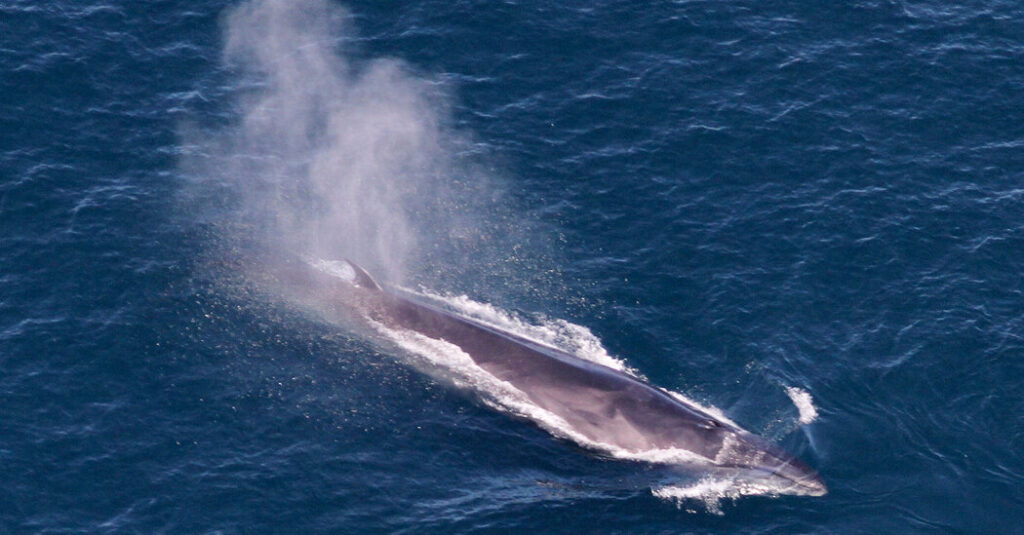
The Northeast Canyons and Seamounts Marine National Monument spans about 4,913 square miles and covers three underwater canyons and four underwater mountains known as seamounts. It is home to at least 10 dolphin species and 13 whale species, including the endangered sperm whale, sei whale and fin whale, according to the U.S. Fish and Wildlife Service, which manages the site, along with the National Oceanic and Atmospheric Administration.
The area is also known for its deep-sea corals, which grow only thousands of feet beneath the ocean’s surface, where sunlight cannot penetrate. These corals, along with sponges and anemones, provide critical refuges where deep-sea fish can feed, breed, rear their young and hide from predators.
Trump Administration: Live Updates
Updated
- A key House Republican is the latest to announce plans to exit Congress.
- Vice President Vance is booed at the Olympics opening ceremony in Milan.
- Trump is hosting governors at the White House, but only Republicans.
Environmentalists said commercial fishing in the area would threaten these fragile ecosystems. They also argued that Mr. Trump was violating the Antiquities Act of 1906, which gives presidents the power to create national monuments but not to reverse the designations of their predecessors.
“Northeast Canyons and Seamounts is a truly special place: a living scientific laboratory, a refuge for creatures as varied as cold-water corals and sperm whales,” Brad Sewell, the managing director of oceans at the Natural Resources Defense Council, an environmental group, said in a statement. “Trump’s move to dismantle those protections is unlawful, and we’re confident that it won’t stand.”
The move was expected to draw praise from fishing industry groups, including the Massachusetts Lobstermen’s Association, which led a legal challenge to Mr. Obama’s creation of the monument. Representatives for the association did not immediately respond to a request for comment.
A federal judge struck down the lawsuit brought by the lobstermen’s group in 2018. Judge James E. Boasberg of the U.S. District Court for the District of Columbia ruled that just as President Theodore Roosevelt had the power to establish the Grand Canyon National Monument in 1908, so Mr. Obama had the authority to create a marine national monument more than a century later.
The Northeast Canyons and Seamounts Marine National Monument lies in a part of the Atlantic Ocean that is warming more than three times as fast as the global average. Mr. Obama announced the designation of the monument at an ocean conservation meeting in Washington, where he framed the move as a critical step to preserve ecosystems at risk as the planet grew hotter.
“If we’re going to leave our children with oceans like the ones that were left to us, then we’re going to have to act, and we’re going to have to act boldly,” Mr. Obama said.
Maxine Joselow covers climate change and the environment for The Times from Washington.
The post Trump Opens Marine National Monument in Atlantic to Commercial Fishing appeared first on New York Times.