This is an edition of The Atlantic Daily, a newsletter that guides you through the biggest stories of the day, helps you discover new ideas, and recommends the best in culture. Sign up for it here.
For as long as the Trump family has been cashing in on crypto, Don Jr., Eric, and their affiliates have deployed a particular narrative about their reasons for investing in the industry. Back in 2024, before the launch of a crypto empire that has now reportedly added at least $867 million to the family fortune, Don Jr. said on his podcast that digital assets were “obviously very appealing to guys like me who have been debanked”—an umbrella term for being cut off from a financial institution—“because they don’t check certain boxes.”
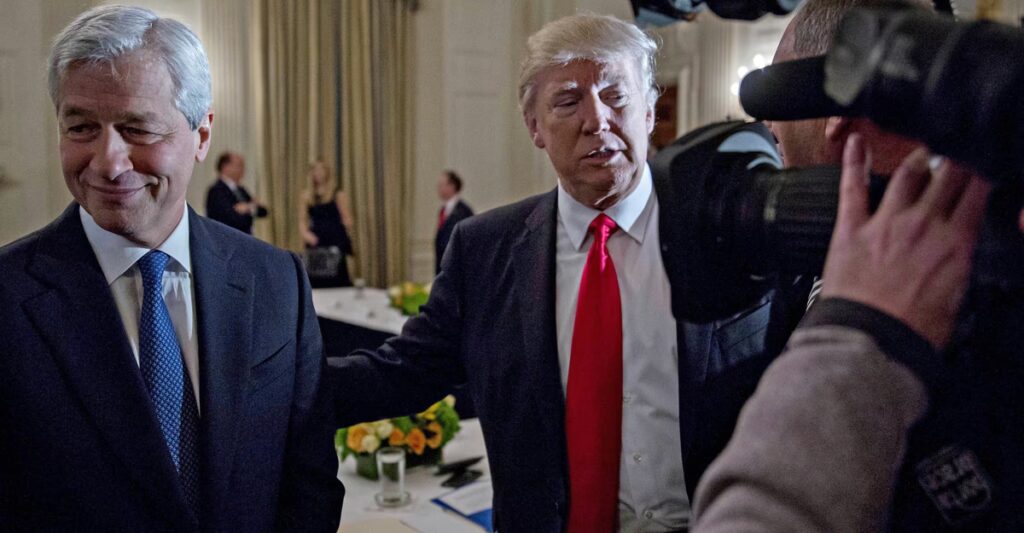
That same narrative is behind the president’s current legal assault on major banks. When Donald Trump returned to office last year, he started going after some of the businesses and individuals who he believed had wronged him in the past. On the list were universities, white-shoe law firms, and some of America’s largest banks. In a recent $5 billion lawsuit against JPMorgan Chase and its CEO, Jamie Dimon, which follows a similar suit from last year against Capital One, Trump alleged that he had been debanked on unfair grounds. In court filings, he accused each firm of closing his accounts in 2021 due to “political and social motivations” and “unsubstantiated, ‘woke’ beliefs” that they needed to distance themselves “from President Trump and his conservative political views.” (The JPMorgan suit, which the company said has “no merit,” arrived a day after Dimon publicly criticized the president’s proposal to cap credit-card interest rates; Capital One has also denied Trump’s allegations and filed a motion to dismiss the case.)
The Trumps were indeed cut off from some financial services in 2021. But although they claim that it had to do with political bias and checking “certain boxes,” there is likely a simpler explanation: the fact that, on January 6, the president fomented a riot at the Capitol and tried to overturn the results of a national election. In the weeks and months after the insurrection, Deutsche Bank and Signature Bank reportedly refused further dealings with Trump, and Capital One and JPMorgan closed many of his personal and business accounts. Part of the reason debanking has become such a flashpoint is that financial institutions aren’t required to explain to their customers why they’ve been cut off. Despite much speculation at the time, only Signature publicly provided reasoning for its decision, citing the Capitol attack.
Debanking is a nebulous concept. It can include loan denials as well as account closures for financial or nonfinancial reasons, and it can encompass broad actions across multiple banks as well as a single action at one bank. It’s not clear whether JPMorgan and Capital One actually discriminated against Trump on the basis of his political views. And even if they are found to have done so, the law is not clear on whether that’s illegal.
The legal experts I spoke with said that Trump’s argument is shaky. The Equal Credit Opportunity Act prevents discrimination against customers on the basis of race, color, religion, national origin, sex, marital status, and age—but, crucially, not political alignment. Beyond that, banks are mostly free to choose whom they do business with. And financial dealings with Trump were considered risky well before January 6, thanks to his history of business failures. In 2016, The New York Times reported that some bankers had captured the sentiment in a neat, two-word phrase: Donald risk.
That risk was only exacerbated by the events of January 6 and by Trump’s impeachment soon after, when it became apparent that there would be some kind of reckoning for what had happened at the Capitol. Nicholas Anthony, a policy analyst at the Cato Institute, a libertarian think tank, told me that the riot was “very reasonable” grounds “for any institution to drop a client.” The banks “were wary of the public seeing them doing business with Trump-related organizations,” Graham Steele, a Stanford Law fellow who worked in the Treasury Department under Joe Biden, explained to me; they were also likely “worried that somehow the funds in their accounts would be found to have helped finance, frankly, an insurrection.”
Even outside of these lawsuits, Trump has argued that conservatives are often targets for debanking. Last summer, he signed an executive order intended to protect customers who are debanked because of their political or religious beliefs. Although this may sound good on paper, he’s focused on the wrong issue. A 2025 review from Reuters found that out of the thousands of complaints about closed bank accounts filed with the Consumer Financial Protection Bureau, fewer than 1 percent of them “include the terms ‘politics,’ ‘religion,’ ‘conservative’ or ‘Christian.’”
But exclusion from the American banking system remains a real problem, particularly for low-income people and people of color. There are few broad studies on the debanking phenomenon as Trump seems to understand it—but there’s plenty of data on the communities that have historically been excluded from the financial system. A 2023 report from the Federal Deposit Insurance Corporation found that Black, Hispanic, and American Indian households were unbanked (meaning they have no checking or savings account) at much higher rates than white households, and that the share of households with no form of mainstream credit at all (credit cards, mortgages, car loans) was higher among lower-income and less-educated households.
“There are certain communities that have a legacy of having been redlined out of getting access to credit and financial services,” Steele said. “That’s the real debanking problem.” Trump’s lawsuits and executive order probably won’t do much to chip away at that systemic issue. The president may say that he is protecting those who face discrimination, but his goals here are, as usual, extremely personal.
Related:
Here are three new stories from The Atlantic:
- The fall of the house of Assad
- The Obama meme on Trump’s Truth Social was exactly what it looked like.
- Peter Wehner: The evangelicals who see Trump’s viciousness as a virtue
Today’s News
- After widespread backlash, including condemnation from Republicans, President Trump deleted a racist video he’d reposted on his social-media account late yesterday depicting Barack and Michelle Obama as apes. The White House had initially dismissed criticism before the clip was removed.
- Trump-administration officials pressured Senate Minority Leader Chuck Schumer to support renaming New York’s Penn Station and Washington Dulles International Airport after Trump in exchange for releasing frozen federal funds for a major Hudson River rail tunnel, according to people familiar with the talks. Schumer, who has no direct oversight of either Penn or Dulles, rebuffed the request. The funding remains stalled.
- Members of Congress will be able to review unredacted files in the Jeffrey Epstein case on Justice Department computers starting Monday, according to sources familiar with the matter.
Dispatches
- The Books Briefing: Reading is a practice, not a chore, Boris Kachka writes.
Explore all of our newsletters here.
Evening Read
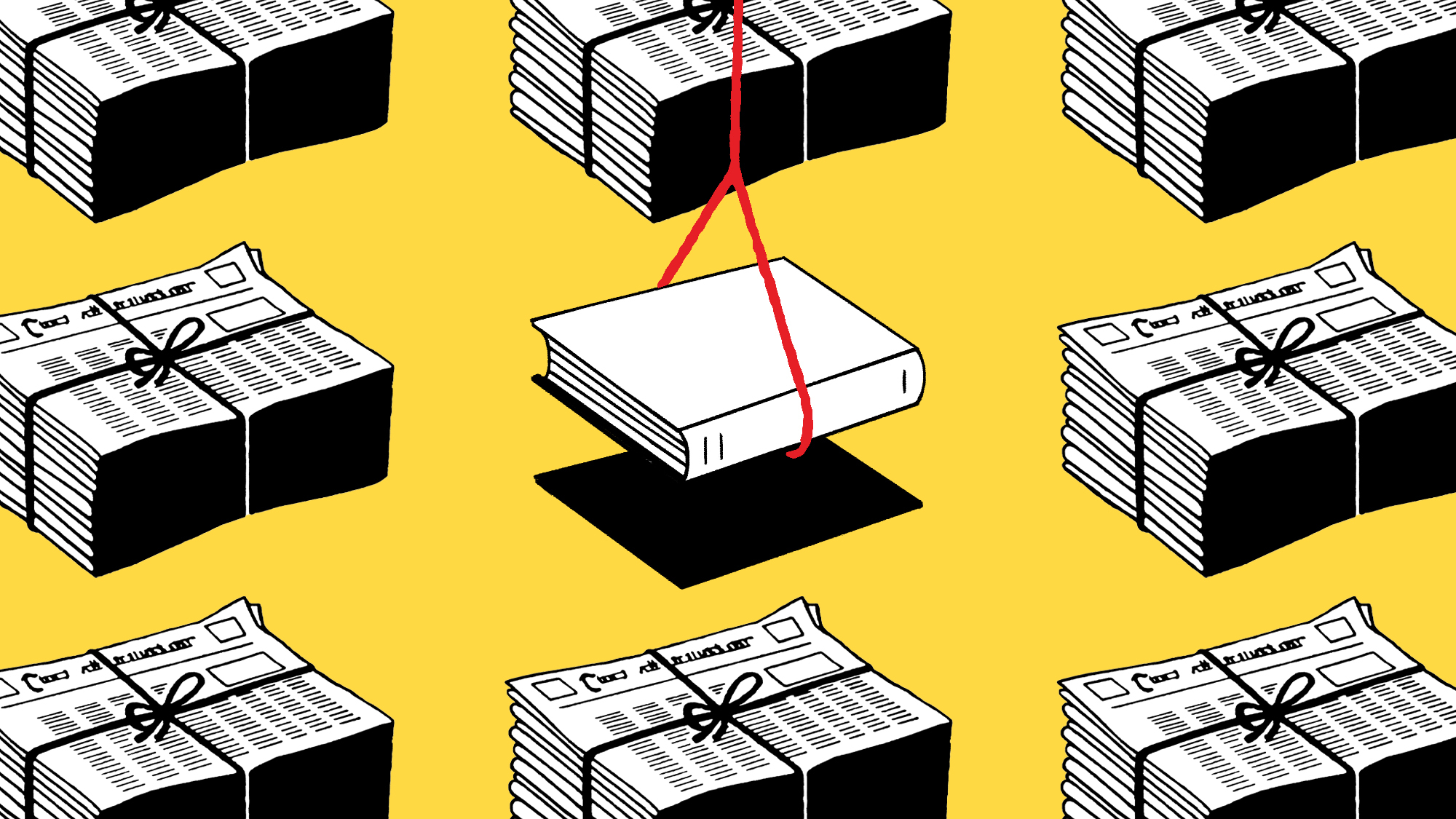
The Literary Ecosystem Is Dying
By Adam Kirsch
With this week’s announcement of massive cuts at The Washington Post, the paper’s Book World supplement earned a dismal distinction: It may be the only newspaper book-review section to have been killed twice. The first time was in 2009, when papers across the country were slashing books coverage in an attempt to stave off budgetary apocalypse. So when the Post relaunched Book World in 2022, readers and writers reacted with the same mixture of amazement and trepidation inspired by the dinosaurs at Jurassic Park. The rebirth of a dead species was wonderful to see, but how would it end?
More From The Atlantic
- Nicholas Florko: Donald Trump wants to be America’s pharmacist.
- Autocracy in America: Democracy under occupation
- Jonathan Chait: Democrats mess with winning in Texas.
- Galaxy Brain: The manosphere breaks containment.
- Arash Azizi: What Iran’s dead loved and fought for
- Autocracy in America: How autocrats meddle with elections
Culture Break
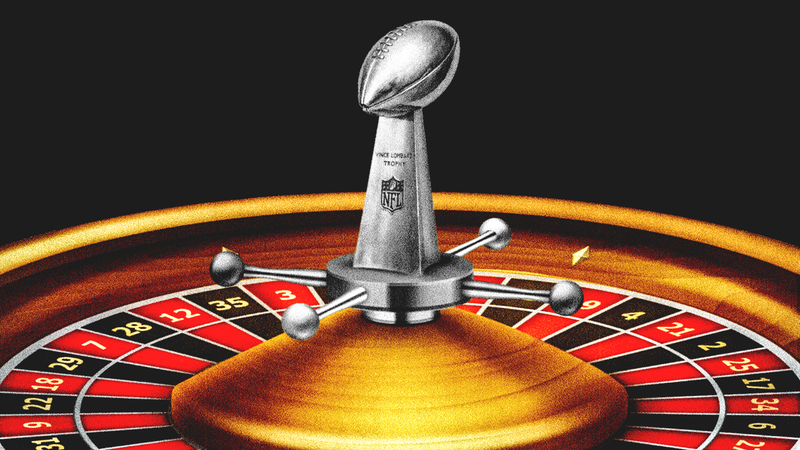
Explore. You’ve never seen Super Bowl betting like this before, Jacob Stern writes.
Read. In his new novel, Daniyal Mueenuddin attempts to bring together the stories of people whose lives rarely intersect in meaningful ways, Karan Mahajan writes.
Rafaela Jinich contributed to this newsletter.
When you buy a book using a link in this newsletter, we receive a commission. Thank you for supporting The Atlantic.
The post Why Trump Is Picking Fights With Big U.S. Banks appeared first on The Atlantic.