
Virginia is the new Illinois.
The practice of drawing partisan districts is named after Elbridge Gerry, the 19th-century Massachusetts governor.
Even he might blush at the extreme gerrymander that Democrats in the commonwealth are pushing.
They want to go from a congressional delegation with six Democrats and five Republicans — broadly representing the partisan make-up of the state — to a 10-1 Democratic advantage.
In other words, purplish Virginia would have a congressional delegation that, in percentage terms, would be more Democratic than that of Illinois; Virginia’s delegation would be 91% Democratic, the Land of Lincoln’s a mere 82%.
Another way to look at it is that Virginia would be almost as purely Democratic as Massachusetts, which has a 9-0 split.
Virginia is reliably Democratic in presidential elections (Kamala Harris won 51% of the vote), but isn’t Vermont (where Harris won nearly 64%) or California (58.5%).
Prior to this year and the inauguration of new statewide officials, Virginia had a Republican governor, a Republican lieutenant governor and a Republican attorney general.
The GOP held a majority in the state House as of 2023 and today is only a step behind Democrats in the state Senate, 21-19.
Yet, the substantial portion of the statewide electorate — sometimes a majority — that votes Republican will be almost completely shut out of congressional seats.
And, of course, this is being done in the name of “democracy.”
Virginia’s move, which still needs to clear hurdles, is a salvo in the mid-decade redistricting wars set off by President Donald Trump and the GOP, beginning in Texas.
It was foolhardy of the GOP to go down this road, but now Democrats in a relatively moderate state are creating a new standard for audacity.
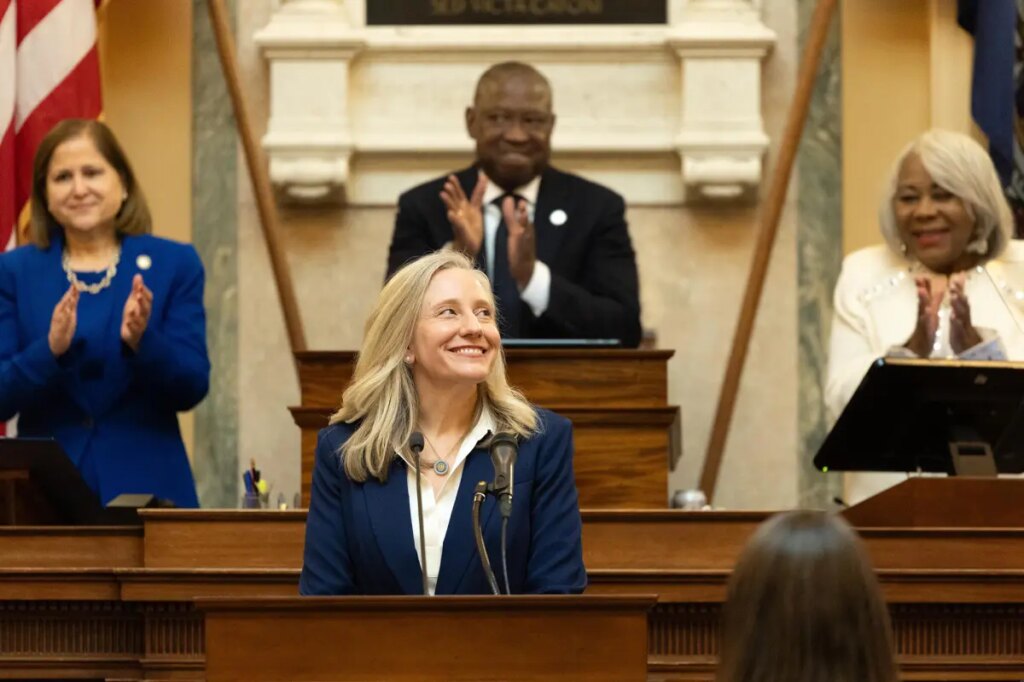
Buoyed by their election victory last year — led at the top of the ticket by Gov. Abigail Spanberger, who is supposed to be a centrist — Democrats have tortured the map to produce the 10 presumptively Democratic seats.
One of their methods is to tap into populous, deep blue Northern Virginia to scoop up heavily Democratic voters, and then draw districts extending into less populated, Republican areas.
The idea is that the Northern Virginia contingent will overwhelm the more rural voters, ensuring that they have little chance of electing a member of Congress who reflects their priorities.
In this sense, the map is not just a partisan power play, but a means of giving Northern Virginia hugely disproportionate sway over the state’s congressional delegation.
One district will reach from the inner suburb of Arlington all the down to York County in the Tidewater area, a roughly three-hour drive.
For all that these areas have in common, the district might as well stretch all the way to Erie, Pa.
To try to force through their map, Virginia Democrats need to maneuver around a constitutional amendment passed by voters in 2020 to create a nonpartisan districting commission, exactly to avoid the kind of outrage Democrats are now proposing.
The amendment passed with 66% of the vote, a strong message from the public that it didn’t want gerrymandered districts.
Democrats have now blown past procedural requirements for re-amending the constitution to allow for their plan, and may yet get blocked by the state’s Supreme Court.
The measure also has to pass in a referendum, and there’s a chance voters reject it, although Democrats have scheduled the vote for April, when turnout is low.
None of this is worthy of a state with one of the finest political traditions in America.
Virginia Democrats tell themselves they are just responding to Texas, but Democratic states like Illinois and California were already heavily gerrymandered prior to the Lone Star state redrawing its map, and Virginia is going above and beyond in its rank partisan grubbiness.
Virginia is reliably Democratic in presidential elections (Kamala Harris won 51% of the vote), but isn’t Vermont (where Harris won nearly 64%) or California (58.5%).
Prior to this year and the inauguration of new statewide officials, Virginia had a Republican governor, a Republican lieutenant governor and a Republican attorney general.
The GOP held a majority in the state House as of 2023 and today is only a step behind Democrats in the state Senate, 21-19.
Yet, the substantial portion of the statewide electorate — sometimes a majority — that votes Republican will be almost completely shut out of congressional seats.
And, of course, this is being done in the name of “democracy.”
Virginia’s move, which still needs to clear hurdles, is a salvo in the mid-decade redistricting wars set off by President Donald Trump and the GOP, beginning in Texas.
It was foolhardy of the GOP to go down this road, but now Democrats in a relatively moderate state are creating a new standard for audacity.
Buoyed by their election victory last year — led at the top of the ticket by Gov. Abigail Spanberger, who is supposed to be a centrist — Democrats have tortured the map to produce the 10 presumptively Democratic seats.
One of their methods is to tap into populous, deep blue Northern Virginia to scoop up heavily Democratic voters, and then draw districts extending into less populated, Republican areas.
The idea is that the Northern Virginia contingent will overwhelm the more rural voters, ensuring that they have little chance of electing a member of Congress who reflects their priorities.
In this sense, the map is not just a partisan power play, but a means of giving Northern Virginia hugely disproportionate sway over the state’s congressional delegation.
One district will reach from the inner suburb of Arlington all the down to York County in the Tidewater area, a roughly three-hour drive.
For all that these areas have in common, the district might as well stretch all the way to Erie, Pa.
To try to force through their map, Virginia Democrats need to maneuver around a constitutional amendment passed by voters in 2020 to create a nonpartisan districting commission, exactly to avoid the kind of outrage Democrats are now proposing.
The amendment passed with 66% of the vote, a strong message from the public that it didn’t want gerrymandered districts.
Democrats have now blown past procedural requirements for re-amending the constitution to allow for their plan, and may yet get blocked by the state’s Supreme Court.
The measure also has to pass in a referendum, and there’s a chance voters reject it, although Democrats have scheduled the vote for April, when turnout is low.
None of this is worthy of a state with one of the finest political traditions in America.
Virginia Democrats tell themselves they are just responding to Texas, but Democratic states like Illinois and California were already heavily gerrymandered prior to the Lone Star state redrawing its map, and Virginia is going above and beyond in its rank partisan grubbiness.
Democratic state Sen. Louise Lucas crowed after Democrats produced their maps, “We said 10-1, and we meant it.”
Yes, indeed, they are determined to protect democracy — Virginia voters be damned.
Twitter: @RichLowry
The post Virginia Democrats aim to ‘protect’ democracy — by screwing voters appeared first on New York Post.