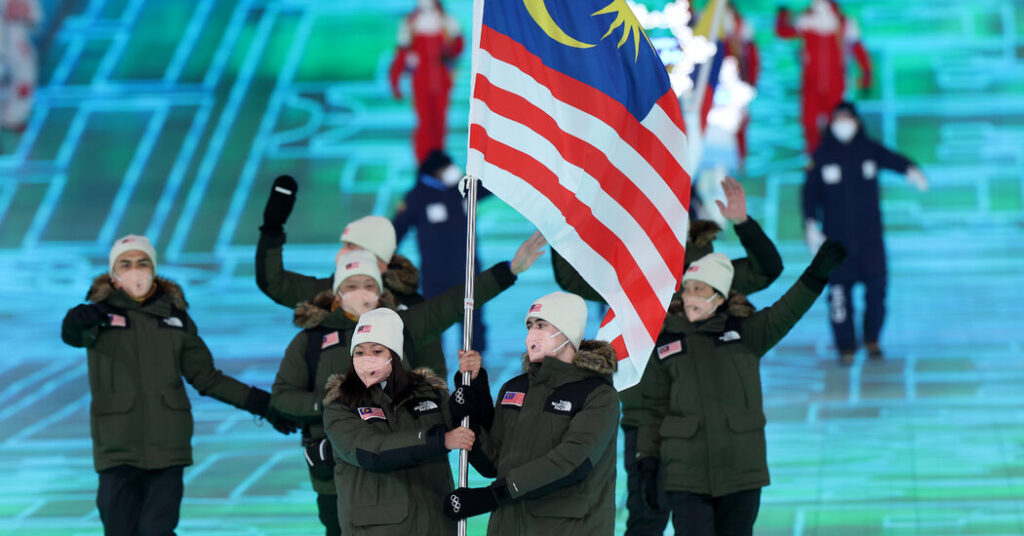
Olympic powerhouses like the United States and Canada have sent more than 200 athletes each to Italy for the Winter Olympics.
And then there is Malaysia.
Its entire contingent is one athlete: Aruwin Salehhuddin, a 21-year-old Alpine skier. At the opening ceremony, she alone hoisted the Jalur Gemilang, the name for the Malaysian flag that means “Stripes of Glory.”
“It’s pretty heavy!” she said.
Four years ago, at age 17, she became the first female athlete to represent Malaysia at the Olympics. But there was a male athlete, too, and they carried the flag together.
“Hopefully, I’m a lot stronger now to be able to lift it up myself,” she said. “I want to be able to raise it high and proud.”
Malaysia is one of 15 nations fielding just one athlete. The list includes other Alpine skiers from Eritrea and Pakistan; cross-country skiers from Malta and Nigeria; and a solitary skeleton athlete from Puerto Rico, a U.S. territory that competes in the Olympics under its own flag and National Olympic Committee.
The Olympic charter requires athletes to be nationals of the countries they represent, but it does not require them to have been born there or to live there. Some athletes opt to compete for their parents’ homeland so they have a better chance of making the Olympics, for family pride, or for some combination of the two.
Salehhuddin said that her dad, who represented Malaysia in slalom canoeing at the Atlanta Games in 1996, was her inspiration. She said she knew from a young age that she wanted to represent Malaysia on the world stage, like he did.
That is how there is an Alpine skier from a country where it hardly ever snows.
Salehhuddin’s parents immigrated to the United States from Malaysia to attend Kent State University in Ohio and raised their daughter in Washington State, where she fell in love with skiing. She now lives in Colorado Springs, but spends most of her time traveling to competitions.
“It feels free,” she said of whooshing down a mountain. “Freedom of mind and body. You’re just out there flying down a slope, you know?”
The drawback to competing alone for a small country — in addition to having no compatriots to celebrate or commiserate with — is the lack of financial support. Salehhuddin said she was almost entirely funded by her parents.
“I’ve been looking for corporate sponsorships, but I’ve been having a pretty hard time, honestly,” she said. “I’m not fully in Malaysia. I’m not fully in the U.S. I’m often in Europe. Who would want to support me?”
She visits Malaysia about once a year to see her grandmother, aunts, uncles and cousins. She speaks Malay and English, calling her language when she’s talking to her family “a mix-mix.” She designed her ski suit to sport Malaysia’s national flower, a red hibiscus.
Malaysia has some small, fake ski slopes in its malls, but no natural ski hills. Salehhuddin said she hoped to show that is was possible to represent a small, unlikely country in Alpine skiing — or be, as she wrote on Instagram, “a tropical girl in the winter world.”
“I want to prove that doing the wildest things you could imagine can actually come to life,” she said.
Heather Knight is a reporter in San Francisco, leading The Times’s coverage of the Bay Area and Northern California.
The post Flying Solo: Some Olympic Athletes Are Their Country’s Whole Team appeared first on New York Times.