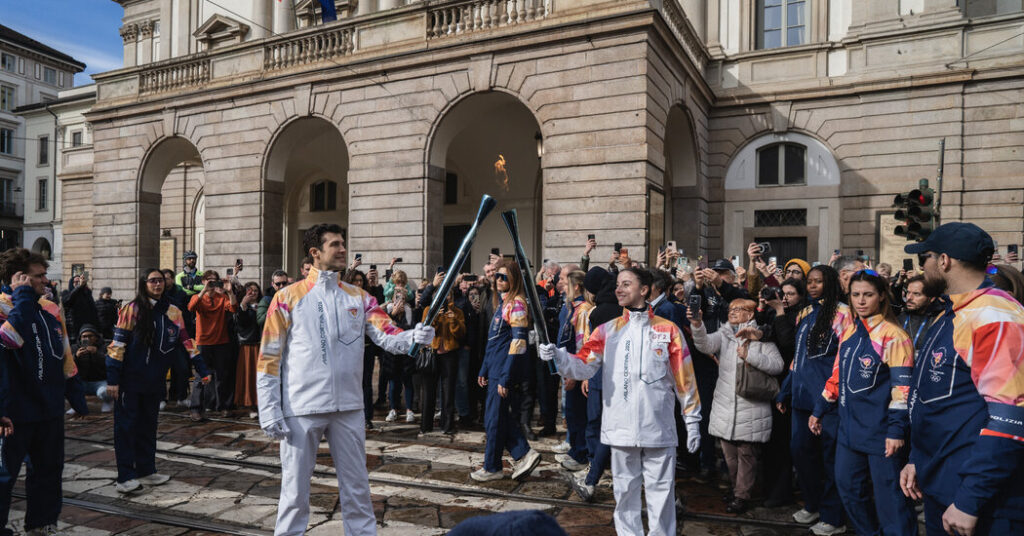
For the past two months, the pre-Games relay of the Olympic torch has drawn crowds and applause as it zigzagged across Italy, passing through some 300 towns and more than 60 UNESCO World Heritage Sites.
On Friday, the torch will get a global close-up when it ends its Olympic journey at not one, but two cauldrons in Milan and Cortina d’Ampezzo, a first that reflects these geographically expansive Games. The cauldrons are at the Arco della Pace in the heart of downtown Milan and in Piazza Dibona in Cortina.
Over the years, Olympic torches have come in various forms and sizes. Some have been ornate, others curved. The 2026 torch design goes back to basics with a sleek, metal rod, which is named “Essential.”
Carlo Ratti, who was responsible for the design, said the name reflected the hallowed sense of the torch and its ancient role.
“The flame is a sacred thing, not an object,” he said, so the designers opted for “an essential shape around the technical core to put the emphasis on the flame.” He added that it was the lightest torch ever made, weighing just over a kilogram, or roughly two pounds, when the gas canister is empty.
Last year, Ratti curated the 19th Venice Architecture Biennale, and that, too, informed the design of the torch in terms of “sustainability and how can we use materials in a more effective way,” he said in a telephone interview.
The torch is made from recycled and recyclable materials, including aluminum and brass. For the core, Ratti partnered with Cavagna Group, which he described as a company typical of Italy’s industrial fabric, “a niche company that is a world leader in something very specific.” Cavagna came up with the engineering for the burner, which is powered by a biofuel produced from food waste. The burner is refillable and can be used up to 10 times.
He said the design team “fell in love with the mechanism” and wanted to share it with the world. As a result, a window in the torch allows viewers to see the moment of ignition as well as the flame inside. The outer finish is made of a material that acts as a mirror, reflecting the surrounding environment.
“We took a different approach” from the design of past torches, Ratti said, adding that the torch was usually about “covering and adding and we worked by subtraction and revealing.”
“Ultimately, the torch is a symbol, and what is important are the values it conveys,” he said.
Elisabetta Povoledo is a Times reporter based in Rome, covering Italy, the Vatican and the culture of the region. She has been a journalist for 35 years.
The post A Lightweight, Minimalist Torch Design Helps Kick Off the Winter Games appeared first on New York Times.