The scientists aboard the icebreaker Araon didn’t manage to squeeze instruments through a half-mile-deep hole in the Thwaites Glacier, Antarctica’s most menacingly unstable mass of ice, to inspect the warming waters underneath.
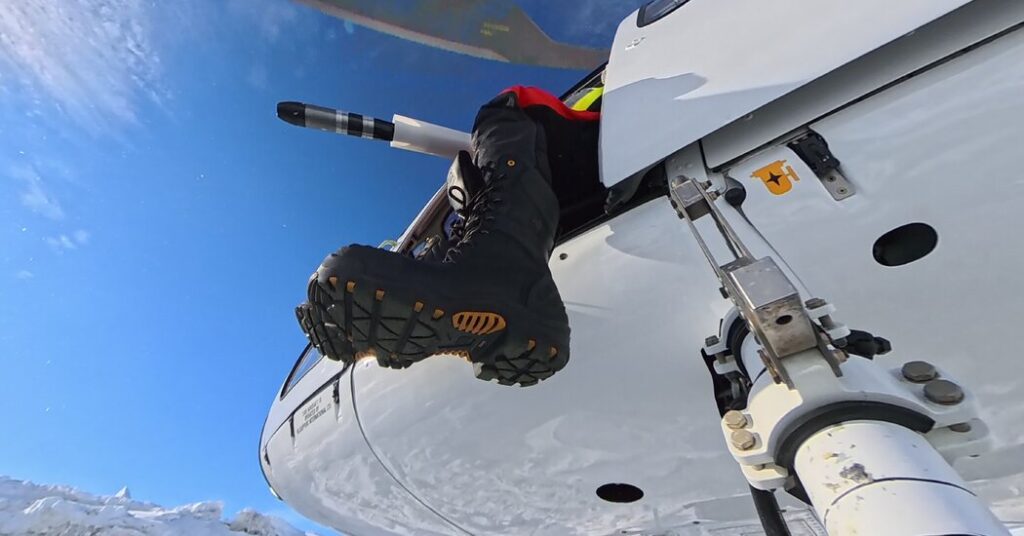
But other researchers on our expedition have placed equipment in spots that are almost as hard to reach. On Thursday, they did it “Mission: Impossible” style, leaning out of a helicopter in midair.
On the western side of Thwaites’s floating ice shelf, the glacier is breaking apart into blocks of ice the size of convention centers. Warm ocean water from around Antarctica pours into a deep undersea trough and underneath the shelf, melting it rapidly from the bottom up. As this ice degrades and weakens, the rest of Thwaites slides faster from the land into the ocean, contributing to global sea-level rise.
Examining the waters under the ice shelf is impossible from the Araon: The rifts between the icy blocks are too narrow to sail through, and are often packed solid with sea ice.
That’s why Jamin Greenbaum, a polar geophysicist at the Scripps Institution of Oceanography at the University of California, San Diego, and his team developed a floating machine, roughly the size of a toolshed, that can be lowered into tight spots from the air and operated from afar. They call it RIFT-OX, for Recoverable Ice Fracture Ocean Explorer, and Dr. Greenbaum hopes it can make the work of exploring the polar seas a lot more portable.
On Thursday, RIFT-OX was collecting data in a vast rift within Thwaites, and Dr. Greenbaum and Siobhan Johnson, a doctoral candidate at the University of Cambridge and the British Antarctic Survey, were suiting up to be flown into the rifts themselves.
The rifts are more like canyons, filled with broken-up ice that has become heaped into phantasmagorical sci-fi formations.
“Even though I’ve been in those rifts a lot, every time I go in it sort of feels like the first time,” Dr. Greenbaum said. “It’s so unlike anything else.”
Ms. Johnson was preparing to collect what, to her knowledge, would be the first cores of sea ice ever taken from Thwaites’s rifts. Dr. Greenbaum would be lowering torpedo-like probes to take measurements that would complement the data from RIFT-OX. He would drop the probes from the helicopter, and as they plunged toward the seafloor, they would send back information on the water’s temperature, salinity and depth.
The probes were about three feet long and cost around $2,000 each. Even under ideal conditions, they can record erratic data, Dr. Greenbaum said. Still, they are quick and easy to deploy, making them useful for scoping out areas where the melting processes might be different or unusual.
Dr. Greenbaum was nervous about clouds in the forecast. Ms. Johnson was nervous about flying. She doesn’t love helicopters. Was she excited to fly in one with the door open?
“That’s one word to describe it,” she said.
At each rift of interest, the pilot, Dominic O’Rourke, kept the helicopter hovering as Dr. Greenbaum slid open the door. First, he smashed through the sea ice by dropping homemade weights, made from the empty metal casings of used probes, that the team calls “Shackleton bombs,” after the famed polar explorer. They weighed about 20 pounds each and contained paper cups filled with cement that Ms. Johnson had mixed the night before.
Then, Dr. Greenbaum carefully unspooled a rope to deposit a probe. Even after multiple rounds of Shackleton bombing, the hole in the ice that he was aiming for could be small. If the probe hit the water too fast, it might be damaged or pop up under the ice. He could ask Mr. O’Rourke to fly a little to the left or a little to the right, but otherwise, the fate of Dr. Greenbaum’s data was in his own hands.
By the end of the day, Ms. Johnson had collected five sea-ice cores. Dr. Greenbaum had released 11 probes, of which seven, maybe eight, had returned good data. He was elated: It was the highest rate of success he’d ever had with this type of instrument.
Two of the probes might even have hit upon fresh discoveries. One of them showed that the seafloor was much deeper in one spot than expected, suggesting another path through which warm ocean water might be flowing toward Thwaites’s base. Another showed the water in a certain rift as being “extremely warm, like over two degrees, which just can’t be right,” Dr. Greenbaum said, using degrees Celsius. “Or there’s something really weird going on here.” (Or, he acknowledged, the probe might have been faulty.)
After returning to the Araon on Thursday evening, the helicopters were wheeled into the hangar, and their rotors were removed. Airborne operations on this expedition are nearing their end, and so is our time in Antarctica.
Raymond Zhong reports on climate and environmental issues for The Times.
The post To Study Antarctic Ice Rifts, You Have to Throw a Few ‘Bombs’ appeared first on New York Times.