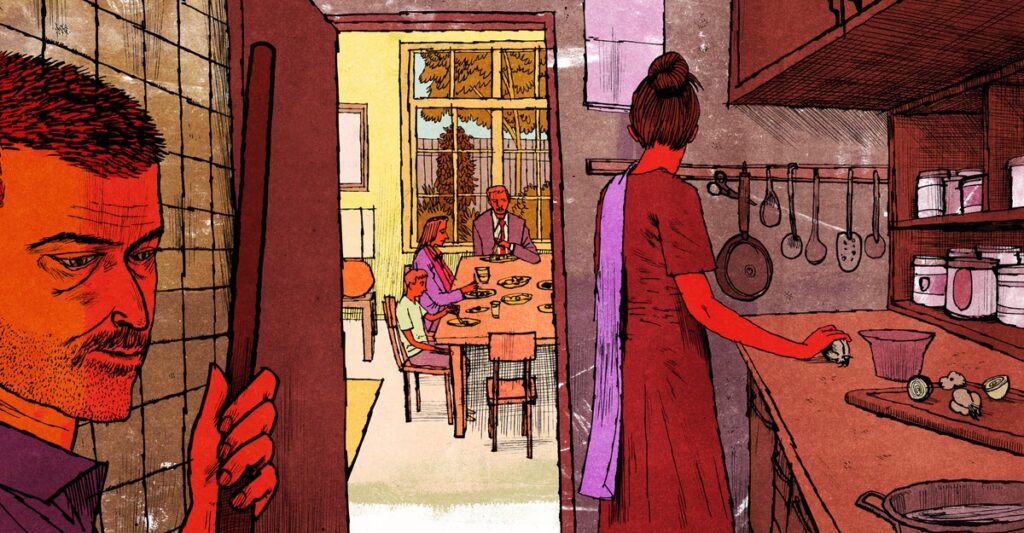
Books about masters and servants tend to come with an inborn flaw: They are written largely by those from the moneyed class, individuals who have seen the poor from above and must now, in their writing, illuminate their lives from within. This gap can sometimes be breached through immersive journalism of the kind championed by George Orwell in Down and Out in Paris and London or Barbara Ehrenreich in Nickel and Dimed. But such instances are rare, and even harder to achieve in countries like India or Pakistan—places with large domestic-worker populations where socioeconomic differences are so harshly inscribed that one can, more often than not, immediately infer a person’s status from their mannerisms and language.
This is what makes the work of the Pakistani American writer Daniyal Mueenuddin so special and surprising. Mueenuddin is a U.S.-educated descendant of a Pakistani feudal family; he spent years running an estate in rural Punjab. In his prize-winning fiction, though, he is somehow able to enter the lives of the servant class with the same gentleness and attention that he lavishes on the ultrarich. The concerns of drivers, retainers, maids, and cooks exist alongside the romantic problems of Paris-hopping Pakistanis with cocaine addictions in his justly acclaimed debut collection, In Other Rooms, Other Wonders, from 2009. Small details shine. Reading about, say, the family life of Nawabdin, an electrician “who flourished on a signature ability, a technique for cheating the electric company by slowing down the revolutions of electric meters,” one wonders: How does he know so much? How does he re-create the lives of those immured within a feudal system without reinforcing his own position through condescending, morose social realism?
Mueenuddin has cited the author Ivan Turgenev—himself an estate owner who captured the lives of both serfs and aristocrats in 19th-century Russia—as one of his inspirations. Turgenev, hampered by czarist censorship, did not write polemics about suffering serfs but instead created hyperrealist, idiosyncratic slices of life that would later inspire Ernest Hemingway. Turgenev’s stories, especially his 1852 collection, A Sportsman’s Notebook, indirectly led to the end of serfdom by humanizing the peasantry for Czar Alexander II. In short, Turgenev was the rare estate owner who listened.
Mueenuddin does the same in his latest work, This Is Where the Serpent Lives.His first book in 17 years and his debut novel, it is a feast of sustained noticing, despite an overarching flaw. One of the main strands in Serpent is based, according to an interview with The New Yorker, on the life of a swashbuckling driver employed for years by Mueenuddin’s father. His fictional driver, Yazid, is the moral center of the novel, described as “an ambling bear” with huge sideburns “moving to his own North.” As a young orphan, Yazid was a cook’s apprentice who emulated the rich schoolboys he served, intending to slowly insinuate himself into their class—only to be thwarted by a jealous, older maidservant.
Mueenuddin’s novel essentially comprises four novella-like storylines about grand landowning families and their employees in Pakistan from the 1950s to the present. Besides Yazid’s story, two short narratives follow reluctant feudal potentates. A final story, which takes up the majority of the novel, focuses on Yazid’s much younger protégé, Saqib, a servant boy of “fine sensibility and intelligence” who also seeks to join the upper class.
[Read: What does the literature of the working class look like?]
Mueenuddin’s novel suggests that there are moral costs to both the rich and the poor for living in a system that allows such little mobility. Wealthy characters verge on making reforms, then pull back at the slightest complication. In the process, they remain stuck within their “ordered purposeless” lives, as Mueenuddin wrote in his collection. The servants, meanwhile, who are “more fed than paid,” recognize that only the most brazen cheating and corruption can break them out of their squalid circumstances—the sort of corruption, of course, that has enabled the elite to thrive in a country where meaningful land reform never occurred and ancient inequalities persist. A novelist depicting both these classes must find an elegant way to integrate stories of inherited ennui and desperate striving. If Mueeneddin doesn’t entirely succeed, this is in part because the unyielding feudal order of Pakistan means that the lives of servants and masters rarely intersect in meaningful ways.
Saqib’s story captures the dilemma of the aspirant even more fiercely than Yazid’s does. “Respectful but not servile,” Saqib enters the good graces of his mistress, Shahnaz Atar, an intelligent woman who, “like most Lahori women of her class,” Mueenuddin writes, “battled constantly to find and train and keep household servants.” Saqib is entrusted with more and more responsibility as he grows up, eventually setting up an ambitious cucumber-farming scheme on the Atars’ estate in rural Punjab. He figures that it will take one careful, major act of corruption to finally ascend to the elite: “Each untrue mark that he inscribed” in the account books would be, Mueenuddin writes, “another step in his emancipation.” Alas, it is this choice that gets him into trouble and causes the fine web of relationships around him to crumble, throwing him violently back to his origins as the mere son of a gardener.
As in his story collection, Mueenuddin succeeds here in painting Yazid and Saqib and a host of secondary characters on the social ladder as distinct individuals, down to their faces and habits and family lives. He also shows how, at this late stage of history—in which Chinese smartphones, Western porn, and Facebook “confettied all over” the populace—the players are more aware than ever of their particular roles. Shahnaz, who grew up largely abroad, sees her position as mistress of an estate “through the lens of her Western politics and experience,” even studying the Russians, including Turgenev, to comprehend the complex social dynamics unfolding on her farm. Her husband’s cousin Rustom, who returns from America to take over his family’s land after his parents and grandfather die, finds himself tacitly okaying the beating of a worker from a rival estate. “What happened to college days and marching for justice in South Africa and in solidarity with ship workers in Poland?” he wonders. Meanwhile, Saqib carefully observes the behavior of his masters, the Atars, in order to model it—noting, for example, that they treat “eating as ceremony.”
[Read: When scarcity blurs the line between right and wrong]
What gives Mueenuddin a harder time is finding a structure that generates meaning from the interplay between the upper and the lower classes. His four stories follow no clear arc, flitting from one time period or character to another. In a short-story collection such as Other Rooms, the question of a narrative through line does not arise. You get discrete stories (or rooms!) about people from different classes, and the links between characters are subtle. In Serpent, however, Mueenuddin’s attempts to give the lives of Yazid and Saqib the same weight as those of the estate owners is strangely lopsided; his characters’ connections feel more circumstantial than inherent to the narrative. A 150-page novel about Saqib alone, for example, might have succeeded more than this brilliant but blowsy book, which had me writing, at page 100, “I still don’t know what this is about.”
Alas, this pitfall has as much to do with the structure of Pakistani society as it does with the structure of the book. Although masters and servants occupy the same spaces, their lives don’t apply equal pressure on each other. A servant could have a tumultuous inner life, but unless he commits a major crime (as in, for instance, Aravind Adiga’s Booker-winning The White Tiger), his emotions are unlikely to infect the master. The master, in turn, usually lives in another sphere—one of extramarital affairs and boozy parties and corrupt business deals. Shahnaz, for example, simply turns away bitterly and sadly after Saqib’s crime. One wishes Mueenuddin had devised a narrative in which she experienced a deeper, more complicated fallout—an exception to the rule.
And so lives that are disparate continue to feel wrenched apart. What we have here is not a novel at all but another linked short-story collection—if only Mueenuddin had named it as such! The lives of these characters are of superb interest. It is the form in which they live that is flawed.
The post How to Portray a Wildly Unequal Society appeared first on The Atlantic.