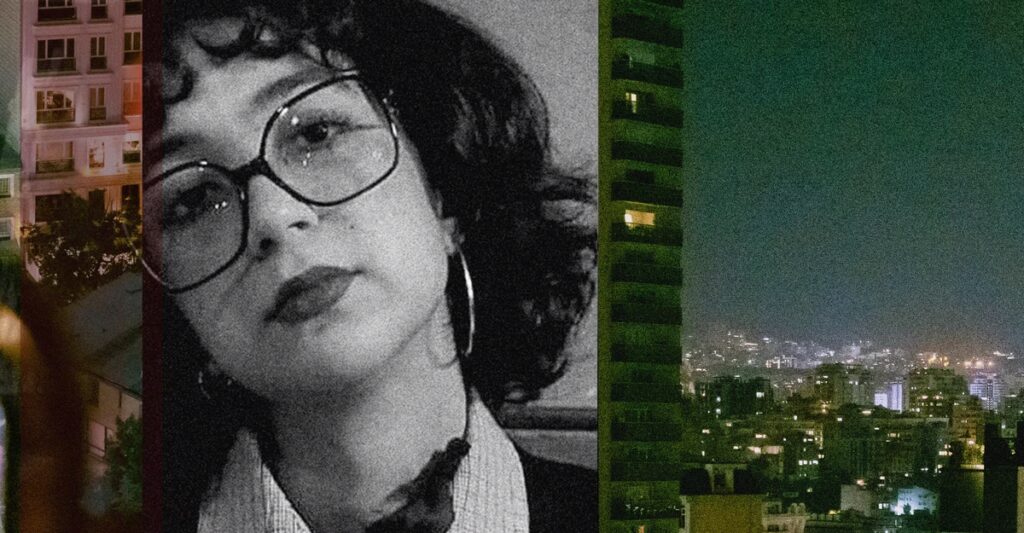
On January 2, Raha Bahloulipour watched Sentimental Value, the latest film by the Norwegian auteur Joachim Trier, in her dorm room at the University of Tehran. It was the first film she viewed in 2026, and she liked it very much.
I know this because Raha was, like myself, an avid user of the film-cataloging app Letterboxd. With its tag system and diary, she jotted down when, where, and in what context she watched movies and what she thought of them. She started her diary in August 2023 and logged a total of 795 films during her 888 days on the app. She gave Trier’s film a heart, indicating that it was a favorite. She also tagged it with “protests,” to note that she’d watched it as anti-regime demonstrations rocked her country.
On January 8 and 9, the Iranian regime mowed down thousands of protesters all across the country. Raha was one of them, killed by a bullet that pierced her lungs.
A 24-year-old student of Italian literature at the University of Tehran, Raha took part in the movement from its beginning, on December 29. On that day, she shared her impressions in a Telegram post that mingled English, Italian, and her native Persian.
“What a Day! What a night!” she wrote. “These streets, these feelings,” she went on: “I want my life to be like this.” She ended her post with a call for a solidarity demonstration on campus.
Raha’s Telegram channel, like much of her life, was dedicated to arts and culture. In thousands of posts, starting in December 2019, she wrote about the music, novels, and films she loved. She also shared her love for the city of Tehran, and the pictures she took during her strolls around the metropolis. Had she belonged to another time or place, Raha might have preferred not to engage in politics. In August 2023, she quoted Joan Didion: “I’m not telling you to make the world better, because I don’t think that progress is necessarily part of the package. I’m just telling you to live in it.”
[Gal Beckerman: The silence of the left on Iran]
But for a woman in contemporary Iran, staying aloof from politics was impossible. Not only did the Islamic Republic restrict what she could wear, listen to, and watch, but its misrule had destroyed her standard of living. In February 2025, she wrote on X: “I am in the most penniless era of my life. I can barely afford one meal a day.” Like many of her compatriots, she could hardly imagine a future. Around the same time, she wrote: “I hate, hate, hate the Islamic Republic, and I am so tired of it.”
Iran’s previous major protest movement erupted in 2022, and Raha, then 20 years old, signaled her support on Telegram. She deeply identified with the movement’s slogan, “Women, life, freedom.” She might have thought of one of her favorite films, Bernardo Bertolucci’s The Dreamers (logged and hearted on Letterboxd in December 2024), about young bohemians drawn into student protests in Paris in 1968: Politics beckoned Raha as it beckons the film’s protagonists.
She took an even more active role in the protests that expanded this January. She posted regularly about them. On January 5, she explained the shift in her channel’s content, telling her followers that she’d understand if they weren’t comfortable with the political output and wanted to leave.
All the while, she never stopped watching movies. She tagged a total of 22 films with “protests,” viewing them throughout the stormy days of January. On January 4, she saw the British thriller V for Vendetta, centered on mass demonstrations against a dystopian fascist government. On the same day, she found time to watch Jennifer Lawrence and Robert Pattinson duke it out in Die My Love and to rewatch the feel-good musical La La Land. Her interest piqued by Trier, she saw his celebrated film The Worst Person in the World on January 6.
Little did she know that this would be the last new watch she would log on Letterboxd (she also logged a rewatch of Houman Seyyedi’s Sound and Fury later that day).
The regime had imposed a sweeping internet blackout. Raha was able to get online briefly on January 9. “I connected for only a moment,” she wrote on Telegram, “and I just want to write: Women, Life, Freedom. Forever.” This would be her last post and political testament.
[Mahsa Alimardani: How doubt became a weapon in Iran]
Iranians are mourning thousands of dead. The exact number eludes us: Nobody believes the regime’s count of 3,000; some in the opposition say that the real number might be 10 times as high. Even at the low end, this is the worst killing of protesters in Iranian history. And no matter what the ultimate tally, every individual is an aching, terrible loss.
Many of the fallen leave behind social-media profiles that open windows, however narrow, onto their lives, their aspirations, and why and for what they risked their lives.
Raha’s story has spread quickly in recent weeks in part because her Telegram posts express a joyful nature that is now gut-wrenching to behold. “I really am a big fan of life,” she wrote in November 2025. In a viral video from the university, she is heard practicing her Italian: “Forse perché mi piace vivere moltissimo quindi.” (“Maybe because my love for life knows no end.”) In one Telegram post, she quoted Matt Haig’s memoir Reasons to Stay Alive: “I want life. I want to read it and write it and feel it and live it.”
Raha’s exuberance was inextricably linked to cinema and literature. In January 2020, at 17 years old, Raha wrote: “Until the cinema can give you courage to go on, you must continue life even if it’s full of pain and suffering.” Four years later, she wrote: “I love cinema because I love humans. I love that humans live and exist.” A year later, she wrote: “I owe so much to cinema. Most of the courage I feel in myself is because of cinema. I just read a letter from Fellini and now I am so calm.”
Judging by her writings, Raha belonged to a milieu in Tehran where the arts are a secular religion. This tugs at me because I once belonged to one very similar. “In days, I am taken by literature and at nights by the movies,” Raha wrote, and she could have been describing my youth in Tehran, even though I am 14 years her senior.
Raha adored the Belgian director Chantal Akerman. Her Toute une nuit (1982), which follows two dozen people through one night in Brussels, was among Raha’s top four on Letterboxd. “Need to soak up every moment of this film,” she wrote after a rewatch. In the world of literature, she reserved a special place for Albert Camus who, together with Milan Kundera, Jostein Gaarder, Simone de Beauvoir, and a few others, has remained as central to her generation as he was to mine. She posted a quote from a love letter that the Spanish-born French actor Maria Casares wrote to Camus: “My Love, I wish I knew a language never used before to speak to you.” Translated into Persian, the line reads like poetry.
As Raha delved into her university studies, her posts reflected her readings in Italian. Oriana Fallaci’s Penelope alla guerra was a new favorite; last September, she wrote excitedly about her class on Dante’s Divine Comedy.
[Arash Azizi: The Islamic Republic will not last]
Many of the works that she—and I—explored as a young person in Iran were of European origin, but what drew her to them was their universality. Raha received nothing passively: She interacted with Western works of art alongside Iranian ones, and in relation to them. Her Telegram channel’s name exemplified this transport of ideas: “Le vent nous portera” (“The Wind Will Carry Us”) is a song by a French rock band, named after a film by the Iranian auteur Abbas Kiarostami, who took it from a poem by the Iranian poet Forough Farrokhzad.
Raha did not consume only Western works. She also read the Palestinian poet Mahmoud Darwish and the South Korean novelist Han Kang. The Mexican American author Valeria Luiselli was another favorite, as her modern urban sensibility helped Raha appreciate flaneuring in her own Tehran. “Now that I am not there, I suddenly catch myself dreaming of walking in Tehran’s streets,” she wrote last year. “This city is truly my lover. Full of danger, chaos, life, and passion.” Elsewhere, she wrote: “I currently love Tehran, the Italian language, cinema, translation, and beautiful humans.”
Raha’s ebullience contrasted starkly with the martyrdom culture promoted by the theocratic regime she lived under. Iran’s rulers, like many religious fundamentalists, celebrate indifference to earthly life and pin their sights on posthumous rewards.
Now, as Iranians bury their new martyrs, an entirely different culture has sprung up around them. Funerals feature not the traditional resigned mourning, but defiance and a celebration of life. Instead of the Islamic term shahid, or “martyr,” Iranians have adopted the Persian term javidnaam, or “eternal name,” to denote this new mentality.
The designation fits Raha very well. She will not be able to watch any of the 279 films on her Letterboxd “Watchlist.” She will not finish her Italian degree. But her writings will indeed be eternal, and her name will live on among Iranians still struggling to take their country back: Raha Bahloulipour, whose life was taken from her perhaps, above all, because she loved it so much. As she wrote on Telegram: “Nothing in this life was as we wanted it. But we wanted it and loved it madly and fought for it.”
The post What Iran’s Dead Loved and Fought For appeared first on The Atlantic.