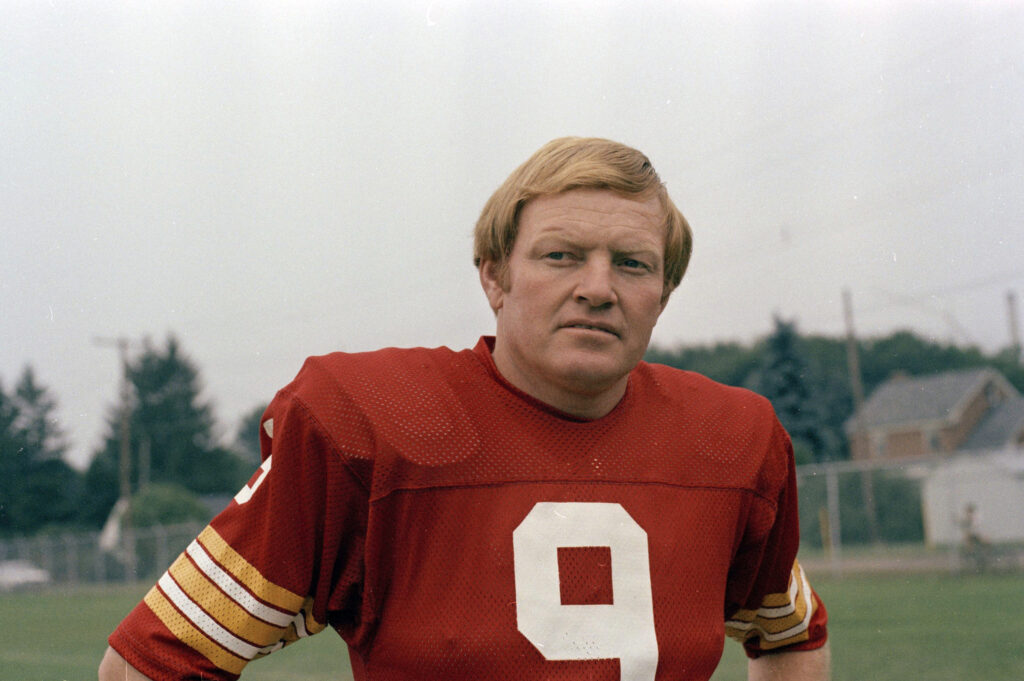
Sonny Jurgensen, a golden-armed Hall of Fame quarterback in Washington who became a longtime radio and television broadcaster for his former team after retiring from pro football in 1974, has died at 91.
His family announced the death Friday in a statementshared by the Washington Commanders. They did not say when or where he died.
Mr. Jurgensen, one of the most popular athletes in Washington sports history, was simply sublime with a football in his right hand, even if he never started a league championship or Super Bowl game over his 18-year National Football League career.
He was considered one of the finest pure passersin the annals of the game and brought great joy to his legions of fans when he starred for the Washington franchise, then called the Redskins, in the 1960s and ’70s. He came to the team in 1964 in a controversial trade with the Philadelphia Eagles and immediately began lighting up the scoreboard at RFK Stadium with his fancy passing and daring play-calling.
“I always thought the two quarterbacks with the purest passing arms were Joe Namath and Sonny Jurgensen,” said Ernie Accorsi, the former general manager of the New York Giants. “The more I thought about it, Sonny was probably the best. I don’t know if I ever saw him throw a ball that wasn’t a tight spiral. He had the purest arm I’ve ever seen.”
Vince Lombardi, who coached Mr. Jurgensen in Washington for the 1969 season, told reporters that year that if he had been his quarterback in Green Bay, “we never would have lost a game.”
In Washington, football fans had an 11-year love affair with the slightly paunchy superstar known by a variety of monikers — “Jurgy,” the “old Redhead” or simply “No. 9,” his uniform number. He had a reputation for having a good time on and off the field.
He often broke curfew in training camp and even the night before key games, only to come through with a good showing on the field.
“When I left Philadelphia,” he once said after the trade to Washington, “all the bartenders wore black armbands.”
In the prime of his career in the 1960s, Mr. Jurgensen played on Washington teams best known for a pass-oriented offense forced to put a lot of points on the board because the defense was so mediocre.
“Jurgensen is so great that he beats you even when you have him cornered,” New Orleans Saints Coach Tom Fears said in 1969. “He’ll duck out of the blitz, lay in perfect passes when his man is covered tight, scramble out of the pocket. He’s just the best.”
In Washington, Mr. Jurgensen’s favorite targets included two Hall of Fame receivers, Bobby Mitchell and Charley Taylor, later joined by a fleet tight end, Jerry Smith.
Mitchell said Mr. Jurgensen was equally dangerous whether throwing long or short, and could adjust the speed on the football to keep defenders at bay and make it relatively easy for his receivers to catch the ball.
“When you came across the middle, the ball would wait for you,” Mitchell said in an interview. “He could throw it soft or throw it hard. If you were covered real well, the ball was actually picking up speed so you could grab it just before you got hit. It was just amazing what he could do with that football.”
Pat Richter, a tight end who also was Mr. Jurgensen’s roommate in training camp and on road trips, recalled the quarterback frequently diagramming plays in the infield dirt at RFK Stadium.
“There were times he’d tell guys just get open and I’ll get it to you,” he said in an interview. “He’d say just go long and it’ll be there. He could throw a screwball or throw it like a curveball. Whatever needed to be done, he could do it.”
The rapport Mr. Jurgensen had with his teammates and fans did not always extend to his coaches, including his last one, the defense-obsessed George Allen, who frequently benched him in favor of the less flashy Billy Kilmer.
Mr. Jurgensen also disdained the seemingly nonchalant coaching style of fellow Hall of Fame quarterback Otto Graham, the Redskins head coach from 1966 to 1968.
“There’s only one difference between Otto and me,” Mr. Jurgensen once said. “He likes candy bars and milkshakes and I like women and Scotch.”
Still, Mr. Jurgensen had his greatest statistical season under Graham in 1967, setting league records for passing yardage (3,747), pass attempts (508) and completions (288). He also threw for 31 touchdowns. Taylor led the league in receiving with 70 catches, with Smith second and Mitchell fourth. Still, while the offense put 347 points on the board, the defense surrendered 353 and the team finished 5-6-3.
In 1969, when Lombardi replaced Grahamas head coach after a brilliant run with the Green Bay Packers, Mr. Jurgensen reported to camp at his lowest playing weight in years, about 210 pounds on his 6-foot frame. Playing under Lombardi, he said, was the greatest experience of his football life.
The Redskins had their first winning record (7-5-2) in 14 years, but the euphoria ended when Lombardi was diagnosed with colon cancer and died in September 1970.
“He was the only coach of the nine I had who simplified the game,” Mr. Jurgensen told a Pro Football Hall of Fame publication in 2010. “Every other coach had a tendency to complicate things, a lot of verbiage on how to call plays and read defenses. His system was by far the simplest and the most successful. It was fun to play the game.”
Bill Austin coached the team for one forgettable season before he was replaced in 1971 by Allen. When Mr. Jurgensen broke his nonthrowing left shoulder while attempting to make a tackle in a preseason game, Kilmer took over at quarterback. A lively “Sonny vs. Billy” debate ignited among fans over who should be the team’s starting quarterback.
The two veterans got along famously — after all, Kilmer’s nickname was Whiskey and he liked the nightlife as much as Mr. Jurgensen did. But Allen, a defensive specialist who demanded mistake-free football, clearly preferred Kilmer’s take-no chances style of play over the more exciting wide-open game Mr. Jurgensen could offer.
It was Kilmer who started Washington’s first-ever Super Bowl game, against the Miami Dolphins at the end of the 1972 season. The Redskins lost, 14-7, as the Dolphins completed the only perfect season in NFL history. Mr. Jurgensen, who was injured with a torn Achilles tendon, was exiled by Allen to an empty sky box high above the filed and had no contact with the team’s coaches.
In 1974, Washington acquired a young quarterback, Joe Theismann, who announced that he would beat out Mr. Jurgensen and Kilmer for the starting job.
The two old veterans disliked the brash young upstart, Mr. Jurgensen said, and “we both told each other we didn’t care which one of us was the starter, as long as it wasn’t Theismann.” They alternated throughout the season, with Kilmer getting most of the starting assignments. In four years under Allen, Mr. Jurgensen started only 13 games — and won 11 of them.
One of Mr. Jurgensen’s final triumphs came in 1974 against Miami, the team that had beaten Washington in the Super Bowl two years earlier. He was 40 by then but still skilled enough to rally the team from deficits of 10-0 and 17-13 before ending the day with a game-winning, six-yard touchdown pass to running back Larry Smith with 16 seconds left on the clock.
In his last game in a Washington uniform, in the playoffs against the Los Angeles Rams, Mr. Jurgensen threw three interceptions and was unable to rally the team to a victory. Though he wanted to return for one more season, Allen insisted that he retire.
Mr. Jurgensen then built a successful broadcasting career on Washington radio and television stations. Beginning in 1981, he teamed with his good friend and former teammate, Hall of Fame linebacker Sam Huff, and veteran sportscaster Frank Herzog on Redskins radio broadcasts. The “Frank, Sonny and Sam” combination lasted until Herzog was replaced by play-by-play announcer Larry Michael in 2004. Huff retired in 2013, and Mr. Jurgensen “decided to hang up my headphones and my clipboard” in 2019, when he turned 85.
Making his mark
Christian Adolph Jurgensen III was born in Wilmington, North Carolina, on Aug. 23, 1934. His parents, who ran a trucking company, called him Sonny because of his “sunny” disposition.
He learned to throw a football by playing catch with his mother in the front yard. In high school, Mr. Jurgensen starred in football, basketball and baseball before attending Duke University on an athletic scholarship.
He played both safety and quarterback in college for a team that rarely threw the ball: In his senior season, he had only 59 pass attempts. After graduating in 1957, he was drafted in the fourth round by the Eagles.
In Philadelphia, Mr. Jurgensen spent three years as a backup to another Hall of Fame quarterback, Norm Van Brocklin, who retired after leading the Eagles to the 1960 NFL championship. The next year, Mr. Jurgensen quickly made a mark in his first game by completing a pass he threw behind his back. By the end of the 1961 season, he had passed for 3,723 yards and 32 touchdowns, both league records at the time.
The Eagles then had back-to-back losing seasons, and the city’s notorious boo-bird fans blamed Mr. Jurgensen. Before the 1964 season, he was traded to Washington for quarterback Norm Snead, arguably the most one-sided talent heist in the history of the Washington franchise.
“It was a shock,” Mr. Jurgensen said in “Hail Victory,” an oral history of the Redskins by Thom Loverro. “But in retrospect, it was the best thing that ever happened to me.”
He married Margo Hart in 1967, and they had two children. A complete list of survivors was not immediately available.
Mr. Jurgensen threw for 255 touchdowns in his career and led the league in passing yardage five times. When he retired in 1974, his 57.1 percent completion percentage was the highest in NFL history. He was inducted into the Pro Football Hall of Fame in Canton, Ohio, in 1983, joining Sammy Baugh as the only other Washington quarterback to be enshrined.
Still, Mr. Jurgensen said the most meaningful tribute he received came from Lombardi.
“Jurgensen is a great quarterback,” the coach said in 1969, in his only season in Washington, according to the Hall of Fame website. “He may be the best the league has ever seen. He is the best I’ve ever seen.”
The post Sonny Jurgensen, one of Washington’s greatest football players, dies at 91 appeared first on Washington Post.