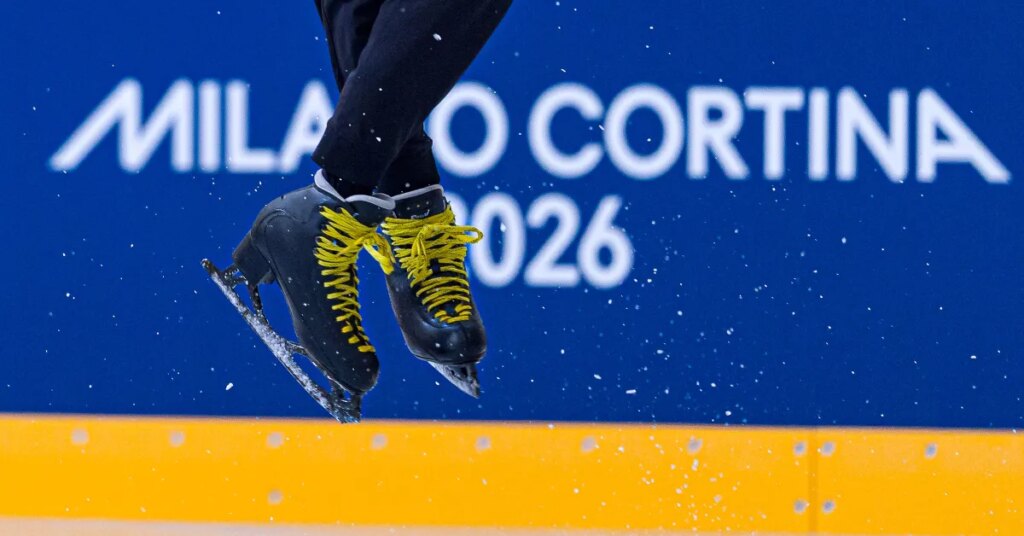
Even casual fans of figure skating have likely heard of the triple axel. And now, thanks to U.S. men’s champion Ilia Malinin, you’ll be hearing a lot about the quadruple axel, or quad axel, too.
What makes it so impressive? Any axel jump–single, double, triple, or quad–actually involves an extra half rotation. So a single axel is really 1.5 turns in the air, the double 2.5, and so on. So yes, that means that Malinin performs 4.5 revolutions in the air between taking off and landing when he does the quad.
[time-brightcove not-tgx=”true”]
Learning the axel starts with one of the simplest leaps skaters learn—the waltz jump. That’s just the half turn from gliding forward to landing backward. Skaters take off moving forward on one leg, then push themselves into the air to turn themselves around, and then land on the opposite leg gliding backward.
Simple enough, when it’s just a half turn. But add a rotation, or two, three, or four, and the jump becomes incrementally more challenging. The axel is the only jump that takes off going forward, and that’s more difficult than taking off gliding backward, since in order to maintain your balance on the ice, your body naturally pushes your weight toward the middle of the blade to avoid tripping over the serrated toe pick. That means a skater taking off while gliding forward has to throw their weight into the air with more force. Add several turns and it becomes that much harder.
Japan’s Midori Ito became the first woman to land a triple axel in competition, in 1988, and the first to land the jump at the Olympics, in 1992. Several U.S. women have also accomplished the feat; Tonya Harding was the first American woman to land the jump in competition, in 1991, and Mirai Nagasu was the first to complete it at the Olympics, in 2018. Among the current U.S. contingent in Milan, Amber Glenn and Alysa Liu have both successfully competed with the jump, though Liu has not included it in her programs since her comeback. Glenn took advantage of the off-ice time during the pandemic to build up strength and technique for the jump, and her coach says it’s now one of her most consistent.
Most men do compete with the triple axel, though Malinin is the only skater to ever land the quad in competition. As remarkable as the feat is, he downplays its difficulty, saying he had more trouble mastering the triple. “I kind of picked up [the quad] naturally,” he says. “It felt easier for me because I was aware of the process.”
The post Why the Triple (and Quadruple) Axel Is So Hard appeared first on TIME.