In the months leading up to the 2024 election, Jill Garvey, an organizer in Chicago for liberal advocacy groups, gathered with some like-minded colleagues and, she recalled, “did some scenario planning.”
“Our sense,” she said, was that “authoritarian movements had coalesced, had singular goals, and were advancing them.”
Since then, the organization that Ms. Garvey founded shortly before Election Day, States at the Core, has hosted regular Zoom trainings in how to track and document the actions of federal immigration agents. These seminars on “ICE-watching” — referring to Immigrations and Customs Enforcement — now draw thousands of attendees at a time.
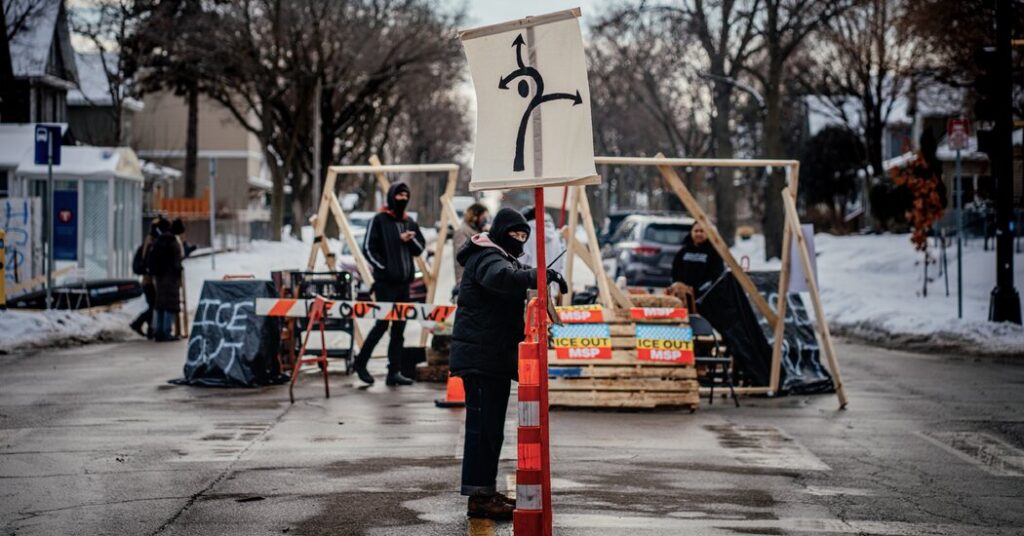
ICE-watching has been at the heart of the opposition to the Trump administration’s raids in Minneapolis, where activists’ unrelenting pursuit of often-bellicose federal agents has led to frequent street confrontations. In two such incidents, federal officers fatally shot Renee Good and Alex Pretti, both Minneapolis residents, killings that were captured on camera from multiple angles by observers.
The videos of these shootings and other instances of aggression by immigration officers have succeeded in doing what perhaps no other anti-Trump protest has done: draw concessions from the administration.
On Wednesday, Tom Homan, Mr. Trump’s border czar, announced the withdrawal of 700 federal agents from the city, a move that followed the reassignment of Gregory Bovino, the border patrol official who had served as the face of the Minneapolis operation.
Thousands of federal agents remain in Minnesota, and raids have continued apace. The ongoing presence in Minneapolis was justified, Mr. Homan said this week, in part by the opposition that remains there. On Wednesday, federal agents, with guns drawn, were filmed stopping a group of observers in Minneapolis and arresting them.
Ms. Garvey is quick to note the role that her organization’s trainings have played in Minneapolis — but also to acknowledge that the strategies long predate her group and others like it.
“There’s a debt of gratitude to Black liberation movements that really pioneered this,” she said. “The Black Panther Party did it.”
The resistance in Minneapolis over the past two months has not looked much like the organized opposition during Mr. Trump’s first term, when demonstrations like the Women’s March assembled crowds of historic size in Washington and state capitals to register dissent. In appearance and format, those protests took cues from the Civil Rights movement marches and the antiwar demonstrations of the 1960s.
Although large marches and vigils have occurred in Minneapolis, the most potent opposition has come from regular, neighborhood-level ICE-watch patrols, which have resulted in smaller, more direct confrontations with federal agents.,
These tactics have their own long lineage. They were adapted from the work of immigrant-rights groups in the Obama and first Trump presidencies, which borrowed strategies from “cop-watch” activism from the 1990s and 2000s, whose own roots go back to 1960s radical groups like the Black Panthers and the American Indian Movement, an indigenous-rights group.
“It’s in the tradition of the AIM patrols,” said Andrew Fahlstrom, a Minneapolis activist who operates a site called Defend the 612 — a reference to the city’s area code — which directs volunteers to ICE-watching efforts in particular neighborhoods. “It’s not like anyone is inventing anything new in protecting your community.”
Both the Panthers and the American Indian Movement blended uncompromising left-wing politics with ground-level community organizing, and they embraced police-monitoring patrols as part of that project.
The Minneapolis efforts have taken shape in the crucible of a federal deployment largely despised by local residents, and brought together not only by dedicated activists, but a broader left-liberal constituency.
The participants in the Twin Cities explain their monitoring in widely differing terms: as resistance to authoritarianism, or a radical project in ground-up politics, or simple neighborliness — and sometimes all of those things at once.
The trainings focus on documenting ICE activities and alerting others to their presence, sometimes using tactics — such as blowing whistles — that shade into disruption. Activists’ guides in some cases link to resources for more directly confrontational civil-disobedience tactics.
While most of these tactics are not new, their impact and the recent support for them from mainstream Democratic officials are unusual. In Minneapolis, ICE-watchers have been the most visible neighborhood opposition in a city where local officials have chosen to file lawsuits and denounce the federal presence in interviews, but have kept their own officers and agencies clear of direct confrontation.
Tim Walz, the state’s Democratic governor, implicitly endorsed such efforts himself last month, urging state residents to “take out that phone and hit record” when encountering federal agents in public. His call echoed similar statements by JB Pritzker, Illinois’s Democratic governor, during federal immigration raids in his state in September.
Americans have divided sharply along partisan lines over the legitimacy of the anti-ICE protests. In an NPR/PBS News/Marist poll taken last week, 85 percent of Democrats said the demonstrations were “mostly legitimate,” as did 65 percent of independents. Only 25 percent of Republicans did.
In a Truth Social post on Saturday, Trump described the activists as “Lunatics, Agitators, and Insurrectionists.”
The Minneapolis organizers say the Trump administration’s strategy of aggressively deploying thousands of armed agents forced them to adapt. ICE-watching tactics took on a new relevance, superseding more familiar forms of protest.
With that relevance came new risks. In the past, “people could expect to go to a march, make a sign, put on a pink hat and come home,” Ms. Garvey said. “And that’s fine. But that’s not the era we’re in.”
Her organization — which is backed by the Hopewell Fund, a large liberal philanthropy — now trains thousands of observers a week.
After the 1965 Watts riots, Community Alert Patrol, a group founded by Black activists in Los Angeles, began monitoring law enforcement in hopes of documenting and preventing police brutality. The project was short-lived, but a young Huey Newton read an article about it and decided to pursue his own police-monitoring effort in Oakland — the origin of the Black Panther Party.
“That was the seed,” said Joshua Bloom, an associate professor of sociology at the University of Pittsburgh and co-author of “Black Against Empire,” a history of the Black Panthers.
The Black Panthers’ patrols, unlike the Watts efforts, were armed. State lawmakers, in response to the Panthers, banned the public from carrying loaded firearms without a permit.
The Panthers’ heyday was brief, ending in a blaze of gun battles with police and indictments. But their patrols inspired similar efforts across the country.
In 1968, the American Indian Movement, which was founded in Minneapolis and modeled on the Panthers, began fielding citizens’ patrols to monitor police.
By the 1990s, when compact video cameras became widely affordable, “cop watch” projects proliferated in cities.
The Panthers “kind of set a blueprint for everyone when it comes to community patrols, this idea of policing the police,” said Sherman Austin, a self-described anarchist activist in Long Beach, Calif., who participated in local police-monitoring efforts in the 2000s.
When the Obama administration increased detentions and deportations of undocumented immigrants, immigrants-rights activists applied the same tactics to Immigrations and Customs Enforcement.
In Chicago, Organized Communities Against Deportations, a group founded in 2013, borrowed police-surveilling strategies from activists in Oakland. “We needed to create our own systems,” Antonio Gutierrez, the group’s strategic coordinator, said.
During Mr. Trump’s first presidency, the group’s organizers hosted “ICE watch” trainings in Chicago. Their work, Mr. Gutierrez said, focused on informing detainees of their rights and documenting the conditions of their arrests in ways that might be useful in court.
“Getting detained by ICE is usually the beginning of the fight, not the end,” he said.
Those efforts contributed to a lawsuit against the Department of Homeland Security charging ICE with illegal and unconstitutional arrests. A settlement, which was in effect until this month, forced ICE to issue a new policy explicitly prohibiting warrantless arrests and vehicle stops.
The widespread adoption of messaging platforms like Signal and WhatsApp added another layer of utility, offering undocumented immigrants real-time information during crackdowns to gauge the risk of picking up children at school or buying groceries.
Last year, as Mr. Trump’s aggressive immigration raids became a central project of his second term, the monitoring strategies drew a new wave of interest.
Mr. Austin, the Long Beach activist, built stopICE.net, which crowdsources and disseminates reports of federal activity nationwide. It attained prominence — and law-enforcement scrutiny — during the Los Angeles crackdown and eventually grew to half a million registered users, Mr. Austin said.
Today, the people picking up these tools, organizers say, extend well beyond the dedicated immigrant-rights activists that had previously used them.
In Mr. Trump’s first term, most Americans opposed Homeland Security’s separations of undocumented families, but most also remained at a remove from such actions.
Nikki Marín Baena, a community organizer in North Carolina, recalls monitoring immigration raids during the first Trump term.
“I remember it feeling like, ‘We are in a war that no one else is in,’” said Ms. Baena, who is the co-director of Siembra NC, a North Carolina immigrant advocacy group.
In Mr. Trump’s second term, deploying thousands of federal agents to liberal cities — which very visibly swept up U.S. citizens and activists opposing the raids — created a palpable sense of emergency among people outside of immigrant communities, Ms. Baena said.
“There’s more of a consensus reality,” she said. “You’re seeing the detentions happen.”
Her group has produced guides that activists in Minneapolis have used in the past year.
Since the Los Angeles raids, activists have tried to grapple with both the scale of the federal raids and the scale of the response. They are increasingly shifting away from coordinating ICE-watching efforts themselves. They are focusing instead on disseminating tactical guidance or connecting volunteers to neighborhood groups, usually organized on Signal.
Soon, Ms. Garvey and Mr. Fahlstrom hope, ICE-watching will simply be embedded in the neighborhoods of cities like Minneapolis, requiring little organizational support at all.
“In the same way that people organize a P.T.A.,” Mr. Fahlstrom said, “they have put those skills into ICE watch.”
Charles Homans is a reporter for The Times and The Times Magazine, covering national politics.
The post Minnesota’s ICE Watchers: How Tactics of 1960s Radicals Went Mainstream appeared first on New York Times.