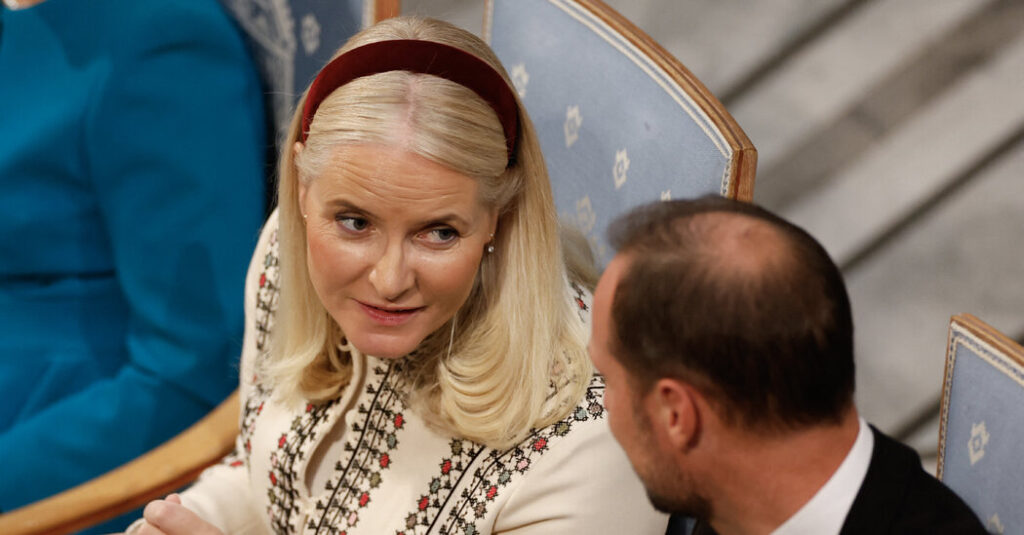
It’s been a rough week for Norway’s royal family.
Newly released files showed how chummy Crown Princess Mette-Marit was with the convicted sex offender Jeffrey Epstein. Then her son was arrested for assault, just before he went on trial for rape in a separate case.
Royal historians say this is the worst crisis the royal family has suffered since the dynasty was established in 1905. But polls, interviews and votes in Parliament show most Norwegians still support the monarchy. Many have voiced anger and disappointment at the crown princess’s relationship with Mr. Epstein, but they aren’t ready to kick her out of the palace.
“This is definitely the most controversial — and if one thinks that it keeps evolving — the most scandalous thing that the Norwegian royal family has been through since the establishment of the royal dynasty.” said Ole-Jorgen Schulsrud-Hansen, a historian who wrote a book about the royal family and who once gave tours of the palace.
Mette-Marit’s son from a previous relationship, Marius Borg Hoiby, is on trial facing 38 criminal charges, including four counts of rape and six of filming people without their consent. He has also been charged with physically attacking and harassing a former partner. Mr. Borg-Hoiby pleaded not guilty to the charges of rape and five of the filming counts. He pleaded guilty to some of the assault accusations.
Mr. Borg Hoiby, 29, was 4 years old when his mother married Crown Prince Haakon, and many Norwegians have watched his repeated run-ins with the law with sympathy for her. Journalists packed the courtroom when the trial began on Tuesday, but the royal family was absent. Instead, they sent a message of support for his accusers.
On Monday, the crown princess also said in a statement that she regretted “having had any contact” with Mr. Epstein, who killed himself in jail in 2019, and that she should have looked more deeply into his record.
Though some of Mette-Marit’s connections with Mr. Epstein were already known, the new information showed a deeper relationship, after his 2008 conviction, than she had previously acknowledged. They joked in emails about Mr. Epstein’s relentless pursuit of young women.
King Harald, her father-in-law, declined to answer questions from journalists about the matter, as he was opening a new wing of a hospital in Oslo on Wednesday.
The dynasty is relatively new. Norway was ruled by Danish and then Swedish kings for five centuries, until it became a fully independent country in 1905. Norwegians then selected a Danish prince as their king.
Having a monarchy helped give the fledgling country a sense of legitimacy. Today, Norwegians say they may not need a royal family, but see it as a clear part of the country’s identity.
“I want it,” said Julie Abrahamsen, a 22-year-old student. “I think many still do.”
Reidar Hjermann, a 56-year old psychologist who lives in Tonsberg, southwest of Oslo, said that the royals were unifying figures, and that he hopes the scandal will blow over soon.
On Tuesday, Norway’s Parliament took a routine vote, held every four years, to uphold the constitutional monarchy. It passed with an overwhelming majority.
One lawmaker proposed an investigation into winding down the monarchy. Only 17 out of 169 lawmakers voted for that.
Marius Dalin, the lawmaker who introduced the proposal, said he “loves” the king and queen but believes it is inevitable that Norway would eventually outgrow them.
“When the people don’t feel that they present their identity and common values,” he said of the royals, “then it’s time.”
Guri Melby, a lawmaker who voted for Mr. Dalin’s proposal, said, “If an elected politician was involved in a scandal in the way that Mette-Marit is involved in the Epstein files, I think that elected politician would have difficulties getting re-elected.”
But in a poll conducted this week by Respons Analyse for the Norwegian newspaper Aftenposten, 54 percent of Norwegians said the country should remain a monarchy, with 33 percent supporting the switch to a republic.
Norway’s royals have stayed popular by upholding the unofficial national ethos of “janteloven,” referring to an egalitarian, community-minded modesty, analysts say. In that high-low spirit, Norwegians have a tradition of posting the king’s picture on outhouses, from the days when people used magazines or newspapers as toilet paper, but would tack a page with a royal photo to the wall rather than defile it.
A friendship with Mr. Epstein, who flaunted his wealth and connections, is “in conflict with how Norwegians want the royal family to be,” said Kim Arne Hammerstad, a political commentator and author of a book on political scandals in Norway.
Still, some republicans concede it would be tough to get rid of the royals.
Kenneth Tiller, who works in real estate in the northern city of Tromso, said he doesn’t want the monarchy. But his grandfather still cherishes a picture of the king on the family outhouse, and he doubts Norwegians will ever turn against them.
“That would take a revolution,” he said.
Louise Krüger, Henrik Pryser Libell and Jeffrey Gettleman contributed reporting.
Lynsey Chutel is a Times reporter based in London who covers breaking news in Africa, the Middle East and Europe.
The post Norway Rallies Behind Royals, Despite Dismay Over Epstein Links appeared first on New York Times.