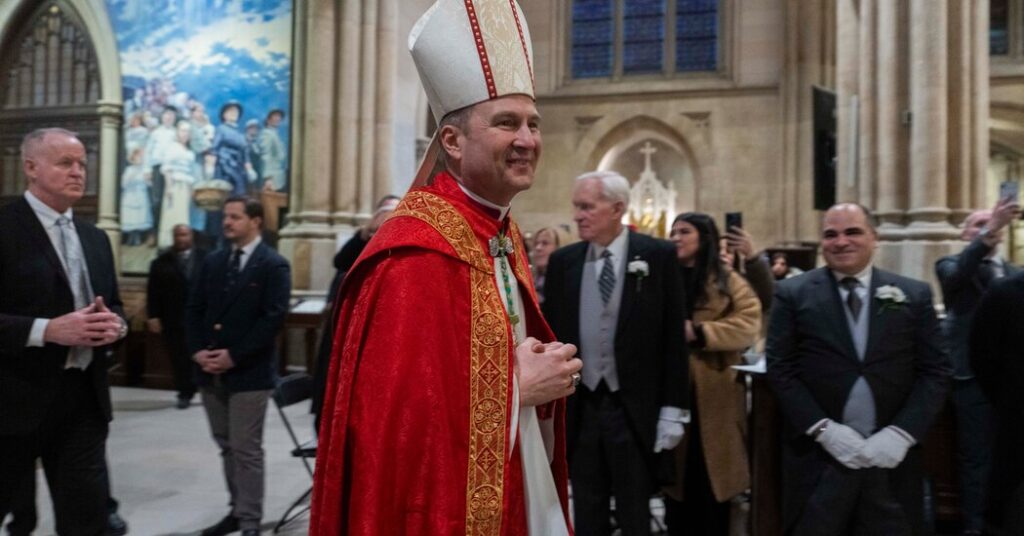
One day before he would be installed as the archbishop of New York, Bishop Ronald A. Hicks stood at the pulpit in St. Patrick’s Cathedral and gestured across Fifth Avenue to the statue of Atlas, the Greek titan who carried the weight of the world on his back.
“As I begin this ministry tomorrow, friends, family — I do not want to be Atlas,” he told worshipers during a Vespers prayer service. “I do not want to pretend that I can carry the weight of this archdiocese on my own shoulders.”
On Friday afternoon, Bishop Hicks, once the leader of a suburban diocese near Chicago of roughly half a million people, will become one of the most prominent religious figures in the country, representing New York’s more than 2.5 million Catholics. But despite the grandeur of the ceremony and the gravity of his new title, the bishop on Thursday aimed to keep the focus on what he saw as the spiritual responsibilities of his position and the role that the church will play in helping him fulfill them.
In English and Spanish, he introduced himself to the archdiocese, which he has called “the parish of America,” with few allusions to the challenges it faces. The city’s faith leaders are grappling with what they have described as the confluence of multiple crises, including an affordable housing shortage and the threat of immigration crackdowns targeting the city’s large immigrant population.
Bishop Hicks, as the head of the church, will almost certainly have to contend with these issues, and more, shortly after he is installed. But on Thursday, he said, he was less interested in making any bold pronouncements than in praying with — and for — the church he would soon lead.
“The church, in her wisdom, gives us an evening like this not to solve all the issues and challenges of our world and of our church — and not even to highlight all of the blessings and successes, either,” he said. “We are here, this evening, to pray.”
Staring back at him from behind the pews were the faces of the city’s immigrants, historical figures and emergency medical workers, depicted in a mural on the back wall of the cathedral. The bishop said the artwork made him think of his own immigrant background as a descendant of Polish, Irish and German immigrants. And, he added, it served as a reminder that people “still look to that golden door” of the church for guidance in difficult times.
The bishop has not yet outlined what he believes the role of the church should be amid an aggressive immigration crackdown in American cities. During a December news conference, he expressed his support for a statement from Catholic bishops opposing mass deportations. Immigration policy, he said, should be “connected to due process,” and the United States should be a place that “upholds human dignity, respect, treating each other well.”
Asked on Thursday about his message to the city’s Catholic immigrants who are fearful of raids by federal agents, the bishop referred to the motto on his coat of arms, “paz y bien,” Spanish for “peace and all good things.”
“Amid the fear, the problems, how we fix all of these conflicts is having faith in God — moving forward but with real hope, too,” he said in Spanish. “And to be examples of how to treat one another.”
A mild-mannered speaker known for his pragmatic, even-keeled leadership style, Bishop Hicks, 58, has described himself as a pastoral leader focused on the individual growth of his parishioners as a way to grow the church as a whole.
“I don’t want to be seen as only the C.E.O. or the corporate president of a group,” he said during a news conference on Thursday. “I’m called here to be a pastor. I’m called here to be a shepherd.”
His ascendance is likely to continue an ideological shift for the church under Pope Leo XIV, who in his nearly nine months in the papacy has echoed his predecessor, Pope Francis, in emphasizing the plight of migrants and the poor. Both Pope Leo and Bishop Hicks have roots in Chicago and spent time as missionaries in Latin America. They met for the first time when the pope, then a cardinal, visited a Chicago-area parish in 2024, Bishop Hicks told a local news station.
Cardinal Blase Cupich of Chicago, a close ally of Bishop Hicks, said both men “see the sufferings of people.”
“They know that there are some people who live in the shadows and on the margins, and special attention has to be given to them to bring them to the center,” he added.
Bishop Hicks’s leadership may also be a departure from that of Cardinal Timothy Dolan, who has led the Archdiocese of New York since 2009. As archbishop, Cardinal Dolan embraced the political influence of his post and stressed the involvement of Catholic clergy in the debate over issues like abortion and same-sex marriage. He also appeared frequently in conservative media and led prayers at both of President Trump’s inaugurations.
The leadership change in the church follows a seismic shift in the city’s politics. Just over one month before Bishop Hicks’s installation, Zohran Mamdani was sworn in as the city’s first Muslim mayor and its youngest in more than a century. Bishop Hicks said on Thursday that he had not yet spoken to Mr. Mamdani, but he added that he looked forward to meeting him.
Maya King is a Times reporter covering New York politics.
The post New York’s Next Archbishop Introduces Himself to ‘the Parish of America’ appeared first on New York Times.