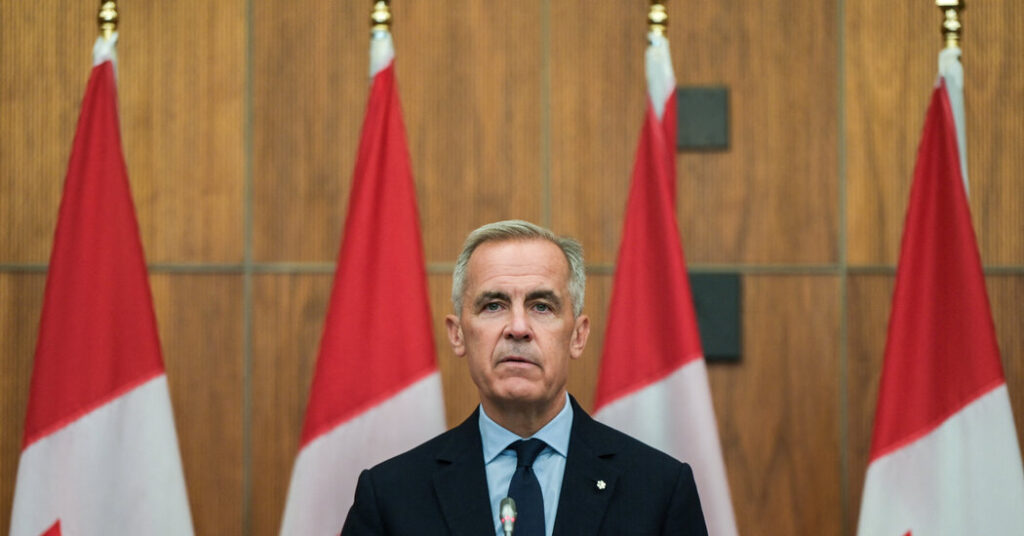
The defiance against America that has consumed Canadian life for over a year now has finally spread to the rest of the West. The message of Prime Minister Mark Carney’s speech at Davos last month — that of a “rupture in the world order” — was not new for Canadians. Just after his election in April, Mr. Carney declared that “our old relationship with the United States, a relationship based on steadily increasing integration, is over.” At Davos, the moment caught up with him, and with Canada.
Throughout last year, the consensus among many European policymakers in the face of Donald Trump’s bombast was to wait out the nonsense and appease when possible. Mr. Carney’s speech arrived at the exact point at which that position proved untenable: Mr. Trump’s intensifying threats to forcibly annex Greenland, not to mention his insults to NATO troops who fought and died alongside U.S. soldiers in Afghanistan. “They stayed a little back, little off the front lines” is a statement that will be remembered in Europe alongside “Ich bin ein Berliner” and “Mr. Gorbachev, tear down this wall” as a presidential remark that embodies the American spirit of its moment. Suddenly, Mr. Trump’s mindless drive toward territorial expansion and his desire to humiliate and degrade were impossible to ignore.
For Canada, though, America’s disrespect and intimidation are now standard issue. The U.S. ambassador to Canada, Pete Hoekstra, seems to have been installed primarily as an insult engine, tasked mainly with belittling his hosts wherever and wherever possible. (His advice to Canadians upset by Mr. Trump’s remarks that Canada should be the 51st American state: “Move on.”) Recent revelations that U.S. officials have been meeting with Albertan separatists have indicated that the Trump administration may not have given up on the idea of Canada’s dissolution. Threatening one’s neighbors, as Canada has learned the hard way over the last year, is a hallmark of autocracy-minded leaders.
Mr. Carney’s speech went beyond diagnosis, though. It also gestured toward a way out. The U.S. president left Greenland alone in part because Denmark and its allies put more troops there. He backed off from recent tariff threats in January as the European Union debated deploying the Anti-Coercion Instrument, a tool kit of retaliatory measures also known as the “trade bazooka.” The lesson: America might be pointing a gun at you, but it can be made to behave if you point a gun back.
For a year, the institutions of Canadian life have been pivoting as fast as possible to prepare for America’s decline into authoritarianism. New trade pipelines to the Asian market are under construction. The military is reported to be modeling plans for resistance to a hypothetical American invasion involving insurgency tactics supposedly inspired by the mujahedeen in Afghanistan. One former top defense official has said that Canadians should “keep our options open” on the topic of nuclear weapons. Even Canadian-centric media content is on the rise here. (Then again, everybody is watching “Heated Rivalry,” not just Canadians.)
Other countries are moving in similar directions. Apps that help consumers boycott American products, which began to launch in Canada way back in early 2025, are surging in places like Denmark and Sweden. It’s not for nothing. With many Canadian provinces pulling American liquor from shelves, the export of U.S. spirits to Canada dropped by 85 percent in 2025 and the bourbon maker Jim Beam has temporarily halted production at one of its Kentucky distilleries. Loathing is a powerful economic and geopolitical force.
American aggression and American decline are of a piece. As Mr. Carney has announced a slew of measures aimed at boosting Canada’s electric vehicle industry, nobody has argued for a moment that American equivalents could compete. By ending E.V. tax credits, Mr. Trump may have all but ensured that the American electric vehicle will one day be a thing of the past. America has decided not to compete. It would rather pose. If you are integrating yourself into the American sphere of influence, or whatever Mr. Trump’s national security apparatus calls it, you are integrating yourself into antiquity — or worse.
At the same time, America is becoming synonymous with dangerous randomness. The constitutional system is in collapse. The legislative branch, made up of both Democrats and Republicans, is missing in action. The Supreme Court debates the legal equivalent of how many angels can fit on the head of a pin, while the legal order that has held the country together for 250 years sputters toward an ignominious end. Nobody knows what America is anymore — not Americans, not their enemies, not their friends.
Coming to terms with this reality has not been easy in Canada. American exceptionalism is a hell of a drug; it’s hard to break the habit of thinking of Americans as the good guys. For Canadians, what is unfolding in Minnesota and elsewhere is happening to our friends, our neighbors, our colleagues, our kin — it is happening to people we love and understand better than anybody. But “the rupture,” as Mr. Carney calls it, is nothing more than seeing clearly. Today, it’s America that poses a threat to our freedom and democracy. Not China. Not Russia. America.
And now, the work begins. For better or for worse, what people most admire in Canada, certainly more than success, is the capacity to endure — no doubt a product of the brutality of the landscape. Atanarjuat, the hero of Inuit legend, survived a murderous plot by running through the snow naked. Terry Fox, as every Canadian schoolchild knows, ran a marathon a day for 143 days on a single leg to raise money for cancer. The idols of our national sport spit out their teeth and get back in the game. Mr. Carney’s speech offered a glimpse of that spirit, too. What liberal democracies need now, more than ever, is the sheer will to go on, without nostalgia for what once was.
The West is feeling its betrayal turn into rage. The world is waking up to both its vulnerability and its value. But better late than never: We’re all Canadian now.
Stephen Marche is the author, most recently, of “The Next Civil War.”
The Times is committed to publishing a diversity of letters to the editor. We’d like to hear what you think about this or any of our articles. Here are some tips. And here’s our email: [email protected].
Follow the New York Times Opinion section on Facebook, Instagram, TikTok, Bluesky, WhatsApp and Threads.
The post We’re All Canadian Now appeared first on New York Times.