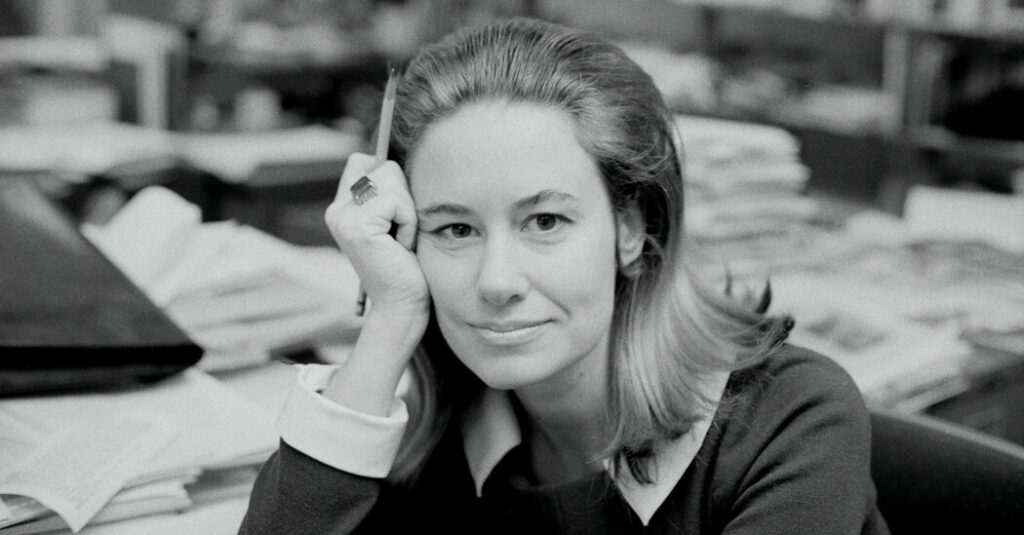
Myra MacPherson, who set her sights on a journalism career when newsrooms were casually hostile to women and who went on to cover politics for The Washington Post and to write a book about the tenacious grip of the Vietnam War on the American psyche, died on Monday in Washington. She was 91.
Her death, in a hospital, was from congestive heart failure, her son, Michael Siegel, said.
Interviewing for a job at The Detroit Free Press in the 1950s, Ms. MacPherson was told there were no openings in the women’s department. “I said I wasn’t considering the women’s department,” she recalled much later. “He looked at me as if I said I just shot my mother or something. He said, ‘We have no women in the city room.’”
Ms. MacPherson found more accommodating employers, working in hard news and features at The Detroit News, The Washington Star and The New York Times. In 1968, The Post hired her to write for its newly created Style section, which borrowed from the vogue of New Journalism to inject irreverence and novelistic storytelling techniques into long articles about Washington power players.
Ms. MacPherson profiled leading figures from the Watergate scandal and went on to cover five presidential elections.
After observing the wife and children of Senator Edmund S. Muskie of Maine on the Democratic presidential campaign trail in 1972, she was inspired to write her first book, “The Power Lovers” (1975), about the pressures within politicians’ marriages.
The book concluded that male elected officials were ipso facto egocentric, and thus their marriages were especially hard on wives and children. It included a memorable quotation from Marian Javits, who was married to Senator Jacob K. Javits of New York: “I am his mistress. His work is his wife.”
In 1979, Ms. MacPherson recalled, she was brought to tears watching the TV movie “Friendly Fire,” in which Carol Burnett played a mother who had lost her son in combat in Vietnam. Ms. MacPherson proposed a series on Vietnam veterans for The Post, then took three years off to expand the material into a book, crisscrossing the United States and interviewing hundreds of veterans as well as their generational peers who had stayed home.
Her book, “Long Time Passing: Vietnam & the Haunted Generation” (1984) delved into the social, political and psychological aftereffects of the war.
Its opening set piece is a wrenching joint profile of Chuck and Tom Hagel, Nebraska brothers who fought in the same combat unit. Chuck Hagel, a Medal of Honor recipient who became a U.S. senator from Nebraska and secretary of defense, thought the war was noble. Tom Hagel, who worked with veterans and later became a law professor, believed it was an abomination. He struggled with nightmares, crying fits and debilitating guilt about civilian deaths.
His symptoms were recognized years later when the American Psychiatric Association included post-traumatic stress disorder in the 1980 edition of its Diagnostic and Statistical Manual of Mental Disorders, the profession’s standard-setting guide. Ms. MacPherson’s book was one of the first to introduce general readers to PTSD, which affected hundreds of thousands of veterans.
Reviewing the book for The Post, Jack Beatty, an editor of The Atlantic Monthly, wrote, “There have been many books on the Vietnam War, but few have captured its second life as memory better.”
The military historian Donald Knox, in The New York Times Book Review, was less admiring, writing that the author’s opinions too often upstaged the powerful voices of her interviewees. “Miss MacPherson pushes, prods and shoves the reader to feel what she thinks he should feel,” Mr. Knox wrote. “On the brief occasions when the author steps off center stage and allows her interviewees the spotlight, the book sings, soars, explodes with feelings.”
Myra Lea MacPherson was born on May 31, 1934, in Marquette, Mich., and grew up in Belleville, Mich., the younger of two children of Douglas MacPherson, an executive for the Argus camera company, and Leola (Hord) MacPherson.
She was an editor on the student newspaper at Michigan State University, where she graduated in 1956 with a bachelor’s degree in journalism.
After being denied a hard-news reporter’s job at The Free Press, she was hired by The News, which sent her to cover the Indianapolis 500 in 1960. She was not allowed into Gasoline Alley, where the drivers and crews worked, and had to conduct interviews through a chain-link fence. “Just how much do your editors hate you?” one male journalist asked.
She later was a reporter at The Star, where she covered the Beatles’ first live concert in the capital in 1964, then worked for The Times from 1966 to 1968 in its version of the women’s department, whose articles often appeared on a page titled Food, Fashions, Family, Furnishings.
Ms. MacPherson’s marriage to Morris Siegel, a Washington sportswriter, ended in divorce in 1985. In 1987, she married Jack Gordon, a Democratic state senator in Florida who was the statehouse’s only male sponsor of the Equal Rights Amendment (it did not pass). Mr. Gordon died in 2005.
In 2010, Ms. MacPherson’s daughter from her first marriage, Leah Siegel, an Emmy-winning producer for ESPN, died of breast cancer at 43.
Besides her son, also from her first marriage, Ms. MacPherson is survived by three grandchildren.
She left The Post in 1991. Her books included “All Governments Lie!” (2006), a biography of the independent journalist I.F. Stone, an early and outspoken critic of the Vietnam War and its coverage in the news media; and “The Scarlet Sisters” (2014), a joint biography of sisters Victoria Woodhull and Tennessee Claflin, 19th-century suffragists, spiritual mediums and advocates of free love.
Shortly after joining The Post, Ms. MacPherson was assigned to cover the delirium of New York Mets fans in 1969 as the team closed in on its first World Series championship. She was barred from the press box at Shea Stadium.
A male sportswriter growled, “The next thing, you girls are going to want to get into the locker room.”
Ms. MacPherson told him, “We don’t want to use the urinals, just the typewriters.”
Trip Gabriel is a Times reporter on the Obituaries desk.
The post Myra MacPherson, Who Wrote Wrenchingly About Vietnam Vets, Dies at 91 appeared first on New York Times.