Life and death and everything in between — the laughter and the mourning — takes place in Oliver Laxe’s “Sirat.” Set in the Moroccan Sahara, it tracks a group of ravers and several fellow travelers across an unforgiving landscape and through a succession of ever-worsening ordeals, some by their own heedless making. It’s a sincere, mesmerizing and admirably unorthodox film that, by turns, invites your love and tests your patience. It demands attention and generosity from you, including toward characters who can be tough to tolerate, much less care about. They and the movie can be maddening, even when it’s impossible to look away.
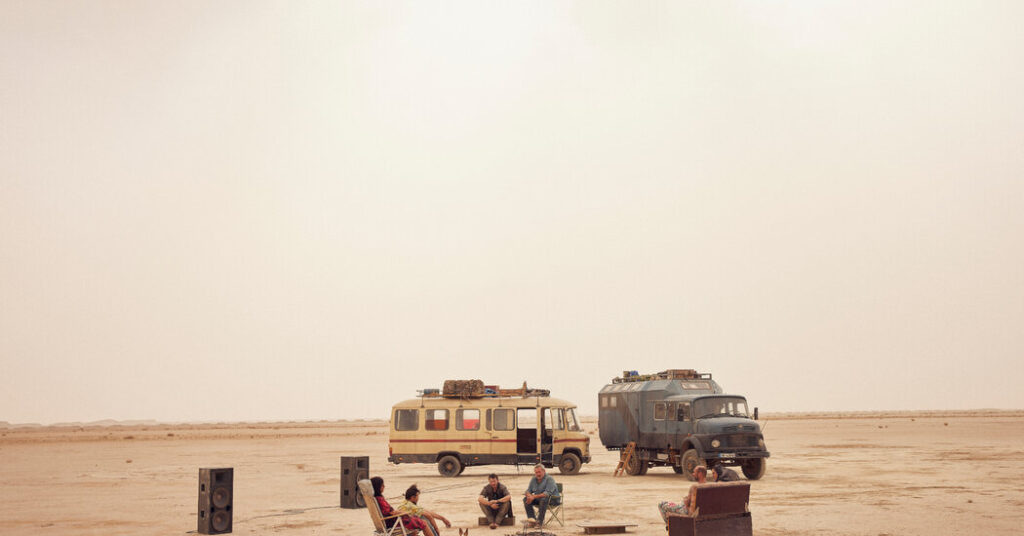
The story is loose and fairly straightforward, and opens with a Spanish interloper, Luis (Sergi López) and his son, Esteban (Bruno Núñez Arjona), who looks around 12, roaming through a throng of ravers handing out missing-person fliers. The setting is a flat stretch of the desert flanked by a towering red-rock wall. Here, Luis is worriedly searching for his adult daughter, who hasn’t been heard from in months. The revelers have come to party, to dance and commune. To that end, they have circled the wagons, as it were, creating a makeshift settlement from their tents and ramshackle vehicles. They’ve also erected a separate wall from stacks of speakers, equipment that relentlessly drives beats into bodies and souls.
These infectious, hypnotic thumps — courtesy the French musician David Letellier — unite the individual ravers, transforming them (and perhaps you) into a synchronized whole. As Luis and Esteban wander through the crowd making inquiries, they seem immune to the music and its effect. They press on, at one point approaching a cluster of men and women. Rough around the edges, these ravers look weathered and wary; one looks like he’s coming down from something. They’re cordial, if noncommittal, and no one says they recognize the woman in the fliers. Soon after, a military convoy rolls up to the rave, and a soldier announces that the country is in a state of emergency. Everyone from the European Union needs to leave.
Much of what follows doesn’t always make sense, at least in the familiar moviemaking terms, which only reinforces the realism and stirs up tension: You’re never sure what will happen, which piques your interest, even if it can unsettle you. It’s a surprise when some of the ravers peel off in their rides in clouds of dust. Still more unexpected and unlikely is Luis’s decision — with Esteban and their dog, Pipa — to follow them in the family’s minivan, a fragile vehicle for precious cargo. It’s a reckless decision, and suggests that the words that open the film are also an omen. “The Sirat bridge connects paradise and hell,” the text reads. And those who travel across it know that “its path is narrower than a strand of hair and sharper than a sword.”
The path in “Sirat” narrows gradually, amid minor troubles, significant hardships and periodic shocks of beauty, like the gasp-worthy images of the ravers motoring through the desert night, enveloped in inky black and swells of dust. The group drives past a cavalcade of fleeing civilians, and buys gas from locals. Around the same time, one raver enters a small, humble room where a TV is playing images of hajj pilgrims. As the sound of a man melodically reciting from the Quran gives way to electronic beats, Laxe cuts to a close-up of a raver walking on the desert floor, which he follows with a fast-moving shot of the highway. As Laxe holds on this image, the road’s ribbon of white seems like a guideline into the unknown.
Laxe may not be interested in telling a conventional story conventionally, but his staging and shooting are both polished, and the cinematography (it was shot on film) and the editing are especially potent. (The cinematographer is Mauro Herce; the editor is Cristóbal Fernández.) To fill in the story’s ellipses, Laxe often narrows in on strong, graphic details, like the early images of the ravers working together to build their wall of sound, their hands and bodies already in sync. At the same time, the director — who shares script credit with Santiago Fillol — demonstrates an old-fashioned flair for suspense here, and he marshals both elements of surprise and the audience’s emotions to sometimes devastating effect.
The ravers Luis and Esteban join are played by nonprofessionals, and they’re more visually convincing than they are dramatically persuasive. (For the most part, they and their characters share the same first names: Stefania Gadda, Joshua Liam Henderson, Tonin Janvier, Jade Oukid and Richard Bellamy.) With their singular, eye-catching looks and lack of actorly finesse, they add to the overall verisimilitude, as does their naturalistic chatter. Yet while this crew easily seizes your attention, it is López, a seasoned Spanish actor, who tethers you throughout. With precision and intensities of feeling, he transforms an outwardly simple character sketch into a man who comes to embody the perfectly imperfect human.
As the journey continues and the travelers face one after another hurdle, Laxe maintains a striking equanimity toward the characters, which can feel like a spiritual ethos. He doesn’t judge them, including politically, and he doesn’t ask you to do the same, even at their most reckless. They can be as unthinkingly entitled as any blundering tourist, whether they’re trampling on the desert or seeking help from a local. Driving deep into another country during national unrest proves to be the least of their problems; it’s also supremely arrogant. These qualms fade when, at last, they cross into hell during a scene of such shocking violence that the pounding of your heart could drown out any electronic beat. It’s quick, and unsparing.
It’s near-unbearable, and as powerful as it is narratively useful. If “Sirat” were another kind of movie, it and some of the other spasms of violence could seem like quasi-Brechtian provocations — a way to push and punish viewers, forcing them out of their ostensible complacency. Yet while the film can be tough going, Laxe’s focus on existential dangers never seems like an intellectual assault or a nihilistic bleat but rather an assertion of life in its raw totality. He’s very adept at seducing and charming you, but it’s his insistence on asking so much of you as a viewer, including your indulgence for other people’s frailties — for their humanity — that makes this beguiling, flawed, at times bonkers movie so deeply moving.
Sirat Rated R for death. Running time: 1 hour 55 minutes. In theaters.
Manohla Dargis is the chief film critic for The Times.
The post ‘Sirat’ Review: A Shocker in the Desert appeared first on New York Times.