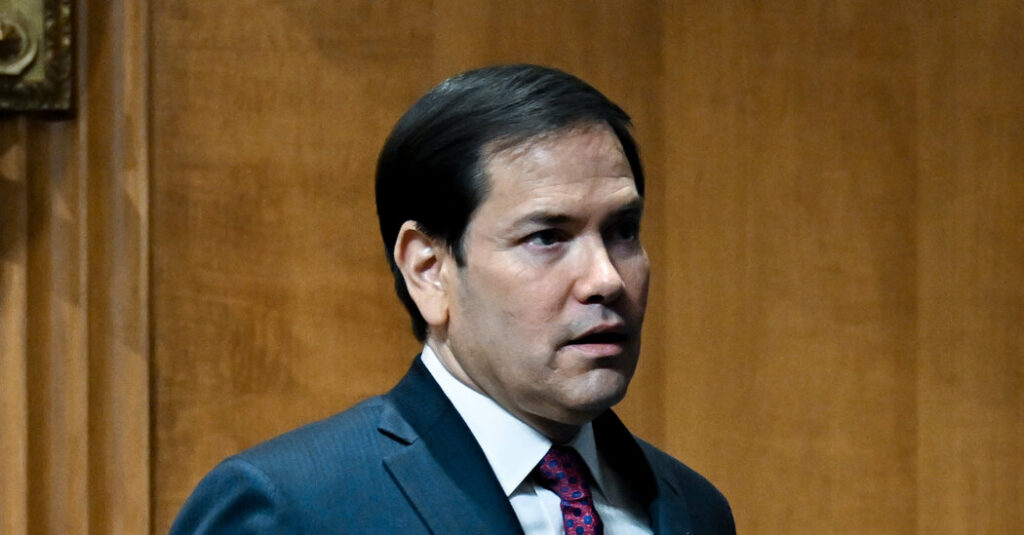
Marco Rubio has stepped away from his acting role as the United States archivist, leaving the agency that preserves federal records without Senate-confirmed leadership — a vacancy that President Trump’s critics see as an attempt to undermine an agency that played a crucial part in one of his criminal indictments.
Mr. Rubio, the secretary of state, had been the acting head of the National Archives and Records Administration since early 2025, after Mr. Trump fired its previous head, Colleen J. Shogan, without citing a cause.
Ms. Shogan’s sudden firing prompted criticism that the president was pursuing a campaign of retribution against the agency that played a crucial role in the classified documents case against Mr. Trump, in which he was accused of retaining secret files after his first term ended.
Mr. Rubio’s time at the agency ended to comply with a law that limits the duration of such temporary appointments to 300 days, according to an email statement sent by the agency. The law, the Federal Vacancies Reform Act, defines how long those who are appointed as acting officers for Senate-confirmed positions can legally serve.
The National Archives said in a statement that Mr. Rubio “delegated” his authority to James Byron, the senior adviser to the archivist. Before taking a leadership role at the agency, Mr. Byron took a leave from his chief executive role at the Richard Nixon Foundation, where he has sought to refurbish the public perception of the former president best known for the Watergate scandal.
The news of Mr. Rubio’s departure was first reported by Federal News Network.
Mr. Trump has not named a new national archivist. The agency does not have a deputy archivist, who by statute would serve as the acting archivist in case of vacancy.
The prolonged vacancy has raised questions about the agency’s ability to ensure that all presidential records are transferred to the National Archives at the end of Mr. Trump’s term. After his first term, Mr. Trump did not provide all materials he was legally required to return to the archives, prompting an extended battle with the agency and the Justice Department.
Jason R. Baron, former director of litigation at the National Archives and Records Administration, said Mr. Trump’s “failure” to name a successor to Ms. Shogan “stems from his longstanding animus toward” the agency, whose inquiries eventually forced Mr. Trump to return presidential records including classified documents.
“What remains deeply concerning is whether the president now intends to simply leave a Senate-confirmed archivist position vacant,” he said.
The White House addressed such concerns in an email statement, saying that the administration was “vetting and interviewing candidates to nominate.”
Mr. Trump was known to tear up White House documents and leave them on the floor during his first term, according to several former staff members. Politico reported in 2018 that some administration officials even had to tape back together shredded documents to ensure compliance with federal laws.
The federal statute stipulates that the archivist “shall be appointed without regard to political affiliations” and “solely on the basis of the professional qualifications.” Many archivists have been scholars of public history or informational science, unlike Mr. Rubio, who has been a career politician for nearly three decades, and Mr. Byron, whose entire career was at the Nixon Foundation before his current role at the National Archives.
“Without nonpartisan, independent leadership at the helm, I remain concerned about the future of the National Archives,” Ms. Shogan, the former archivist, said in a text message.
Mr. Rubio’s departure as the acting archivist came after months of his juggling multiple positions within the administration. At one point, he had four titles: secretary of state, acting administrator of the U.S. Agency for International Development, acting archivist and interim national security adviser.
Mr. Rubio is left with two full-time positions within the administration. In August, he handed over his role as the acting U.S.A.I.D. administrator to Russell Vought, the chief of the White House budget office. He still serves as Mr. Trump’s acting national security adviser.
Minho Kim reports on breaking news for The Times from Washington.
The post Secretary Rubio Gives Up Role as Acting U.S. Archivist appeared first on New York Times.